
Proof of Delivery: What It Actually Proves, and What It Does Not
Proof of delivery is the first document anyone asks for when a consignment is disputed, and the one most people have never read closely. It settles a narrower question than its name suggests: it shows that goods reached a place at a time and that somebody took them, and it is silent on whether they were the right goods or whether they were intact. This guide covers what a POD proves and what it does not, how electronic and paper records differ when a claim is three weeks old, why half the search results for this term are about something else entirely, and the five things to do when a delivery arrives damaged.
What is proof of delivery, and what is it for?
Proof of delivery is the record that a consignment reached a place, at a time, and that somebody there took it. That is its whole job, and it is narrower than most people assume. It exists to settle one question — did the goods arrive — and it is the first document anyone asks for when the answer is disputed. A POD is evidence, not a contract: the contract is the terms you booked under. Our POD glossary entry gives the short definition; this covers what it is worth when something has gone wrong.
What does a POD actually prove?
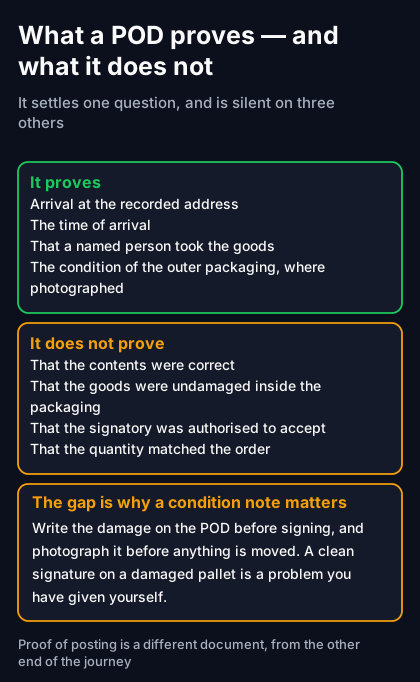
Three things, and not a fourth. It proves the consignment arrived at the address recorded, at the time recorded, and that a named person accepted it. It does not prove the goods were undamaged, that they were the right goods, or that the person signing had authority to accept them.
| A POD proves | A POD does not prove |
|---|---|
| Arrival at the recorded address | That the contents were correct |
| The time of arrival | That the goods were undamaged inside the packaging |
| That a named person took the goods | That the signatory was authorised to accept them |
| The condition of the outer packaging, where photographed | That the quantity matched the order |
That gap is why a condition note written on the POD at the moment of delivery is worth more than any amount of argument afterwards. A clean signature on a damaged pallet is a problem you have given yourself.
What should be on a usable POD?
Six fields, and the last two are what separate a modern record from a scribble.
| Field | Why it matters |
|---|---|
| Printed name of the person accepting | A signature alone is often unreadable and proves nothing |
| Signature | The acceptance itself |
| Date and time | Decides whether a delivery window was met |
| Delivery address as attended | Distinguishes the right door from a neighbouring unit |
| Photograph of the goods as delivered | The only field that records condition |
| Condition note or exception | The only field that records a dispute at the moment it arose |
If a carrier's POD has the first four and not the last two, it can tell you that something arrived and nothing about what state it was in.
What is the difference between paper and electronic proof of delivery?
Where the record lives, and how quickly you can get it. A paper POD exists once, travels back with the driver, and reaches you days later if at all. An electronic POD is captured on a device at the point of handover and is available immediately.
| Paper POD | Electronic POD | |
|---|---|---|
| Available | When the driver returns it | At the moment of delivery |
| Timestamp | Written by hand | Recorded by the device |
| Location | Whatever the address says | Can be recorded from the device |
| Photograph | Rare | Standard |
| If it is lost | There is no second copy | Stored centrally |
The practical difference shows up in a dispute three weeks later, when a paper POD is a photocopy of a signature and an electronic one is a time, a place and a picture.
Is proof of delivery the same as a CMR note?
No, and confusing them is expensive on an international movement. A CMR note is the contract of carriage for international road freight, created before the journey, signed by sender, carrier and consignee, and governed by the CMR Convention. Proof of delivery is a record made at the end of a journey.
The CMR note does double duty — its third copy, signed on arrival, serves as the delivery evidence — but it starts life as the contract, and reservations about damage must be entered on it at the point of delivery to preserve a claim. See our CMR Convention glossary entry. For a domestic UK movement there is no CMR note, and the POD is the only record there is.
Is it the same as proof of posting?
No. A proof of posting is a receipt showing an item was handed over to a postal operator; proof of delivery shows it arrived. They sit at opposite ends of the journey and prove opposite things, and the confusion is common enough that half the search results for "proof of delivery" are about the wrong one. If you are told you have proof of posting and the consignment is missing, you have evidence that it was sent and none that it was received.
What happens when nobody is there to sign?
It depends what you authorised, and the authorisation needs to exist before the driver arrives rather than over the phone from the kerb. A dedicated courier will normally attempt delivery, contact the recipient and then contact you — a vehicle carrying only your consignment can wait in a way a multi-drop round cannot.
Where goods are left without a signature, the POD records the fact and the location, usually with a photograph, and the acceptance evidence is weaker: you have proof it was left somewhere, not proof anyone took it. For anything valuable, fragile or regulated, a named signature is the point of using a dedicated vehicle at all. Failed attempts and redelivery are covered in our terms.
What do you do if goods arrive damaged?
Write it on the POD before you sign, and do it before the driver leaves. That one act converts an argument into a record.
- Note the damage on the POD itself, specifically — "corner of pallet crushed, two cartons split" beats "damaged".
- Photograph it where it stands, before anything is moved or unwrapped further.
- Keep the packaging. A claim about transit damage that cannot show the packaging is much harder to make.
- Report it inside the window. Under our terms, claims must be reported within 24 hours of delivery.
- Send the POD, the photographs and the consignment details together.
Signing clean and raising it next week is the commonest way a good claim becomes a weak one. Our goods-in-transit cover is £50,000, and the limits and exclusions are set out in full on the terms page.
Who should be allowed to sign for a delivery?
Someone who can be identified afterwards, which is a lower bar than it sounds and one that is frequently missed. A POD signed by "reception" or an illegible mark on a device tells you a human was present and nothing more; a printed name tells you who to ask when the consignment cannot be found inside the building.
Three cases cause most of the trouble. A neighbouring unit in the same business park accepts a delivery as a favour, and the goods are now in a building nobody at your customer controls. A security gate signs for a consignment it will not carry further, so the POD is clean and the goods are at a barrier. And a contractor on site signs for materials they have no responsibility for. In each case the delivery is complete as far as the carrier is concerned, which is precisely why naming the authorised recipient at booking is worth the thirty seconds it takes.
What does a POD mean for a consignment that was never collected?
Nothing — and that is the gap people fall into. Proof of delivery records the end of a journey; it says nothing about the start. If a collection was attempted and the goods were not ready, or were not what was described, there is no POD to point at because no delivery happened.
The record that matters at that end is proof of collection: the same fields, captured when the driver takes the goods. It establishes what was handed over, in what condition and at what time, which is what a later dispute about damage actually turns on — because the question is almost never "did it arrive" but "was it already like that". Our proof of collection glossary entry covers it. On a dedicated vehicle, collection and delivery evidence are two ends of one unbroken chain with one driver in between.
How long should you keep a proof of delivery?
Longer than you expect to need it, because the reason you will need it is one you have not anticipated. A POD supports a dispute about whether goods arrived, a VAT position on a zero-rated export, an audit trail for regulated goods, and a customer query months later.
For regulated consignments the retention period is set by the sector rather than by the carrier — pharmaceutical and clinical movements in particular are audited against documentation long after delivery, which is why GDP transport records are kept to a defined schedule. For ordinary commercial deliveries, keeping the POD as long as you keep the invoice is a sound default.
What should you ask a carrier before you book?
Four questions, and the answers tell you more about a carrier than their price does.
| Ask | What a good answer sounds like |
|---|---|
| What does your POD record? | Name, signature, time, address, photograph |
| When will I get it? | At delivery, not on request |
| Can the recipient add a condition note? | Yes, on the device, before signing |
| What is the claims window? | A specific period, stated in the terms rather than quoted on the phone |
A carrier that cannot say what its POD records is telling you something about what happens when a delivery goes wrong.
What does T&C Logistics provide?
A signed proof of delivery with a photograph on every job, captured at the point of handover rather than written up later. Because every consignment travels on a dedicated vehicle with one driver, the chain between collection and delivery has no transfers in it — which is the part that matters when the question is where something was last seen intact.
GPS tracking runs on every vehicle, so arrival times are recorded rather than estimated. Goods-in-transit cover is £50,000, rising to £1,000,000 through partner carriers for consignments that need it, and the limits, exclusions and claims window are on our terms page. Call 07963 400173 or send the collection and delivery postcodes by WhatsApp for a quote.
Questions
- What does a proof of delivery actually prove?
- That a consignment reached the recorded address at the recorded time and that a named person accepted it. It does not prove the contents were correct, that the goods were undamaged inside the packaging, or that the signatory had authority to accept them. That gap is why a condition note written on the POD before signing is worth more than any argument afterwards.
- What is the difference between proof of delivery and proof of posting?
- They sit at opposite ends of the journey. A proof of posting is a receipt showing an item was handed to a postal operator; proof of delivery shows it arrived and who took it. The confusion is common enough that half the search results for “proof of delivery” are actually about proof of posting. If a consignment is missing and you hold only a proof of posting, you have evidence it was sent and none that it was received.
- Is an electronic POD better than a paper one?
- For evidence, yes. A paper POD exists once, travels back with the driver and reaches you days later. An electronic POD is captured at the point of handover, carries a device timestamp and usually a photograph, and is stored centrally so it cannot be lost with the paperwork. The difference shows up three weeks later, when one is a photocopied signature and the other is a time, a place and a picture.
- Is a CMR note the same as a proof of delivery?
- No. A CMR note is the contract of carriage for international road freight, created before the journey and signed by sender, carrier and consignee. It does double duty, because its third copy signed on arrival serves as delivery evidence, but reservations about damage must be entered on it at the point of delivery to preserve a claim. A domestic UK movement has no CMR note, and the POD is the only record.
- What should I do if my delivery arrives damaged?
- Note the damage on the POD specifically before you sign — “corner of pallet crushed, two cartons split” rather than “damaged” — photograph it before anything is moved, and keep the packaging. Then report it inside the carrier's window; under our terms claims must be reported within 24 hours of delivery. Signing clean and raising it the following week is how a good claim becomes a weak one.
- What happens if nobody is there to sign?
- A dedicated courier will normally attempt delivery, contact the recipient and then contact you, because a vehicle carrying only your consignment can wait in a way a multi-drop round cannot. Where goods are left without a signature the POD records the fact, the location and usually a photograph — but that is proof it was left somewhere, not proof anyone took it.
- How long should I keep proof of delivery records?
- As long as you keep the invoice, as a default, and longer for regulated goods. A POD supports a dispute about arrival, a VAT position on a zero-rated export, and an audit trail months after the event. Pharmaceutical and clinical movements in particular are audited against documentation long after delivery, and the retention period there is set by the sector rather than by the carrier.
- What proof of delivery does T&C Logistics provide?
- A signed POD with a photograph on every job, captured at handover rather than written up later, with GPS tracking on the vehicle so arrival times are recorded rather than estimated. Every consignment travels on a dedicated vehicle with one driver, so there are no transfers in the chain between collection and delivery. Call 07963 400173 or send the postcodes for a quote.