
Shipping to EU After Brexit 2026: Complete UK Business Guide
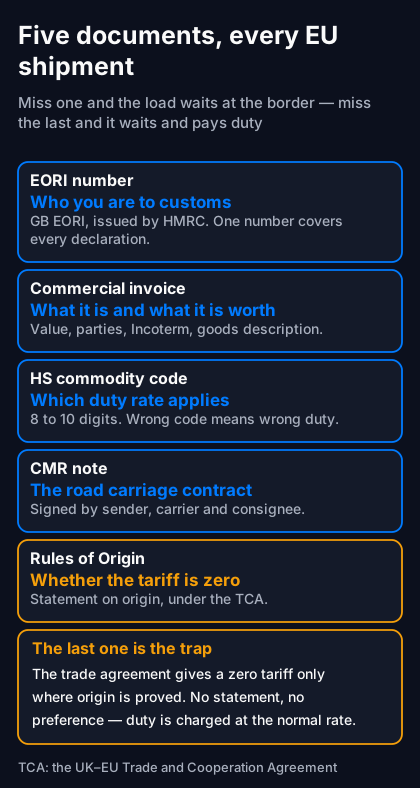
Since 1 January 2021, trading goods between the UK and EU has meant navigating a full customs border. What was once a frictionless internal market is now a complex cross-border operation. For UK exporters and their EU customers, this shift has fundamentally changed supply chains: every shipment now requires commercial documentation, customs declaration, Rules of Origin proof, and compliance with two regulatory jurisdictions.
This guide is for UK-based businesses shipping to the EU, and EU importers receiving goods from the UK. We cover the legal requirements, practical shortcuts, and common pitfalls that affect cost and delivery timescale. By 2026, the landscape may shift further—but these core principles will remain.
Across the UK, there are 10,776 postal-courier operators, 88,659 transport-logistics firms, and 3,093 air-transport providers competing on speed and compliance. Getting the basics right separates efficient traders from those stuck at borders.
What actually changed on 1 January 2021?
From 1 January 2021, every shipment from the UK to the EU became a customs export and every import to the UK became a customs entry, meaning tariffs, physical checks, and customs paperwork now apply to all consignments.
Before the Brexit transition period ended, UK–EU trade was treated as domestic movement. There were no tariffs, no physical border checks, and no customs paperwork. That changed overnight.
- Tariffs apply unless your goods qualify for preferential origin under the Trade and Cooperation Agreement (TCA).
- Physical checks happen at ports and borders—randomised and risk-led, but they occur.
- Delay is built in: even compliant shipments take longer because paperwork must be processed before cargo clears.
- Cost splits change: historically, the exporter handled export customs; now the EU importer shoulders much of the import burden and tariff liability.
The Office for National Statistics reports that UK exports to the EU fell 15% in the first year post-transition. Much of that reflects compliance friction, not loss of trade appetite. Small and medium-sized enterprises (SMEs) with fewer than 250 employees account for 73% of UK goods exporters—many of whom are learning these rules as they trade.
Understanding what changed—and why—is the first step to maintaining competitiveness.
What documents do you need for every EU shipment?
Every consignment from UK to EU requires a CMR consignment note, commercial invoice with HS codes, packing list, EORI numbers for both parties (T&C Logistics Ltd moves goods under GB507872864000), and a statement of origin—missing or incomplete documents trigger customs delays, penalties, and potential rejections.
CMR (International Carriage of Goods by Road)
The CMR consignment note is a tripartite legal document signed by the shipper, carrier, and receiver. It serves as proof of contract, proof of delivery, and—critically—as evidence of export for customs purposes. For road freight to the EU, a CMR is compulsory. Digital CMRs (eCMR) are now accepted by most EU jurisdictions.
Commercial Invoice
This must include:
- Full description of goods (not vague—"materials" will not pass).
- HS (Harmonized System) code for each line item.
- Quantity and unit price in GBP.
- Total invoice value.
- Seller's EORI number (UK-side).
- Buyer's EORI number (EU-side).
- Country of origin statement (e.g., "Product of the United Kingdom").
Packing List
Itemises each package weight, dimensions, and contents. Customs and carriers use this to match physical cargo to paperwork.
EORI Numbers
Every UK business trading with the EU must have a UK EORI (issued by HMRC). Every EU importer must have an EU EORI. These are checked at every touchpoint. Register yours at gov.uk/eori if you haven't already.
HS Codes
The Harmonized System code determines tariff rate and eligibility for preferential origin. Misclassifying goods (intentionally or through negligence) voids origin claims and triggers higher duties retrospectively.
Statement of Origin
A declaration that the product qualifies as "Product of the UK" under TCA rules. For high-value or sensitive goods, exporters often issue a formal origin certificate.
In the EU, 26,550 warehousing and logistics companies are licensed to handle customs-cleared goods. Partnering with one ensures paperwork is compliant before border submission.
How do customs declarations work for UK-EU trade?
Customs declarations are submitted by the exporter via the UK Customs Declaration System (CDS) and by the importer via the EU member state system; the importer is the legal entity liable for duties, VAT, and compliance.
UK Export Declaration (via CDS)
The UK moved from the CHIEF system to the Customs Declaration System (CDS) in January 2021. Exporters must submit an export declaration to HMRC before cargo leaves the UK. This can be done directly (if you have software) or through a customs broker. The declaration includes HS codes, origin statement, and calculated duty (if non-preferential).
EU Import Declaration (via Member State System)
The EU importer must lodge an import declaration with the destination member state's customs authority. They declare the goods as imported, claim any deferred-payment terms, and accept or contest tariff assessment. This is where most EU businesses experience friction—they inherit VAT and duty bills that UK exporters no longer handle.
Importer of Record
Under Post-Brexit rules, the importer is the legal entity clearing goods into the EU customs territory. They are responsible for:
- Submitting the import declaration.
- Paying import VAT, duty, and any penalties.
- Holding origin documentation for audit.
- Accepting liability if goods are non-compliant.
The exporter can facilitate (provide origin docs, ensure HS accuracy), but cannot change who is liable. This is a fundamental shift for UK exporters used to managing end-to-end customs clearance.
For complex or high-value shipments, using a customs broker on both sides is often more cost-effective than managing declarations in-house, especially if delays or rejections occur.
What is Regime 42 and how does it help EU importers?
Regime 42 (deferred payment) is an EU import procedure allowing importers to delay paying duties and VAT until after goods are cleared and placed into free circulation, reducing upfront cash-flow impact.
Instead of paying tariffs on day one, an importer can:
- Lodge the import declaration.
- Collect the goods under customs supervision.
- Pay duties and VAT in arrears (usually monthly).
- Use the goods commercially while the paperwork is finalised.
This reduces cash-flow impact for importers—a significant advantage for SMEs importing regular shipments. However, Regime 42 requires:
- An EU importer with a clean customs record.
- Pre-authorisation from the destination member state.
- Proof of origin (to qualify for TCA tariff rates).
- Enough customs bond/guarantee to cover potential duty shortfall.
For UK exporters, the benefit is that your EU customer can clear goods faster and with less upfront cost, making your offer more competitive. However, you cannot trigger Regime 42 yourself—your EU customer must request it and be approved.
Ensure your origin documentation is airtight so your importer can claim Regime 42 confidently. A missing origin certificate can block the procedure and force them back to cash-on-entry terms.
"When we started T&C in 2020, we knew EU logistics was about to become complex for every UK shipper. The businesses thriving now are the ones who embrace the paperwork upfront and build it into their pricing and timescale. Cutting corners on origin docs or HS codes costs more later."
— Founder, T&C Logistics
What are the Rules of Origin under the TCA and who qualifies for preferential rates?
The Trade and Cooperation Agreement (TCA) grants UK goods preferential tariff rates—often 0%—if they meet Rules of Origin criteria; without qualification, goods face full MFN tariffs of 10–20%+ depending on product.
The Core Rule: 100% Preferential Tariff
A good qualifies for preferential origin if it is "wholly obtained" in the UK—meaning all materials, components, and labour are sourced and performed in the UK territory. Examples:
- UK-grown wheat milled in the UK = preferential.
- UK steel forged and finished in the UK = preferential.
- UK-designed software developed in the UK = preferential.
Cumulation: Where It Gets Complex
If your product includes components made in the EU, it can still qualify — provided it meets the product-specific rule of origin written for its commodity code. Those rules differ by product: some set a value threshold, some require a change of tariff heading, and some specify a process, so there is no single percentage that applies across a catalogue. This is cumulation: EU components are treated as if UK-made, provided they themselves meet origin rules.
Cumulation is powerful for manufacturers with supply chains spanning UK and EU. But it requires documentation: your EU supplier must provide an origin declaration stating their goods qualify under RoO. Without it, you cannot claim cumulation and the good loses preferential status.
UK manufacturing output is valued at approximately £180 billion annually (ONS 2023). Much of it incorporates EU materials. Understanding cumulation rules unlocks that trade—but poor documentation closes it.
What are the most common Rules of Origin compliance traps?
Rules of Origin compliance traps include assuming assembly in the UK grants automatic origin status, not collecting supplier origin declarations, mismatching HS codes, storing origin documents poorly, and failing to ensure importers have confidence in your documentation.
Trap 1: Assuming 'Made in UK' is Automatic
Assembly in the UK does not automatically grant preferential origin. If all components are imported and simply bolted together in the UK, the good is not UK-origin—it is origin of the component-source country. The UK must add "substantial transformation": manufacturing, processing, or value-addition that changes the nature or function of the input.
Trap 2: Not Collecting Supplier Origin Declarations
If you use sub-suppliers (domestic or EU), they must provide origin declarations confirming their inputs qualify. If you claim cumulation but cannot produce this paperwork, customs will reject your origin claim during an audit—and you (the exporter or importer) face back-duty bills.
Trap 3: Mismatching HS Codes
Different HS codes have different RoO thresholds. Classifying a product under the wrong code can mean it fails the origin test even if it otherwise qualifies. Work with a customs broker or consultant to confirm HS classification before you commit to origin claims.
Trap 4: Storing Origin Docs Poorly
You must keep origin invoices, supplier declarations, and manufacturing records for at least four years. HMRC and EU customs routinely audit origin claims. Poorly organised records—or missing documents—result in origin denial and tariff reassessment.
Trap 5: Treating Origin as Exporter-Only Responsibility
The importer (EU-side) is liable if origin claims are false. This means your EU customer needs confidence in your documentation. If you cannot provide clear, auditable proof, they will absorb the tariff cost—and may stop buying from you.
3,093 UK air-transport and 88,659 logistics firms handle cross-border cargo. Those with robust origin-documentation processes maintain customer trust and avoid customs disputes.
What are the trade-offs between ferry and Eurotunnel for EU road freight?
Ferry routes offer flexible scheduling and higher load capacity at lower per-unit cost but take 8–14 hours, whilst Eurotunnel Freight delivers under 4 hours with consistent scheduling but at higher per-unit cost and narrower operating windows.
Ferry (Dover, Holyhead, Southampton, etc.)
Pros: More flexible scheduling, higher load capacity, cheaper per unit for large shipments, less weather-dependent than you might think. Cons: Longer transit time (8–14 hours depending on route and weather), pre-boarding customs checks can cause delays if paperwork is incomplete, vehicle and driver rest requirements add hours.
Eurotunnel Freight
Pros: Faster (under 4 hours Dover–Calais), reduced customs delay risk (some pre-checks happen in UK), driver fatigue lower (fewer hours away from cab), consistent scheduling. Cons: Higher per-unit cost, narrower operating window (no night transits), weather closures (rare but serious), higher fuel surcharge during peak demand.
Practical Choice
For urgent, high-value, or hazardous shipments, Eurotunnel usually justifies the cost. For regular, non-time-critical shipments, ferry is cost-effective. For biological samples or pharmaceutical cold-chain goods, either works—but routing must guarantee temperature control and minimal dwell time at borders.
Choose based on product value, tariff sensitivity, and delivery requirements with your customer. Customs paperwork is identical either way; the difference is speed and predictability.
When should you use a specialist EU freight partner?
A specialist EU freight partner is essential for high-volume, complex, or hazardous goods shipments, or when Rules of Origin compliance is intricate and requires expert verification, customs brokerage, and audit-ready documentation.
A partner should offer:
- Customs brokerage: submitting CDS declarations, handling importer coordination, managing Regime 42 authorisation.
- Origin documentation support: verifying HS codes, collecting supplier declarations, maintaining audit-ready records.
- Hazardous goods expertise (if relevant): ADR compliance, packaging certification, carrier insurance.
- Cold-chain logistics (if relevant): temperature-controlled vehicles, pharma-grade handling, biological sample tracking.
- Route optimisation: choosing ferry vs Eurotunnel, selecting consolidation points, managing last-mile delivery into the EU.
T&C Logistics handles European road freight for UK exporters, including full customs declaration support, hazardous goods (ADR), cold-chain, and biological samples. Our quote form takes 2 minutes; contact us on +44 7963 400173 (06:00–17:00) or +44 7737 778964 (08:00–22:00) to discuss your route and compliance needs.
Questions
- Do I need an EORI number to export to the EU?
- Yes. Every UK business exporting goods must have a UK EORI number, issued by HMRC. Your EU customer must also have an EU EORI. Both are required on the commercial invoice and customs declaration. Register at gov.uk/eori if you haven't already. Registration is free and takes a few days.
- What is the difference between preferential and non-preferential tariffs?
- Preferential tariffs (often 0%) apply if your goods meet Rules of Origin under the TCA—meaning they are substantially made in the UK or incorporate EU content that qualifies under cumulation rules. Non-preferential tariffs are the standard MFN rate, typically 10–20%+ depending on the HS code. Meeting RoO criteria saves significant duty costs and is essential for competitiveness.
- Who pays import VAT and duty—the exporter or importer?
- The EU importer is the legal importer of record and is liable for import VAT and duty. Under Regime 42, they can defer payment, but they still owe it. As the exporter, you can make your offer more attractive by ensuring flawless origin documentation, which lets your customer claim preferential rates and, if authorised, use Regime 42 to defer costs.
- What happens if my origin claim is rejected by customs?
- If customs reject your origin claim, the good is assessed at the non-preferential (MFN) tariff rate. Your EU importer will face a higher duty bill and may seek compensation from you. To avoid this, ensure your origin documentation is audit-ready: keep supplier declarations, manufacturing records, and HS code justification for at least four years. A customs broker can help verify origin before shipment.
- Is a CMR document compulsory for road freight to the EU?
- Yes. The CMR (International Carriage of Goods by Road) consignment note is legally required for road transport to the EU. It serves as proof of contract, evidence of export for customs, and proof of delivery. Digital CMRs (eCMR) are now widely accepted. Every carrier should provide a CMR as part of the standard service.