
Waybills compared: air, sea and road, and what each one pays
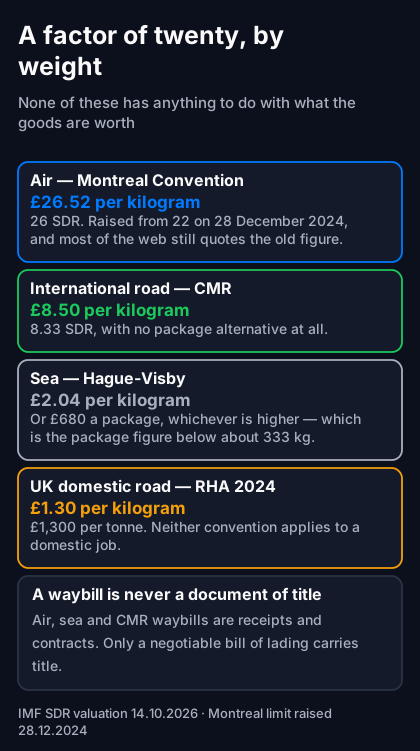
Three waybills cover almost every international shipment, and none of them is a document of title: an air waybill, a sea waybill, and the CMR consignment note that nobody calls a waybill but which behaves like one. What differs between them is not the paperwork but the money — the liability limit per kilogram spans a factor of twenty across the four regimes. One of those figures changed on 28 December 2024 and most of the web has not caught up.
What is a waybill?
A waybill is a transport document that acts as a receipt for goods and as evidence of the contract of carriage, and that — unlike a negotiable bill of lading — is never a document of title. Goods travelling on a waybill are released to the named consignee on proof of identity, not against surrender of paper.
That single property defines the whole family. Nothing has to be couriered ahead of the shipment, nothing can be endorsed to a third party, and nothing is lost if the document is lost. The trade-off is equally clean: a party that needs to control the goods by holding a document cannot do it with a waybill, which is why letters of credit are not built on them.
What are the three waybills you will actually meet?
One per mode, with different issuers and different liability regimes behind them.
| Document | Mode | Issued by | Governing regime |
|---|---|---|---|
| Air waybill (AWB) | Air | The airline or its accredited cargo agent | Montreal Convention |
| Sea waybill | Sea | The carrier | Carrier's terms; Hague-Visby where a bill would have applied |
| CMR consignment note | International road | The sender and the carrier jointly | CMR Convention |
The CMR note is a waybill in substance even though nobody calls it one: receipt, evidence of contract, not a document of title. The bill of lading is the odd one out in international transport precisely because it can carry title and these cannot.
What is an air waybill, and what is its number?
An air waybill is the contract between the shipper and the airline, and its number is the eleven digits you track a shipment by. The first three identify the issuing airline, the next seven are the serial number, and the eleventh is a check digit derived from the serial — which is why a mistyped AWB number usually fails validation rather than finding somebody else's cargo.
Two forms exist on the same shipment. A master air waybill is issued by the airline to the consolidator; a house air waybill is issued by the consolidator to each underlying shipper whose goods share that consolidation. If you booked through a forwarder you almost certainly hold a house AWB, and the master sits above it.
It has been electronic by default for years: IATA's e-AWB programme replaced the paper original as the standard contract of carriage on enabled routes.
How much is each regime actually worth per kilogram?
Air pays the most and UK domestic road the least, and the spread is wider than most shippers expect — a factor of about twenty between the top and the bottom.
| Mode | Regime | Limit | In sterling |
|---|---|---|---|
| Air | Montreal Convention | 26 SDR per kg | £26.52 per kilogram |
| International road | CMR Convention | 8.33 SDR per kg | £8.50 per kilogram |
| Sea | Hague-Visby | 666.67 SDR per package, or 2 SDR per kg | £680 per package, or £2.04 per kilogram |
| UK domestic road | RHA Conditions of Carriage 2024 | £1,300 per tonne | £1.30 per kilogram |
Sterling figures use the IMF Special Drawing Right valuation for 14 October 2026, at which £1 was 0.980496 SDR.
Why is the air figure different from the one you will find elsewhere?
Because most of the web still carries 22 SDR per kilogram, and that figure is out of date. The Montreal Convention requires its limits to be reviewed every five years against inflation, and the 2024 review raised the cargo limit from 22 to 26 SDR per kilogram with effect from 28 December 2024. Carriers were given a six-month grace period to work through existing air waybill stock.
The practical consequence is small but real: a claim on a shipment carried after that date is assessed at the higher figure regardless of what is printed on an older form. It is worth checking which number a quote, an insurance schedule or a claim letter is using, because an 18% difference on a heavy consignment is not a rounding error. The Convention has force in UK law through the Carriage by Air Act 1961 as amended.
Can a waybill limit be raised?
Yes, and in every regime it has to be done before carriage. Under the Montreal Convention the shipper may make a special declaration of interest in delivery at the point of handing over the cargo, against a supplementary sum if the carrier requires one, and the carrier is then liable up to the declared amount. CMR has the equivalent in a declared value or special interest written on the consignment note.
- Work out the consignment's value per kilogram, not its total value.
- Compare it with the limit for the mode you are using.
- If the value per kilogram is higher, either declare it before the goods move or insure the cargo separately.
- Do not expect to declare it afterwards. A declaration made once a claim exists is not a declaration.
For most air cargo the Montreal limit of £26.52 a kilogram covers ordinary goods and badly undercovers electronics, instruments and pharmaceuticals. That is an underwriting decision rather than a paperwork one.
How long do you have to claim on air cargo?
Less time than on road, and the deadline is absolute rather than indicative. Under the Montreal Convention the person entitled to delivery must complain to the carrier forthwith on discovering damage and, at the latest, within 14 days of receiving the cargo. For delay the window is 21 days from the date the cargo was placed at their disposal. Every complaint must be in writing.
Miss it and the position is stark: no action lies against the carrier at all, save in the case of fraud on its part. That is not a limitation period you can argue around — it extinguishes the claim. Beyond it sits Article 35, which gives two years from arrival, from the date the aircraft ought to have arrived, or from when the carriage stopped.
| Event | Air — Montreal | Road — CMR |
|---|---|---|
| Damage apparent at delivery | Forthwith, and within 14 days | Not later than the time of delivery |
| Damage not apparent | Within 14 days of receipt | Within 7 days, Sundays and holidays excepted |
| Delay | Within 21 days | Within 21 days |
| Limitation period | 2 years | 1 year, 3 for wilful misconduct |
Road is harsher on apparent damage and gentler on everything else. The practical rule for both is the same: write the reservation at handover rather than relying on a photograph taken later.
Who issues the air waybill on a job we handle?
Not us. T&C Logistics holds no IATA cargo agent accreditation, so an air waybill for your consignment is issued by the airline or by an accredited forwarder, under their contract of carriage rather than ours.
What we do is the landside leg, and the boundary is firm: all of our collection is landside, we hold no CAA airside access and no airside vehicle credentials, so ramp-side movement stays with the cargo handler. In practice that means collecting from or delivering to a handler's landside counter at Heathrow or another airport, against the AWB number the forwarder gives you. Our air freight page sets out what that covers and the licences page lists what we hold and what we do not.
What does the driver need at a cargo handler's counter?
The AWB number, and enough identification to be released the right consignment. Handlers release against the document and the collecting party, not against a delivery address, so a job booked without the number is a job the driver cannot complete.
- The air waybill number, including the house AWB where a forwarder consolidated the shipment.
- Confirmation the consignment has been released by customs and by the handler — those are two separate events, and the second usually lags the first.
- The collecting company's details as they were given to the handler.
- Any special-handling codes, because they decide which counter and which window.
The common failure is booking a collection against a flight arrival rather than against a release. Freight lands hours before it is available, and a vehicle sent against the wrong event waits. Our air freight against road freight comparison covers when the air leg is worth it in the first place.
Which document should your shipment travel on?
Match the document to the mode, and only create a document of title when somebody genuinely needs one.
| Situation | Document |
|---|---|
| Air freight, any terms | Air waybill — there is no negotiable alternative in common use |
| Sea freight, paid in advance or on open account | Sea waybill |
| Sea freight under a letter of credit | Bill of lading, order form |
| International road | CMR consignment note |
| UK domestic road | The carrier's delivery note |
One further distinction is worth drawing before you choose. A sea waybill and a straight bill of lading behave almost identically in practice, but only the bill is capable of being switched to an order bill later if the commercial arrangement changes. Where a sale is agreed on open account and might move to a letter of credit mid-shipment, issuing a straight bill rather than a waybill keeps that door open at no cost.
Air is the simplest case because the choice does not exist: cargo moves on an air waybill and the title function has to be solved another way, usually by a bank holding the goods through a forwarder's release instruction rather than through the transport document. Our waybill glossary entry covers the short definition.
Questions
- Is a waybill the same as a bill of lading?
- No. Both are receipts and evidence of the contract of carriage, but a negotiable bill of lading is also a document of title, so whoever lawfully holds it can claim the goods. A waybill is never a document of title: goods are released to the named consignee on proof of identity. Nothing travels ahead of the shipment, nothing can be endorsed to a third party, and nothing is lost if the document is lost.
- What is the liability limit for air cargo?
- 26 Special Drawing Rights per kilogram under the Montreal Convention, which is about £26.52 per kilogram on the IMF valuation for 14 October 2026. The figure changed on 28 December 2024, when ICAO's five-yearly inflation review raised it from 22 SDR, with a six-month grace period for carriers to use up existing air waybill stock. Most online guidance still quotes 22, which is 18% low.
- What do the eleven digits of an air waybill number mean?
- The first three identify the issuing airline, the next seven are the serial number, and the eleventh is a check digit calculated from the serial. That is why a mistyped AWB number usually fails validation rather than matching somebody else's cargo. Where a forwarder consolidated the shipment there are two numbers: a master air waybill between the airline and the consolidator, and a house air waybill between the consolidator and you.
- Do you issue air waybills?
- No. T&C Logistics holds no IATA cargo agent accreditation, so the air waybill is issued by the airline or by an accredited forwarder under their own contract of carriage. We handle the landside leg: collection from or delivery to a cargo handler's landside counter against the AWB number. We hold no CAA airside access and no airside vehicle credentials, so ramp-side movement stays with the handler.
- Which pays more if cargo is damaged, air or road?
- Air, by roughly three times. The Montreal Convention caps air cargo liability at 26 SDR per kilogram, about £26.52, while CMR caps international road carriage at 8.33 SDR per kilogram, about £8.50. UK domestic road is lower again: RHA Conditions of Carriage 2024 set £1,300 per tonne, which is £1.30 per kilogram. None of the four figures has anything to do with what the goods are worth.
- Can I declare a higher value than the waybill limit?
- Yes, and only before carriage. Under the Montreal Convention the shipper may make a special declaration of interest in delivery when handing over the cargo, against a supplementary sum if the carrier asks for one, and the carrier is then liable up to the declared amount. CMR has an equivalent declared value written on the consignment note. Neither works retrospectively, so compare the value per kilogram against the limit before you book.
- Why was my air freight not ready when the flight landed?
- Because landing and release are two different events, and the second routinely lags the first by hours. Freight has to be broken down by the handler, presented to customs and then released, and a vehicle sent against the flight arrival time rather than against the release will wait. Booking a collection against the release notification rather than the flight is the single change that removes most air freight waiting time.