
Bill of lading or CMR note: which one your shipment actually needs
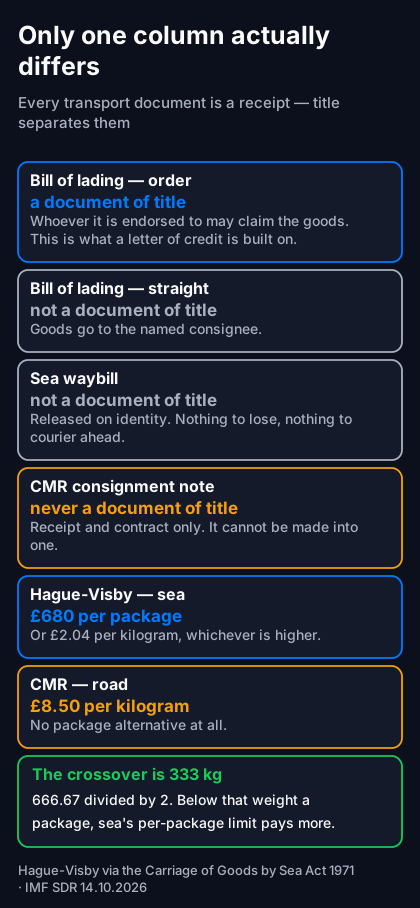
A bill of lading does three jobs: receipt, evidence of contract, and — uniquely among transport documents — a document of title that lets whoever holds it claim the goods. A CMR note does the first two and can never do the third. That gap is why a UK seller shipping to Europe by road gets asked for a document their carrier cannot issue, and why the liability limits of the two regimes are not comparable without doing the arithmetic. This sets out both, with the figures.
What is a bill of lading?
A bill of lading is the carrier's document for a sea shipment, and it does three jobs at once. It is a receipt for the goods, it is evidence of the contract of carriage, and — in its negotiable form — it is a document of title, meaning that whoever lawfully holds it can claim the goods.
The third function is the one that makes it unusual. Most transport documents describe goods; a negotiable bill of lading effectively is the goods for commercial purposes while they are at sea. That is why banks finance against it, why it can be traded while the vessel is still sailing, and why losing one is a serious event rather than an administrative nuisance.
Why does a road carrier get asked for one?
Because the buyer's paperwork was written for sea freight and nobody updated it. A UK seller sending goods to Europe by road is regularly asked for "the bill of lading" by a customer, a freight forwarder, or a bank operating a letter of credit, and the honest answer is that road carriage does not produce one.
What it produces is a CMR consignment note, which does two of the three jobs: receipt, and evidence of the contract. It is not a document of title and cannot be made into one. A party expecting to control delivery by holding a piece of paper will not get that from a road movement, and finding this out when the goods are already at the border is expensive.
What are the three types of bill of lading?
They differ in who can claim the goods, which is the only distinction that matters commercially.
| Type | Who may claim the goods | Document of title? |
|---|---|---|
| Straight, or non-negotiable | The named consignee only | No |
| Order | Whoever the bill is endorsed to | Yes |
| Bearer | Whoever physically holds it | Yes |
A straight bill behaves much like a CMR note: it names a consignee and the goods go to them. An order bill is the financing instrument, endorsed from party to party, and it is what a letter of credit is usually built around. A bearer bill is rare and risky for the obvious reason.
Who can sue the carrier when goods arrive damaged?
Whoever holds the right to sue, which is not always the person who paid for the goods. The Carriage of Goods by Sea Act 1992 transfers rights of suit along with a bill of lading, so an endorsee who became the holder acquires the right to claim against the carrier as if they had been party to the contract.
Road is simpler because the document never changes hands: under CMR the sender and the consignee each have standing in their own right, defined by the Convention rather than by who is holding paper. A claim can therefore be brought on a road movement by a party who never saw the consignment note, which is rarely true at sea.
How do the liability limits compare?
Different conventions, different formulas, and they do not line up. Sea carriage under the Hague-Visby Rules, given force in the UK by the Carriage of Goods by Sea Act 1971, caps liability at 666.67 units of account per package or 2 units per kilogram, whichever produces the higher figure. Road carriage under CMR caps it at 8.33 units per kilogram with no package alternative at all.
| Regime | Limit | In sterling |
|---|---|---|
| Hague-Visby, per package | 666.67 SDR | £680 per package |
| Hague-Visby, per kilogram | 2 SDR | £2.04 per kilogram |
| CMR, per kilogram | 8.33 SDR | £8.50 per kilogram |
Sterling figures use the IMF Special Drawing Right valuation for 14 October 2026, at which £1 was 0.980496 SDR.
Which limit actually applies to a given package?
Whichever is higher, and the arithmetic settles it rather than the lawyer. Divide 666.67 by 2 and you get 333: for any package weighing less than about 333 kilograms, the per-package limit produces more compensation than the per-kilogram one, and above that weight the position reverses.
Since most packages weigh far less than a third of a tonne, the practical sea limit is usually £680 a package. That is why how the goods are described on the bill matters so much. Twenty cartons declared as twenty cartons attract twenty package limits; the same twenty cartons inside a container, with the container declared and the cartons not enumerated, can attract one.
Road has no such lever. CMR pays by weight and only by weight, so a light, valuable consignment is poorly covered by sea and worse covered by road, while a heavy, cheap one is the reverse.
Can either limit be raised?
Yes, and in both regimes it has to be done before the goods move. Under Hague-Visby a shipper may declare the nature and value of the goods before shipment and have that value inserted in the bill — an ad valorem declaration — which displaces the standard limits. Under CMR the equivalent is a declared value or a special interest in delivery, written on the consignment note against an agreed surcharge.
Neither can be done afterwards. A declaration made once a claim exists is not a declaration, and this is the single most common reason a shipper discovers the cap only when it is too late to move it. The decision is therefore commercial rather than legal: is the statutory floor enough for this consignment, and if not, is the surcharge cheaper than cargo insurance?
Which document should travel with your goods?
The one that matches the mode, and for a multimodal shipment, both for their own legs. Sending the wrong one is not a formality — it is sending a document with the wrong legal effect.
| Movement | Document | Governing regime |
|---|---|---|
| Sea, port to port | Bill of lading | Hague-Visby Rules |
| International road | CMR consignment note | CMR Convention |
| UK domestic road | The carrier's own delivery note | The carrier's conditions of carriage |
| Road leg feeding a sea leg | Both, each for its own leg | Both |
The third row is worth naming because it surprises people: a domestic UK road job is governed by neither convention. Our proof of delivery article covers what the delivery note does and does not establish.
What is a sea waybill, and when is it the better document?
A sea waybill is a contract of carriage and a receipt, and deliberately not a document of title. The goods are released to the named consignee on proof of identity rather than against presentation of paper, so nothing has to travel ahead of the vessel and nothing can be lost in transit.
For most straightforward shipments that is an improvement rather than a compromise. Where the seller is paid before shipment, or the parties trade on open account, the title function of a bill of lading is pure overhead: it creates a document that must be couriered, tracked and surrendered, and it delays release whenever it arrives after the ship. A sea waybill removes the whole problem.
It is the wrong choice in exactly one circumstance, and it is the circumstance that matters most: where a bank is financing the trade and needs to control the goods. A letter of credit built on a document of title cannot be satisfied by a waybill.
What happens if a bill of lading is lost?
It becomes expensive, because the document is the entitlement. A carrier that releases goods without the original bill has delivered to someone who may not have been entitled to them, and remains liable to whoever was. So carriers do not simply waive it.
The ordinary remedy is a letter of indemnity, usually backed by a bank guarantee, under which the party seeking release undertakes to meet any claim arising from delivery without the original. A bank countersignature is commonly required and is not free, and the exposure typically runs well above the value of the cargo. The practical lesson is the one that argues for a waybill in the first place: a negotiable bill of lading is a bearer instrument for commercial purposes, and it should only be created where someone actually needs it to be one.
What should you do when a buyer asks for a bill of lading?
Establish what they actually need it for, because the answer differs sharply depending on the reason.
- They want proof the goods shipped. A CMR note does this, and a signed one does it better than an unsigned bill.
- Their bank requires a document of title under a letter of credit. Road carriage cannot supply one. The credit terms have to change, or the shipment has to include a sea leg that genuinely produces a bill.
- They want to control release of the goods. On a road movement this is done by instructing the carrier, not by holding paper.
- They are using the phrase loosely for "the transport document". Which is most of the time, and a CMR note ends the conversation.
Our Incoterms and Incoterms 2020 material covers who is responsible for arranging carriage in the first place, which is the question underneath most document disputes. We do not issue bills of lading, because we are a road carrier and road carriage does not produce them. Where a consignment needs a sea leg, that leg is booked through a forwarder who issues one under their own contract. Our bill of lading glossary entry covers the definition, and the European road freight page covers what we move and how it is documented.
Questions
- Is a CMR note the same as a bill of lading?
- No. Both are receipts and both are evidence of the contract of carriage, but a negotiable bill of lading is also a document of title — whoever lawfully holds it can claim the goods, which is why banks finance against it. A CMR note is not a document of title and cannot be made into one. A buyer expecting to control delivery by holding paper will not get that from a road movement.
- Can a road carrier issue a bill of lading?
- Not for a road leg. Bills of lading belong to sea carriage, and road carriage produces a CMR consignment note for an international movement or the carrier's own delivery note for a domestic one. Where a shipment genuinely needs a bill — typically because a letter of credit requires a document of title — it needs a sea leg booked through a forwarder who issues one under their own contract of carriage.
- What is the liability limit under a bill of lading?
- Under the Hague-Visby Rules, 666.67 Special Drawing Rights per package or 2 SDR per kilogram, whichever produces the higher figure. The 'whichever is higher' is the half most often dropped. On the IMF valuation for 14 October 2026 that is about £680 per package or £2.04 per kilogram. Divide 666.67 by 2 and the crossover is 333 kg: below that weight the per-package limit pays more.
- Why does a container count as one package?
- Because the bill of lading describes it that way. Where the packages inside a container are enumerated on the bill, each counts for package limitation; where they are not, the container itself can be treated as the single unit. Twenty cartons declared as twenty cartons attract twenty package limits, and the same twenty inside an undeclared container can attract one. How goods are described on the bill is therefore a commercial decision, not a clerical one.
- Can I raise the liability limit above the statutory cap?
- Yes, in both regimes, and only before the goods move. Under Hague-Visby the shipper declares the nature and value of the goods before shipment and has that value inserted in the bill — an ad valorem declaration — which displaces the standard limits. Under CMR the equivalent is a declared value or a special interest in delivery written on the consignment note against an agreed surcharge. Neither works retrospectively.
- Which convention covers a UK domestic road delivery?
- Neither. The CMR Convention applies only where collection and delivery are in two different countries, and the Hague-Visby Rules cover sea carriage under a bill of lading. A Birmingham to Glasgow job falls outside both and runs on the carrier's own conditions of carriage, which typically cap liability far lower — RHA Conditions of Carriage 2024 set £1,300 per tonne, or £1.30 per kilogram.
- My buyer is asking for a bill of lading on a road shipment. What do I send?
- Find out what they need it for first. If they want proof the goods shipped, a signed CMR note does that job properly. If their bank requires a document of title under a letter of credit, road carriage cannot supply one and either the credit terms change or the routing does. Most of the time the phrase is being used loosely to mean 'the transport document', and a CMR note ends the conversation.
Explore more
More from the blog
- Van Size Guide: Which Courier Vehicle Do You Need?
- Heathrow Cargo: Complete Shipper's Guide to UK's La…
- The nine ADR dangerous goods classes, and what they…
- The CMR note: what it covers, and what it actually…
- Commodity Codes Explained: How to Classify UK Impor…
- Sending Large and Heavy Items by Courier: When a Pa…