
The CMR note: what it covers, and what it actually pays
The CMR note is the contract, the receipt and the evidence for every international road movement, and most senders meet it as a piece of paper the driver hands over to be signed. Three things on it decide what happens when something goes wrong: the gross weight, the dangerous goods designation, and whether anyone wrote a reservation before signing. This sets out what the Convention actually requires, what the carrier is liable for, and how little that liability is worth per kilogram.
What is a CMR note?
A CMR note is the consignment note for international road freight, and it is both the contract and the receipt. CMR stands for the French title of the 1956 Geneva Convention on the contract for the international carriage of goods by road, which the UK brought into domestic law through the Carriage of Goods by Road Act 1965.
It is not a customs document and it is not a proof of delivery in the ordinary sense, though it ends up doing the second job. Under Article 9 the note is prima facie evidence of three separate things: that a contract of carriage was made, what its conditions were, and that the carrier received the goods. If the carrier signs it without writing a reservation, the goods are presumed to have been in good condition and to have matched what the note describes. That presumption is why the document matters more than its appearance suggests.
When does the CMR Convention apply, and when does it not?
Article 1 sets a single test: the place where the goods are taken over and the place designated for delivery must be in two different countries, at least one of which is a Contracting country. Nothing else is required. The nationality of the carrier, the ownership of the goods and the route taken are all irrelevant.
Two consequences follow that senders regularly get wrong. First, a movement from Birmingham to Lyon is governed by CMR whether or not anyone produces a CMR note, because the Convention attaches to the contract rather than to the paperwork. Second, a movement from Birmingham to Glasgow is not governed by CMR at all, however international the carrier is. A purely domestic UK job runs on the carrier's own conditions of carriage, which is a materially different regime — see the liability figures below.
What has to be on a CMR note?
Article 6 lists the particulars. Most are obvious; three are not, and those three are where notes go wrong.
| Particular | Note |
|---|---|
| Date and place of issue | — |
| Name and address of the sender and of the carrier | — |
| Place and date of taking over, and the place designated for delivery | — |
| Name and address of the consignee | — |
| Description of the goods, the method of packing, and the dangerous goods designation | The ADR class and UN number belong here |
| Number of packages, their special marks and numbers | — |
| Gross weight, or quantity otherwise expressed | Liability is calculated on this figure |
| Charges: carriage, supplementary, customs and others | — |
| Instructions for customs and other formalities | — |
| A statement that the carriage is subject to the Convention | Often the only missing line |
The gross weight is the one to check before signing. It is not a logistics detail: it is the multiplier in the compensation formula, and an understated weight permanently caps what can be recovered.
Who gets which of the three copies?
Three originals, signed by the sender and the carrier, and Article 5 assigns them precisely. The second copy is the one most often misdescribed.
| Copy | Goes to |
|---|---|
| First | Handed to the sender at collection |
| Second | Accompanies the goods — it travels in the cab and is produced at delivery |
| Third | Retained by the carrier |
Plenty of guides describe the three as sender, carrier and consignee. That is where the second copy usually ends up, but it is not what the Convention says, and the distinction matters when a consignment is redirected in transit or delivered to a different address: the copy follows the goods, not a named party.
What is the carrier liable for?
Article 17 makes the carrier liable for total or partial loss, for damage, and for delay, throughout the period between taking over the goods and delivering them. Liability is presumed, which reverses the ordinary position: the claimant does not have to prove fault, the carrier has to establish a defence.
There are four defences, and they are narrow:
- The loss was caused by a wrongful act or neglect of the claimant.
- It followed the claimant's own instructions, where those instructions were not the carrier's fault.
- It arose from inherent vice in the goods themselves.
- It was caused by circumstances the carrier could not avoid and the consequences of which it was unable to prevent.
The fourth is not the same as force majeure and is harder to run than it looks. "Unable to prevent" is assessed against what a diligent carrier could have done, not against what this carrier happened to do.
How much is the carrier's liability actually worth?
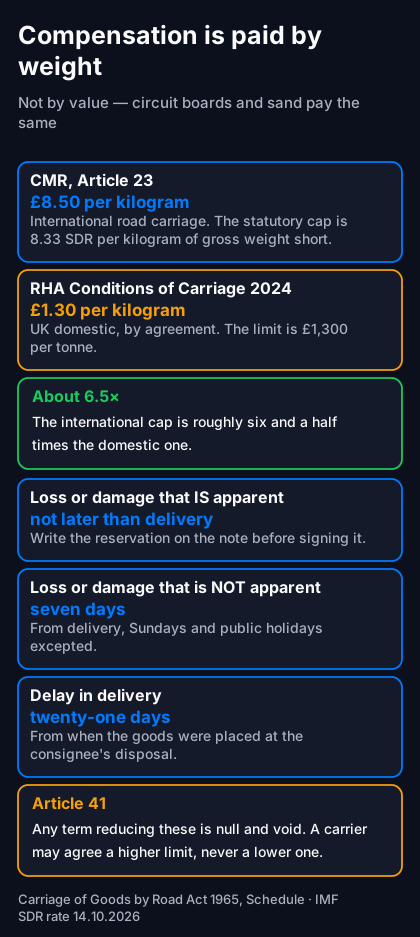
Article 23 caps compensation at 8.33 units of account per kilogram of gross weight short. The unit of account is the IMF Special Drawing Right, a currency basket revalued daily, and the IMF publishes it daily, so the sterling figure moves — but the ratio to domestic terms does not move much, and it is large.
| Regime | Applies to | Limit | Per kilogram |
|---|---|---|---|
| CMR, Article 23 | International road carriage | 8.33 SDR per kg | £8.50 |
| RHA Conditions of Carriage 2024 | UK domestic, by agreement | £1,300 per tonne | £1.30 |
The sterling conversion uses the IMF SDR valuation for 14 October 2026, at which £1 was 0.980496 SDR. On those rates the international statutory cap is roughly six and a half times the standard domestic one. Neither figure has anything to do with what the goods are worth: a pallet of circuit boards and a pallet of sand are compensated identically by weight. That gap is the reason cargo insurance exists, and it is a different product from the carrier's own goods-in-transit cover — ours is described in our terms of service.
How long do you have to make a claim?
Article 30 sets three separate deadlines, and they depend on what went wrong rather than on when you noticed. This is the most misreported part of the Convention: several pages currently ranking for CMR guidance state "seven days for visible damage", which is wrong in both halves.
| What happened | Reservation due |
|---|---|
| Loss or damage that is apparent | Not later than the time of delivery |
| Loss or damage that is not apparent | Within seven days of delivery, Sundays and public holidays excepted |
| Delay in delivery | Within twenty-one days from the time the goods were placed at the consignee's disposal |
Apparent damage must be reserved at the moment of handover, which in practice means writing it on the CMR note before signing. Beyond the reservation deadlines sits the limitation period in Article 32: one year to bring an action, extended to three years where the carrier's conduct amounted to wilful misconduct.
Can a carrier's own terms reduce any of this?
No. Article 41 is blunt: any stipulation which would directly or indirectly derogate from the provisions of the Convention is null and void. A clause in a carrier's conditions shortening the seven-day window, lowering the 8.33 SDR cap or excluding liability for delay has no effect on an international movement, whatever the customer signed.
The reverse is not true, and the Convention supplies two mechanisms for raising the ceiling. Article 24 lets the sender declare, in the consignment note itself, a value for the goods exceeding the Article 23 limit, against a surcharge to be agreed. Article 26 lets the sender fix an amount of special interest in delivery, again against an agreed surcharge, which reaches consequential loss that the per-kilogram formula cannot. Both have to be written on the note before carriage, not claimed afterwards.
There is also a ceiling the carrier can lose entirely. Under Article 29 the carrier cannot rely on the limiting provisions at all where the damage was caused by its wilful misconduct, or by default treated as equivalent to wilful misconduct by the court hearing the case. And separately from compensation, Article 23 paragraph 4 requires the carriage charges, customs duties and other charges incurred to be refunded in full on total loss and proportionately on partial loss — those sit outside the 8.33 SDR calculation rather than inside it.
So the practical question for a sender is never whether the carrier's terms reduce the floor — they cannot — but whether the floor is high enough for the goods in question. At £8.50 a kilogram it usually is not.
What does this mean for a UK sender booking a European job?
Four things to settle before the vehicle arrives, none of which takes long and all of which are hard to fix afterwards.
- Check the gross weight on the note matches reality, because it is the compensation multiplier.
- Decide whether £8.50 per kilogram covers the consignment. If it does not, arrange cargo cover or declare a higher value before collection, not after a problem.
- Make sure the dangerous goods designation is present where it applies, and that it matches the UN number on the packages.
- Brief whoever receives the goods that apparent damage must be written on the note at delivery. A photograph taken an hour later is evidence of something, but it is not a reservation.
CMR sits alongside the customs chain rather than inside it: the note travels with the goods while the transit declaration and the goods movement reference handle the border. For the definition and the background, see our CMR Convention glossary entry; for the work itself, our European road freight page sets out what we move.
Questions
- Does a CMR note apply to a UK domestic delivery?
- No. Article 1 of the Convention applies only where the place of taking over and the place designated for delivery are in two different countries, at least one of them a Contracting country. A Birmingham to Glasgow movement falls outside CMR entirely, however international the carrier is, and runs instead on the carrier's own conditions of carriage. That matters because the domestic liability limits are far lower: RHA Conditions of Carriage 2024 cap compensation at £1,300 per tonne.
- How much compensation does CMR actually pay?
- Article 23 caps it at 8.33 units of account per kilogram of gross weight short. The unit of account is the IMF Special Drawing Right, revalued daily; on the IMF table for 14 October 2026 that worked out at about £8.50 per kilogram. The figure is by weight, not by value, so a pallet of electronics and a pallet of sand attract identical compensation. For anything with a value above roughly £8.50 a kilogram, the statutory cap will not cover the loss.
- How long do I have to report damage under CMR?
- It depends on the type of loss, not on when you noticed. Apparent loss or damage must be reserved not later than the time of delivery, which in practice means writing it on the note before signing. Damage that is not apparent allows seven days from delivery, Sundays and public holidays excepted. Delay allows twenty-one days from the time the goods were placed at the consignee's disposal. Several guides online state seven days for visible damage, which is wrong.
- Can a carrier's terms and conditions override the CMR Convention?
- Not downwards. Article 41 provides that any stipulation which would directly or indirectly derogate from the Convention is null and void, so a clause shortening the claim window, lowering the 8.33 SDR cap or excluding liability for delay has no effect on an international movement regardless of what the customer signed. A carrier may agree a higher limit than the Convention gives, because that does not derogate from it.
- Who keeps the three copies of a CMR note?
- Article 5 assigns them specifically. The first copy is handed to the sender at collection, the second accompanies the goods and is produced at delivery, and the third is retained by the carrier. Guides often describe them as sender, carrier and consignee, which is where the second usually ends up but is not what the Convention says. The distinction matters when a consignment is redirected in transit, because the copy follows the goods rather than a named party.
- Is the CMR note a customs document?
- No. It is a contract of carriage and a receipt, and it carries instructions for customs formalities rather than performing them. The customs work runs on separate documents: a transit declaration under NCTS where goods move under duty suspension, and a goods movement reference under GVMS at a GB border. The CMR note travels with the goods, which is why it is often the only piece of paper the driver physically holds.
- What is CMR insurance, and is it the same as goods in transit cover?
- They are different products. CMR insurance covers a carrier's legal liability under the Convention, which is capped by weight at 8.33 SDR per kilogram. Goods in transit cover is a policy on the goods themselves, with its own sum insured. Because the statutory cap is calculated on weight rather than value, a consignment can be fully within a carrier's liability cover and still leave the owner badly short. Cargo insurance taken out by the goods' owner is what closes that gap.