
UN3480 vs UN3481: which number applies to your lithium batteries
Two UN numbers cover nearly every lithium ion consignment that moves by road in the UK, and the difference between them is simply whether the battery travels with the equipment it powers. Get it right and most shipments qualify for an exemption that makes them an ordinary van job. Get it wrong — or borrow the air rules for a road movement, which the first page of search results will encourage you to do — and you either over-restrict a simple delivery or under-declare a genuinely hazardous one.
What is the difference between UN3480 and UN3481?
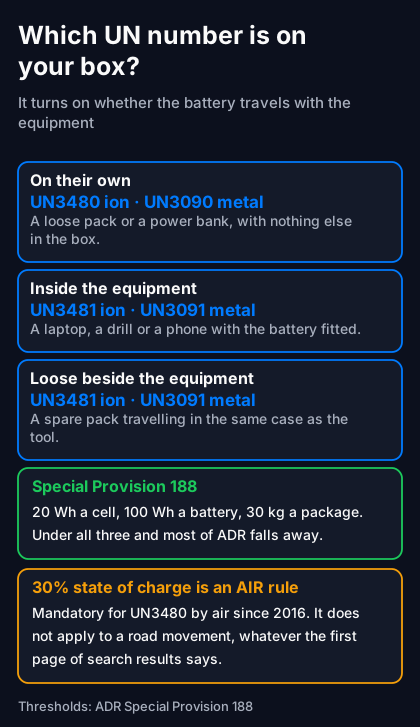
UN3480 is lithium ion batteries shipped on their own. UN3481 is lithium ion batteries either contained in a piece of equipment or packed alongside it in the same box. That single distinction — whether the battery travels alone or with the thing it powers — decides the number, the packing instruction and most of what follows.
Both sit in Class 9, miscellaneous dangerous substances and articles, under the ADR agreement that governs dangerous goods by road in the UK and across Europe. Neither is an exotic classification: a laptop, a cordless drill and a power bank between them cover all three cases, and most senders meet one of them without realising a UN number is involved at all.
Which UN number applies to what you are sending?
Work from the chemistry first, then from whether equipment is in the box. Lithium ion and lithium metal are different substances with different numbers, and sodium ion joined the list in 2025.
| What is in the box | Lithium ion | Lithium metal |
|---|---|---|
| Batteries on their own | UN3480 | UN3090 |
| Batteries inside equipment | UN3481 | UN3091 |
| Batteries loose in the box next to the equipment | UN3481 | UN3091 |
So a power bank sent by itself is UN3480. The same power bank is still UN3480, because it is the equipment. A laptop with its battery fitted is UN3481. A cordless drill with a spare pack rattling beside it in the case is also UN3481, because "packed with" and "contained in" share a number. Sodium ion batteries, added by ADR 2025, take UN3551 alone and UN3552 with equipment.
How do you work out the watt-hour rating?
Multiply the amp-hour rating by the nominal voltage. A 5,000 mAh cell at 3.7 V is 5 Ah × 3.7 V = 18.5 Wh. That arithmetic decides which rulebook you are in, so it is worth doing before you book anything.
Three steps, in order:
- Read the amp-hours off the battery. If it is printed in milliamp-hours, divide by 1,000.
- Multiply by the nominal voltage, also printed on the cell.
- Compare the answer with 20 Wh for a single cell and 100 Wh for an assembled battery.
Lithium metal batteries are rated by lithium content in grams rather than watt-hours, with thresholds of 1 g for a cell and 2 g aggregate for a battery. Since 1 January 2009 the watt-hour rating has had to be marked on the outside case of a lithium ion battery, so for anything made this decade the number is usually already there.
When are lithium batteries exempt from most of ADR?
Special Provision 188 releases small cells and batteries from most of ADR, and it is the provision almost every ordinary consignment travels under. It is a conditional exemption, not a blanket one, and failing any single condition puts the whole load back under the full regime.
| Condition | Threshold |
|---|---|
| Lithium ion cell | 20 Wh or less |
| Lithium ion battery | 100 Wh or less |
| Lithium metal cell | 1 g lithium or less |
| Lithium metal battery | 2 g aggregate lithium or less |
| Gross mass of the package | 30 kg or less, unless the batteries are installed in or packed with equipment |
Beyond the numbers, each cell has to be protected against short circuit and packed in an inner packaging that completely encloses it, and the package has to carry the battery mark. Go over any threshold and you are into fully regulated Class 9 carriage, which needs an ADR-licensed driver, a transport document and orange plates on the vehicle.
What does the lithium battery mark look like, and what changes on 31 December 2026?
The mark is a rectangle with a red hatched border, showing a group of batteries with one damaged and emitting flame, above the UN number. Minimum size is 100 mm wide by 100 mm high with hatching at least 5 mm wide, reduced to no less than 100 mm by 70 mm where the package is genuinely too small for the full size.
Two things have changed. ADR 2025 renamed it the lithium or sodium ion battery mark, because sodium ion batteries now use the same one with their own UN number. And the telephone number that used to be required on the mark no longer is — but existing stock bearing a phone number may be used only until 31 December 2026. If you have a roll of pre-printed labels in a cupboard, that is the date they stop being compliant, and it is close enough to be worth checking now rather than in January.
Why do the air rules differ from the road rules?
Because a fire in a cargo hold at 35,000 feet cannot be driven to the hard shoulder. Air transport is governed by the IATA Dangerous Goods Regulations rather than ADR, and the differences are large enough that applying one set to the other is the commonest mistake we see.
| Rule | Road (ADR) | Air (IATA DGR) |
|---|---|---|
| State of charge limit for UN3480 | No general limit | 30% of rated capacity, mandatory since 2016 |
| Shipper training | Required proportionate to the role | Formal, certificated, renewed on a fixed cycle |
| Who carries it | Any operator with an ADR-licensed driver for the class | Only an accredited agent and a carrier that accepts the UN number |
The 30% state-of-charge figure is the one that travels furthest out of context. It is an air requirement. A full UN3480 pack moving by road from Birmingham to Glasgow is not subject to it, and discharging a customer's batteries to 30% before a van job achieves nothing except an annoyed customer. Equally, a consignment prepared to road standards will be refused at a cargo handler's counter. Decide the mode first.
What happens if the battery is damaged, defective or going for recycling?
It leaves the ordinary rules entirely. A battery that is swollen, has been in a fire, has a damaged casing or is otherwise suspect falls under Special Provision 376, which requires packaging designed to contain a thermal runaway and, in the worst category, carriage under conditions approved by the competent authority. Special Provision 188 does not apply, whatever the watt-hour rating says.
Batteries collected for disposal or recycling are a separate case again, carried under Special Provision 377 and packing instruction P909. That route exists precisely because a scrap pallet of mixed end-of-life cells cannot realistically be assessed one by one.
If you are not certain which of the three a battery is in, treat it as damaged until someone qualified says otherwise. The cost of over-classifying is a more expensive packaging spec. The cost of under-classifying is a vehicle fire.
What else changed in ADR 2025 and the 2026 IMDG Code?
ADR 2025 came into force on 1 January 2025 and split section 2.2.9.1.7 in two — 2.2.9.1.7.1 now covers lithium batteries and 2.2.9.1.7.2 covers sodium ion, which previously had no entries at all. UN3551 and UN3552 were created for them.
At sea, IMDG Code Amendment 42-24 became mandatory on 1 January 2026 and removed a shortcut that a lot of exporters relied on. UN3171, the generic "battery-powered vehicle" entry, is no longer permitted for lithium or sodium powered vehicles. Three specific entries replace it:
| UN number | What it covers |
|---|---|
| UN3556 | Vehicle, lithium ion battery powered |
| UN3557 | Vehicle, lithium metal battery powered |
| UN3558 | Vehicle, sodium ion battery powered |
If you move electric vehicles, e-bikes or battery-powered plant to a port, the declaration you used in 2025 is no longer valid for the sea leg.
What does a road carrier actually need from you?
Less than most senders expect for a consignment under Special Provision 188, and more than most expect above it. Either way the carrier needs to know before the van is allocated, not when the driver arrives.
- The UN number, or enough detail for someone to work it out: chemistry, watt-hours or lithium content, and whether equipment is in the box.
- Whether any battery is damaged, defective or being moved for recycling.
- The gross weight of each package, because 30 kg is a threshold and not a rounding point.
- Confirmation that the battery mark is applied, where one is required.
Our drivers hold ADR licences covering classes 2, 3, 4, 5, 6, 8 and 9, which includes lithium batteries. We do not carry class 1 explosives or class 7 radioactive material. For a consignment that needs more than a licensed driver — competent authority approval under SP 376, for instance — the work goes to a partner carrier under its own approvals and we say so when you ask.
Who is responsible if the classification is wrong?
The consignor. Under ADR the duty to classify, pack, mark and declare sits with the person offering the goods for carriage, and it does not transfer to the carrier at the moment the driver signs for the box. A carrier who knowingly accepts a misdeclared load takes on its own liability, but that is in addition to yours rather than instead of it.
In practice this means the person booking the van is accountable for a watt-hour figure they may never have seen. The way out is not guesswork: the rating is printed on the battery, the manufacturer's safety data sheet or UN 38.3 test summary gives the rest, and a supplier who cannot produce either is telling you something useful about the consignment. If the paperwork does not exist, the honest answer is to treat the batteries as fully regulated and price the job accordingly.
If you are shipping these regularly, our lithium battery courier page covers the practical side, the lithium battery service page the booking side, and the hazardous goods service page what we carry across the other classes. The nine ADR classes explains where Class 9 sits among the rest.
Questions
- Is UN3480 or UN3481 more restricted?
- UN3480 is the more restricted of the two. Batteries travelling on their own have no surrounding equipment to absorb impact or contain a fault, so by air they carry a 30% state-of-charge limit that UN3481 does not. By road under ADR there is no state-of-charge limit on either, and the practical difference narrows to packaging: UN3481 batteries installed in equipment are exempt from the 30 kg package limit that applies to loose cells under Special Provision 188.
- Do I need an ADR driver to move a laptop or a power bank?
- Almost never. A laptop battery is typically 40 to 100 Wh and a power bank 18 to 74 Wh, so both sit under the 100 Wh threshold in Special Provision 188 and travel outside most of ADR provided the package is under 30 kg gross, each cell is protected against short circuit, and the battery mark is applied. An ADR-licensed driver becomes necessary above those thresholds, or for any battery that is damaged or defective.
- What is the 30% state of charge rule, and does it apply to road transport?
- It is an IATA Dangerous Goods Regulations requirement, mandatory for UN3480 since 2016, limiting lithium ion batteries shipped on their own to 30% of rated capacity on an aircraft. It does not apply to road transport under ADR, which has no general state-of-charge limit. Because almost every guide online is written by an air forwarder, this is the rule most often applied to van movements where it has no effect except to inconvenience the sender.
- My labels have a phone number printed on them. Can I still use them?
- Until 31 December 2026, yes. The telephone number is no longer a required element of the lithium or sodium ion battery mark, but marks bearing one remain acceptable through the end of 2026. After that date the pre-printed stock is no longer compliant. If you hold a roll of labels, check the quantity against your shipping volume now rather than discovering the problem in January.
- How do I convert milliamp-hours to watt-hours?
- Divide the milliamp-hour figure by 1,000 to get amp-hours, then multiply by the nominal voltage. A 10,000 mAh power bank at 3.7 V is 10 Ah multiplied by 3.7 V, which is 37 Wh, comfortably under the 100 Wh battery threshold. Since 1 January 2009, lithium ion batteries have had to carry the watt-hour rating on the outside case, so for recent equipment you can usually read it rather than calculate it.
- What do I do with a swollen or fire-damaged battery?
- Treat it as damaged or defective under Special Provision 376, regardless of its watt-hour rating. The Special Provision 188 exemption does not apply, the packaging must be capable of containing a thermal runaway, and the most severe category requires carriage under conditions approved by the competent authority. If you are unsure whether a battery qualifies as damaged, classify it as damaged. Over-classifying costs more in packaging; under-classifying risks a vehicle fire.
- Which UN number applies to an electric vehicle or an e-bike?
- Not UN3480 or UN3481. Since IMDG Code Amendment 42-24 became mandatory on 1 January 2026, the generic UN3171 battery-powered vehicle entry can no longer be used for lithium or sodium powered vehicles. Lithium ion powered vehicles take UN3556, lithium metal UN3557, and sodium ion UN3558. If you move e-bikes or battery plant to a port, a declaration drawn up in 2025 is no longer valid for the sea leg.