
The nine ADR dangerous goods classes, and what they mean for a delivery
Nine classes, three relief routes and one points calculation decide whether your consignment is an ordinary van job or a fully regulated dangerous goods movement with plates on the vehicle and a licensed driver behind the wheel. Most senders who discover they are carrying dangerous goods discover it late — a pallet of aerosols, a box of lithium batteries, a drum of resin hardener. This sets out the classification, the exemptions that most small consignments actually travel under, and what each one requires of you.
What are the nine ADR dangerous goods classes?
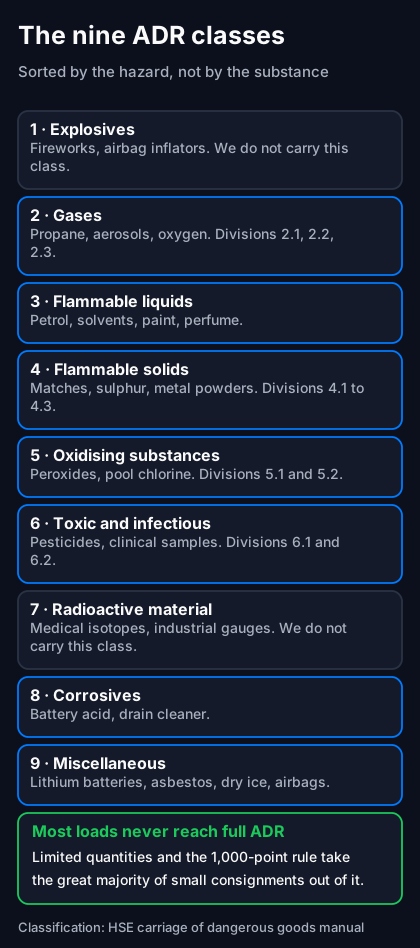
ADR sorts every dangerous substance into one of nine classes by the hazard it presents, not by what it is made of or what it is used for. Several classes are split into divisions where the hazard behaves differently — a flammable gas and a toxic gas need different handling even though both are gases.
| Class | Hazard | Everyday examples |
|---|---|---|
| 1 | Explosives (divisions 1.1 to 1.6) | Fireworks, airbag inflators, blasting charges |
| 2.1 | Flammable gas | Propane, butane, aerosols |
| 2.2 | Non-flammable, non-toxic gas | Nitrogen, medical oxygen, carbon dioxide |
| 2.3 | Toxic gas | Chlorine, ammonia |
| 3 | Flammable liquid | Petrol, solvents, paint, perfume, alcohol |
| 4.1 | Flammable solid, self-reactive, desensitised explosive | Matches, sulphur, metal powders |
| 4.2 | Liable to spontaneous combustion | White phosphorus, oily rags, some catalysts |
| 4.3 | Emits flammable gas on contact with water | Calcium carbide, sodium, magnesium powder |
| 5.1 | Oxidising substance | Hydrogen peroxide, pool chlorine, nitrates |
| 5.2 | Organic peroxide | Resin hardeners, curing agents |
| 6.1 | Toxic substance | Pesticides, cyanides, some laboratory reagents |
| 6.2 | Infectious substance | Clinical samples, diagnostic specimens, cultures |
| 7 | Radioactive material | Medical isotopes, industrial gauges |
| 8 | Corrosive substance | Battery acid, drain cleaner, sodium hydroxide |
| 9 | Miscellaneous | Lithium batteries, asbestos, dry ice, airbags |
Class 9 is the one most senders meet without expecting to. It is the catch-all for hazards that fit nowhere else, and lithium batteries are in it — which means a box of power banks is technically a dangerous goods consignment.
What do packing groups I, II and III mean?
The packing group grades how dangerous a substance is within its class. Group I is high danger, group II medium and group III low, and the grade drives the packaging standard, the quantity thresholds and how much paperwork follows the load.
It is assigned in column 4 of Table A in the ADR dangerous goods list, and it is a property of the entry rather than something you choose. Two flammable liquids in the same class can sit in different groups because their flashpoints differ.
Not everything gets one. As the HSE puts it, some substances are not assigned a packing group — notably gases and explosives. Divisions 5.2 and 6.2 and class 7 have none either, because their hazard is not graded on the same scale. Those entries carry a transport category instead, which is what the exemption calculation in the next section runs on.
When do the ADR rules not apply to your load?
More often than most senders assume. ADR has three separate relief routes, and the majority of small commercial consignments travel under one of them rather than as fully regulated dangerous goods.
| Route | What it relieves | Where the limit lives |
|---|---|---|
| Limited quantities (chapter 3.4) | Most of ADR, for small inner packagings in an outer box | Column 7a of Table A |
| Excepted quantities (chapter 3.5) | More than limited quantities, for very small amounts | Column 7b of Table A |
| The 1,000-point rule (1.1.3.6) | Placarding, orange plates and much of the vehicle equipment | Transport category, column 15 |
They are not alternatives you pick between. Limited and excepted quantities depend on how the goods are packed; the 1,000-point rule depends on how much is on the vehicle. A load can qualify for one, both or neither. What none of them does is remove the duty to classify correctly in the first place — the relief flows from the classification, so getting the class wrong invalidates the exemption you were relying on.
How does the 1,000-point rule work?
Every entry carries a transport category from 0 to 4 in column 15 of Table A. Multiply the quantity of each substance by the points value for its category, add them up, and if the total is 1,000 or less the load escapes placarding and much of the vehicle equipment requirement.
| Transport category | Points per kg or litre | Maximum on its own |
|---|---|---|
| 0 | No exemption available | None — a single item ends the calculation |
| 1 | 50 | 20 kg or litres |
| 2 | 3 | 333 kg or litres |
| 3 | 1 | 1,000 kg or litres |
| 4 | 0 | Unlimited — never counts towards the total |
Category 0 is the trap. It does not score nothing; it removes the exemption altogether, so one category 0 item on an otherwise trivial load puts the whole vehicle under full ADR. And the relief is partial even when you qualify: the driver still needs training appropriate to the job, the goods still need correct packaging and marking, and the transport document is still required. The rule exempts you from looking like an ADR load, not from being one.
What counts as a limited quantity?
Limited quantities work on package size rather than vehicle load. Each UN entry sets a maximum for the inner packaging in column 7a — often 1 litre or 5 litres for a liquid — and provided you stay under it, the outer package travels under chapter 3.4 instead of the full regime.
| Constraint | Limit |
|---|---|
| Inner packaging | As set in column 7a for that UN number |
| Combination packaging, gross mass | 30 kg |
| Shrink- or stretch-wrapped tray, gross mass | 20 kg |
| LQ mark, minimum size | 100 mm by 100 mm, reduced to 50 mm by 50 mm on a small package |
This is the route most retail chemistry travels on: paint, aerosols, cleaning products and perfume reach shops as limited quantities. The consignor must tell the carrier in a traceable form that limited quantities are on board, which in practice means in writing on the booking rather than mentioned to the driver at the kerb.
What has to be on the dangerous goods note?
The dangerous goods note is the transport document that travels with the load, and ADR prescribes both what it says and the sequence of the description. A note that is merely nearly right is a common roadside enforcement finding, because the detail is easy to check and hard to fudge.
The description of the goods runs in a set order: the UN number preceded by the letters UN, the proper shipping name from Table A, the label model numbers, and the packing group where one is assigned. Around that description the document carries:
- The number and description of the packages.
- The total quantity of each dangerous good, by mass or volume.
- The consignor's name and address.
- The consignee's name and address.
- The tunnel restriction code, where one applies to the route.
Use the proper shipping name from the regulations, not the trade name. "Thinners" is not a proper shipping name; UN1263 PAINT RELATED MATERIAL is. The gov.uk guidance on moving dangerous goods sets out the wider duties, including when an undertaking must appoint a dangerous goods safety adviser.
What does a fully regulated ADR load look like?
Visibly different from an ordinary delivery, which is the point of the marking. Once a load exceeds the relief thresholds, the requirements stack up across the driver, the vehicle and the paperwork at the same time.
- A driver holding an ADR vocational training certificate for the relevant class, in addition to the Driver CPC every professional driver carries.
- Plain orange plates front and rear, or plates showing the hazard identification and UN numbers where the load requires them.
- Hazard warning diamonds on the packages matching the class and any subsidiary risk.
- Vehicle equipment appropriate to the load, including fire extinguishers sized for the vehicle and the kit listed in the written instructions.
- Written instructions in the cab, in a language the driver reads, telling them what to do if something goes wrong.
The paperwork and the plates are the cheap part. The constraint that actually decides whether a job can run today is the licensed driver, because the ADR certificate is held by the individual and is class-specific — a driver qualified for class 3 is not thereby qualified for class 7.
Which classes can a same-day courier carry?
Ours hold ADR licences covering classes 2, 3, 4, 5, 6, 8 and 9. We do not carry class 1 explosives or class 7 radioactive material, and we do not take those on through a partner either — they need operators built around them.
| Class | Our position |
|---|---|
| 2, 3, 4, 5, 6, 8, 9 | Carried, with an ADR-licensed driver where the load requires one |
| 1 (explosives) | Not carried |
| 7 (radioactive) | Not carried |
Division 6.2 deserves a note, because it sounds more restrictive than it usually is. Most clinical and diagnostic work moves as UN3373 Category B biological substance, which travels under packing instruction P650 and outside most of ADR — that is the basis of our biological samples courier work. Category A infectious substances are a different proposition entirely.
Whether a job needs an ADR vehicle at all is usually settled by the exemption arithmetic above rather than by the class on its own, which is the practical difference between an ADR and a standard courier booking. Every credential is listed with its evidence on our licences page, including what we do not hold. If a job needs something outside that list, an accredited partner carries it under its own approvals and we will name them for your job. For the practical side of booking a load, see our hazardous goods service.
Questions
- How many classes of dangerous goods are there?
- Nine, numbered 1 to 9 and grouped by the hazard presented rather than by the substance itself. Five of them are split into divisions where the hazard behaves differently: class 2 into flammable, non-flammable non-toxic and toxic gases; class 4 into flammable solids, substances liable to spontaneous combustion, and substances emitting flammable gas on contact with water; class 5 into oxidising substances and organic peroxides; class 6 into toxic and infectious substances; and class 1 into divisions 1.1 to 1.6.
- What is the 1,000-point rule in ADR?
- It is the small-load exemption in ADR 1.1.3.6. Each entry has a transport category in column 15 of Table A, with a points multiplier: category 1 scores 50 points per kg or litre, category 2 scores 3, category 3 scores 1, and category 4 scores nothing. Stay at or under 1,000 points in total and the vehicle escapes placarding and much of the equipment requirement. Category 0 scores no points because it removes the exemption entirely.
- Does a limited quantity load still need an ADR driver?
- No ADR vocational training certificate is required for a load carried entirely as limited quantities under chapter 3.4, but the driver still needs training proportionate to the role and the consignor must inform the carrier in a traceable form that limited quantities are on board. The packaging, the inner-quantity limit from column 7a, the 30 kg gross package limit and the LQ diamond mark all still apply. The relief is from most of ADR, not from all of it.
- Which dangerous goods classes will you not carry?
- Class 1 explosives and class 7 radioactive material. Our drivers hold ADR licences for classes 2, 3, 4, 5, 6, 8 and 9, and those two sit outside what we do. We do not subcontract them either, because both need operators whose whole business is built around them rather than a same-day courier with a partner arrangement. Everything we hold, and everything we do not, is listed with its evidence on our licences page.
- Are lithium batteries dangerous goods?
- Yes, class 9. A box of power banks or spare laptop batteries is technically a dangerous goods consignment, which surprises most senders. In practice the great majority travel under Special Provision 188, which releases cells up to 20 Wh and batteries up to 100 Wh from most of ADR provided the package is 30 kg gross or less, each cell is protected against short circuit, and the battery mark is applied to the outside of the box.
- What is the difference between a packing group and a transport category?
- A packing group grades how dangerous a substance is within its class, from I for high danger to III for low, and it drives the packaging standard. A transport category sets the points multiplier for the 1,000-point exemption calculation. They are assigned in different columns of Table A and do not track each other. Gases, explosives, organic peroxides, infectious substances and radioactive material carry no packing group at all, but every entry has a transport category.
- Do you need a dangerous goods note for every hazardous consignment?
- A transport document is required for dangerous goods carriage, including loads under the 1,000-point exemption, though excepted quantities under chapter 3.5 are treated differently. The description must run in the order ADR sets out: UN number preceded by the letters UN, proper shipping name from Table A, label model numbers, and packing group where assigned. Use the proper shipping name rather than the trade name — UN1263 PAINT RELATED MATERIAL, not thinners.
Explore more
More from the blog
- GVMS and the Goods Movement Reference Explained
- Import VAT and Postponed VAT Accounting: How It Is…
- Incoterms 2020 Explained: All Eleven Rules and Who…
- ISPM 15: when your pallet needs a stamp, and when i…
- NCTS Explained: UK Transit Declarations, Guarantees…
- Sending Goods Abroad for Repair, and Bringing Them…