
Import VAT and Postponed VAT Accounting: How It Is Actually Paid
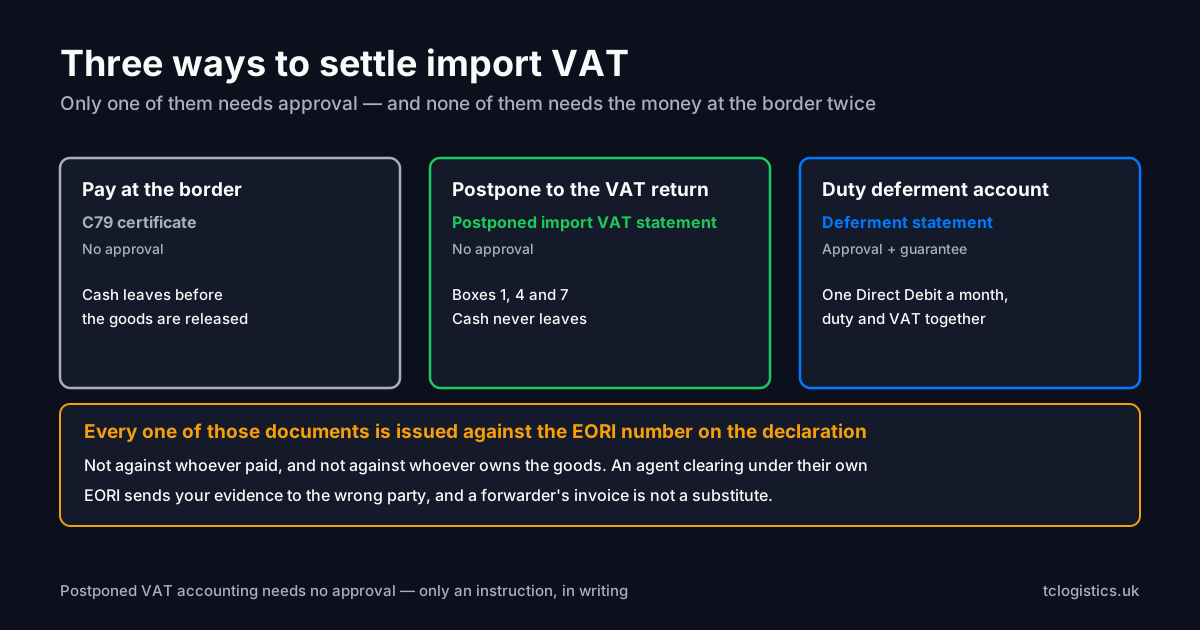
Import VAT is usually recoverable, which makes it a cash-flow problem rather than a cost — right up to the point where the evidence for the reclaim turns out to be in somebody else's name. This guide covers the three ways import VAT can be settled, why postponed VAT accounting needs no approval but does need an instruction, which boxes the figures go in, the difference between a C79 and a postponed import VAT statement, and the single detail on a declaration that decides whether you can reclaim at all.
What is import VAT, and who owes it?
Import VAT is VAT charged on goods entering the UK, at the same rate the goods would carry if bought here. It is not a customs duty and it is not an extra tax: for a VAT-registered business it is normally recoverable, which makes it a cash-flow question rather than a cost. The person who owes it is the importer of record — the party named on the customs declaration — and that is not always the party who owns the goods. Duty and import VAT are calculated on different bases and settled by different routes, so they are worth keeping apart in your head from the start. The rate itself follows the goods' commodity code, which is why a classification error can change a VAT bill even where the duty rate is nil.
What are the three ways to settle it?
Three, and the choice is about timing rather than amount.
| Route | When you pay | What you get back | Needs approval? |
|---|---|---|---|
| Pay at the border | Before the goods are released | A monthly C79 certificate | No |
| Postponed VAT accounting | Never — it goes on the VAT return | A monthly postponed import VAT statement | No |
| Duty deferment account | One Direct Debit a month | A deferment statement | Yes — and a guarantee, unless waived |
Postponed VAT accounting is the default worth choosing for most importers because it costs nothing and removes the cash gap entirely. Deferment is about duty as much as VAT, and earns its paperwork where there is real duty to defer.
What is postponed VAT accounting, and who can use it?
Postponed VAT accounting lets you account for import VAT on your VAT return instead of paying it at the border and reclaiming it later. The same figure goes on as output tax and input tax, so for a fully taxable business the net effect is nil — and the money never leaves.
Any UK VAT-registered business importing goods into Great Britain can use it, and no approval or application is required. That surprises people who assume a scheme this useful must have a gatekeeper. There is no form and no waiting period; it is a choice made on each declaration. What that means in practice is that it is also a choice that can silently not be made, which is the next section.
What do you actually have to do to use it?
Two things, and only one of them is yours if someone else clears the goods.
- Your VAT registration number must be on the import declaration, at header level in Data Element 3/40.
- If anyone else handles your imports — a freight forwarder, a customs broker, a courier clearing on your behalf — you must tell them in writing that you want to use postponed VAT accounting. They will not assume it.
That second point is where most lost PVA goes. An agent given no instruction will clear the goods the way they always do, the VAT is paid at the border, and the first you know is a recharge on their invoice weeks later. The instruction costs one sentence in an email and it needs to exist before the goods arrive, not after.
Which boxes does it go in on the VAT return?
Three, and the figure in two of them is identical, which is the whole point of the scheme.
| Box | What goes in it | From where |
|---|---|---|
| Box 1 | The import VAT due for the period | Your monthly postponed import VAT statement |
| Box 4 | The same figure, reclaimed as input tax | The same statement |
| Box 7 | The value of the imported goods, excluding VAT | Your own records |
Box 1 and box 4 cancelling out is what makes the scheme cash-neutral for a fully taxable business. A partly exempt business recovers only its recoverable proportion in box 4, so the two figures differ and the difference is a real cost — which is the case where paying at the border and reclaiming changes nothing except the timing.
Where do you get the monthly statement?
From the Customs Declaration Service, through your Government Gateway account. The postponed import VAT statement is published monthly and lists the import VAT postponed against your EORI number in that period, which is the figure HMRC expects to see in box 1.
Two practical points. It is published in arrears, so a VAT return prepared before the statement appears is prepared on an estimate — HMRC's guidance allows that, with a correction once the statement arrives. And it only shows what was declared against your EORI; anything cleared under somebody else's number is invisible on it, which is the same failure mode as the C79 below.
What is a C79, and how is it different?
A C79 is the monthly certificate for import VAT that was actually paid at the border, and it is the evidence HMRC expects to support a reclaim of that VAT. The postponed import VAT statement and the C79 are mutually exclusive for a given consignment: VAT is either postponed or paid, and you get the corresponding document.
| C79 | Postponed import VAT statement | |
|---|---|---|
| Covers | Import VAT paid at the border | Import VAT postponed to the VAT return |
| Supports | A reclaim in box 4 | Boxes 1 and 4 together |
| Issued | Monthly, in arrears | Monthly, in arrears, via CDS |
| Addressed to | The EORI on the declaration | The EORI on the declaration |
The last row is the one that costs money, and it has its own section below.
Why does the EORI on the declaration matter so much?
Because the C79 and the postponed VAT statement are issued against whichever EORI number appears on the declaration — not against whoever paid, and not against whoever owns the goods.
If a freight agent clears your goods under their own EORI, the certificate goes to the agent. You will have been recharged the VAT on their invoice, you will have no C79 in your name, and the evidence HMRC wants for your reclaim sits in somebody else's file. An invoice from a forwarder showing VAT recharged is not a C79 and does not replace it. The fix exists — the agent can make a post-entry amendment to the declaration so the certificate reissues against the correct EORI — but it is work after the fact, and it only happens if someone notices. The prevention is one line on the booking: these goods are imported in our name, under our EORI, and we are using postponed VAT accounting.
What is a duty deferment account for?
Deferring the payment itself. A duty deferment account lets customs duty, excise duty and import VAT accumulate and be settled in one Direct Debit a month, rather than consignment by consignment before release.
Unlike postponed VAT accounting it does need approval, and it normally needs a financial guarantee from a bank or insurer to cover the deferred balance. A guarantee waiver can be applied for alongside the account for businesses established in the UK for customs purposes, which removes the main cost of holding one. Approval produces a deferment approval number that goes on the Direct Debit instruction and on declarations. For an importer using postponed VAT accounting the remaining case for deferment is duty: if the goods carry a real duty rate and arrive frequently, deferring it is worth the application; if the duty is nil, it rarely is.
When can you not reclaim import VAT?
When you are not the owner of the goods, when you have no certificate in your name, or when the goods are used for exempt activity. These are three different problems with three different fixes.
| Situation | Position |
|---|---|
| You are the importer of record but never owned the goods | Not recoverable — the VAT is not your input tax |
| You own the goods but the agent used their EORI | Recoverable in principle; the evidence is in the wrong name. Ask for a post-entry amendment |
| You are partly exempt | Recoverable to your recoverable proportion only |
| Goods imported for a customer, not for you | Not yours to reclaim; the owner reclaims it |
The first and last rows are the same mistake seen from two sides, and they are common wherever a UK business imports on behalf of someone else as a convenience. Being named on the declaration does not make the VAT yours to recover.
How does this interact with the rest of the customs paperwork?
It is the fourth question of five on a declaration, and the only one that is purely about money.
| Question | Answered by |
|---|---|
| Who is importing? | EORI number — and it decides who gets the VAT certificate |
| What are the goods? | Commodity code — and it sets the duty and VAT rate |
| Where are they from? | Statement on origin — it can take the duty rate to nil |
| Who settles the tax, and when? | Postponed VAT accounting, a C79, or a deferment account |
| How do they move? | Transit and GVMS references |
Goods that come back after a repair abroad sit outside this chain in a useful way: see outward processing and returned goods relief, where the relief can remove the import VAT rather than merely postpone it.
Where does a courier fit into this?
At exactly one point, and it is the expensive one. If we or anyone else arrange clearance on your behalf, the EORI that goes on the declaration determines where your VAT certificate lands — so tell us in writing, at booking, whose EORI the goods are imported under and whether you are using postponed VAT accounting. That instruction is the difference between a clean reclaim and an argument with HMRC about alternative evidence.
T&C Logistics moves the consignment; the declaration and the VAT position belong to you or your customs broker. We collect and deliver across the UK and hand over landside at the port or the cargo handler. Call 07963 400173 or send the collection and delivery postcodes for a quote.
Questions
- Do I need approval to use postponed VAT accounting?
- No. Any UK VAT-registered business importing into Great Britain can use it, with no application and no waiting period. It is chosen on each declaration by putting your VAT registration number at header level in Data Element 3/40. The only administrative step is telling whoever clears the goods, in writing, that you want to use it — an agent given no instruction will pay the VAT at the border.
- What is the difference between a C79 and a postponed import VAT statement?
- They cover opposite routes. A C79 is the monthly certificate for import VAT actually paid at the border, and it supports a reclaim in box 4. A postponed import VAT statement lists VAT that was postponed to your VAT return, and it supports boxes 1 and 4 together. Both are monthly, both come in arrears, and both are issued against the EORI number on the declaration.
- Which VAT return boxes does postponed VAT accounting use?
- Box 1 for the import VAT due in the period, taken from your monthly postponed import VAT statement; box 4 for the same figure reclaimed as input tax; and box 7 for the value of the imported goods excluding VAT. For a fully taxable business boxes 1 and 4 cancel out, which is what makes the scheme cash-neutral. A partly exempt business recovers only its recoverable proportion in box 4.
- My freight agent used their own EORI. Can I still reclaim the VAT?
- In principle yes, but the evidence is in the wrong name: the C79 or statement was issued to the agent, not to you, and a forwarder's invoice showing VAT recharged is not a substitute. The clean fix is to ask the agent to make a post-entry amendment to the declaration so the certificate is reissued against your EORI. Preventing it is one line at booking stating whose EORI the goods are imported under.
- What if my postponed VAT statement is not available before my VAT return is due?
- The statements are published monthly in arrears, so this happens. HMRC's guidance allows the return to be prepared using an estimate of the import VAT, with a correction once the statement appears. Keep the basis of the estimate with your records — it is the difference between a corrected figure and an unexplained one.
- Do I need a duty deferment account if I use postponed VAT accounting?
- Usually only if there is real customs duty to defer. Postponed VAT accounting already removes the VAT from the border, so deferment adds value where the goods carry a duty rate and arrive frequently. It needs approval and normally a financial guarantee, though a guarantee waiver can be applied for by businesses established in the UK for customs purposes.
- Can I reclaim import VAT on goods I imported for a customer?
- No. Import VAT is recoverable by the owner of the goods as their input tax, and being named as importer of record on the declaration does not make it yours. A business that imports as a convenience for a customer carries the VAT and cannot deduct it; the owner is the party entitled to reclaim. This catches UK companies that handle clearance on behalf of an overseas seller.
- Does T&C Logistics handle import VAT for me?
- No — the declaration and the VAT position belong to you or your customs broker. What matters from our side is the instruction: tell us at booking whose EORI the goods are imported under and whether you are using postponed VAT accounting, because that determines where your VAT certificate lands. We move the consignment, collect and deliver across the UK, and hand over landside at the port or cargo handler.
Explore more
More from the blog
- GVMS and the Goods Movement Reference Explained
- Incoterms 2020 Explained: All Eleven Rules and Who…
- NCTS Explained: UK Transit Declarations, Guarantees…
- Sending Goods Abroad for Repair, and Bringing Them…
- Pallet Sizes and How Many Fit in Each Vehicle: UK G…
- Road Charges on a UK Delivery: What They Are, and W…