
Pallet Sizes and How Many Fit in Each Vehicle: UK Guide
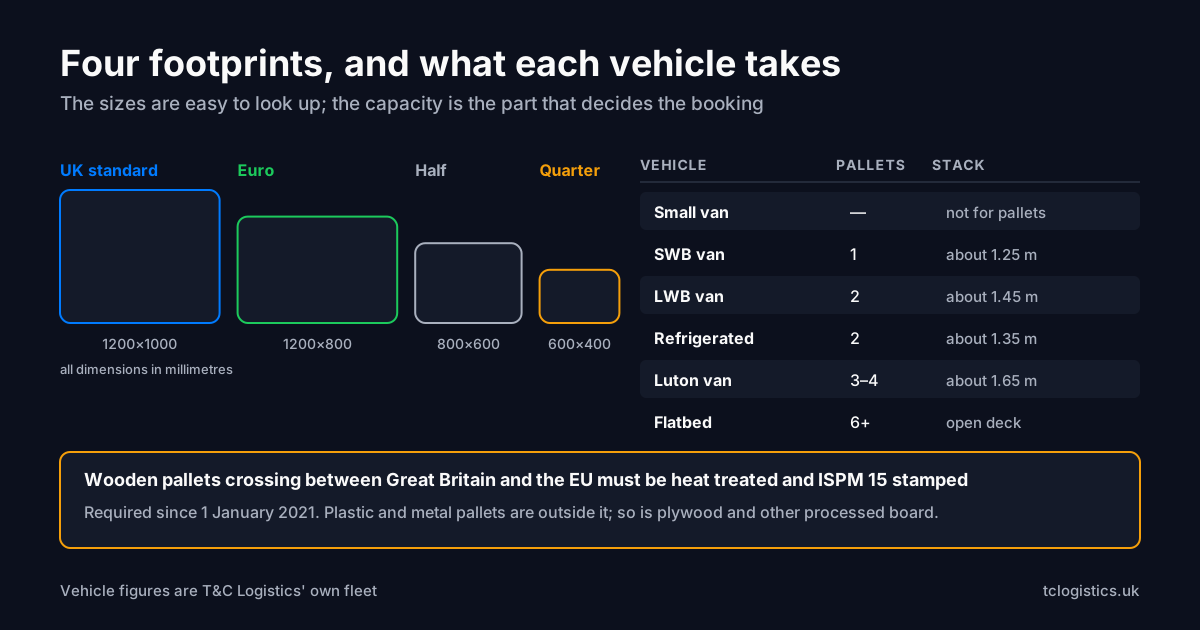
Pallet dimensions are easy to look up and rarely the thing that goes wrong. What goes wrong is the step after: how many of them fit in the vehicle you are about to book, how tall you can build them, what the tail lift will take, and whether anyone at the far end can get the pallet off the kerb. This guide puts the standard footprints next to real vehicle capacities, and covers the two things that stop a palletised consignment — an overhanging load, and a wooden pallet with no ISPM 15 stamp on its way to the EU.
What are the standard pallet sizes in the UK?
Four footprints cover almost everything moving by road in Britain, and the one most people mean by "a pallet" is the 1200 × 1000 mm industrial pallet rather than the Euro pallet.
| Name | Footprint | Also called | Typical use |
|---|---|---|---|
| UK standard | 1200 × 1000 mm | EPAL 2, industrial pallet | The default for UK domestic freight |
| Euro pallet | 1200 × 800 mm | EPAL 1, EUR1 | European trade, retail supply chains |
| Half pallet | 800 × 600 mm | EPAL 6, EPAL 7 | Retail displays, smaller consignments |
| Quarter pallet | 600 × 400 mm | Display pallet | Point-of-sale, small batches |
A standard wooden Euro pallet is 144 mm tall before anything goes on it and weighs around 25 kg empty — two numbers worth holding on to, because both come out of your usable space and payload. Our pallet dimensions glossary entry lists the full set.
What is the difference between a Euro pallet and a UK pallet?
200 mm of width, and a different idea about what it is for. The Euro pallet at 1200 × 800 mm is built to fit European standard shelving and to load two abreast across a 2,400 mm trailer; the UK standard at 1200 × 1000 mm gives 25% more deck area and suits heavier, bulkier domestic loads.
| Euro (1200 × 800) | UK standard (1200 × 1000) | |
|---|---|---|
| Deck area | 0.96 m² | 1.20 m² |
| Commonly rated to | 1,500 kg | 1,250 kg |
| Dominant in | EU trade, pooled retail networks | UK domestic freight |
| Across a 2.4 m trailer | Three lengthways, or two turned | Two abreast |
Both are ISO-compliant footprints overseen by the European Pallet Association. If you are shipping into an EU retail supply chain, ask before you build the load: a UK standard pallet will often physically fit and still be refused at the receiving bay, because the racking is cut for 800 mm.
How many pallets fit in each vehicle?
This is the question the pallet sizes exist to answer, and it is decided by floor area and door width before it is decided by weight. These are the figures for our own fleet.
| Vehicle | Load length | Internal height | Pallets | Max payload |
|---|---|---|---|---|
| Small van | 1.7 m | 1.2 m | — | 350 kg |
| SWB van | 2.4 m | 1.4 m | 1 | 600 kg |
| LWB van | 3.4 m | 1.6 m | 2 | 1,000 kg |
| Refrigerated van | 3.0 m | 1.5 m | 2 | 800 kg |
| Luton van | 4.1 m | 1.8 m | 3–4 | 1,200 kg |
| Flatbed | 6.0 m+ | Open | 6+ | 3,500 kg+ |
A small van carries boxes, not pallets — it has neither the door aperture nor the floor for one. The jump that surprises people is between the Luton and the flatbed: a Luton is the largest vehicle most operators will send without an operator's licence behind it, and the next step up is a different class of job. Our van size guide covers the non-palletised side of the same decision.
How tall can a loaded pallet be?
Take the vehicle's internal height and subtract the pallet. That is the whole calculation, and it is the one most often skipped.
| Vehicle | Internal height | Usable stack height on a 144 mm pallet |
|---|---|---|
| SWB van | 1.40 m | about 1.25 m |
| Refrigerated van | 1.50 m | about 1.35 m |
| LWB van | 1.60 m | about 1.45 m |
| Luton van | 1.80 m | about 1.65 m |
Leave a hand's width under the roof: a load built to the exact internal height cannot be walked in on a pallet truck, and a tail-lift adds a slight tilt as it rises. If the stack has to be taller than the van allows, the answer is a flatbed or a curtain-sider, not a tighter wrap.
How much can a pallet carry, and what runs out first?
Rarely the pallet. A Euro pallet is commonly rated to 1,500 kg and a UK standard pallet to 1,250 kg, which is well above what the vehicle underneath it can legally carry.
| Limit | Typical value | Runs out |
|---|---|---|
| The pallet itself | 1,250–1,500 kg static | Almost never |
| Vehicle payload | 600–1,200 kg for a van | Usually first, on dense goods |
| Tail-lift capacity | Up to 500 kg per lift on our Lutons | First, on a single heavy pallet |
| Floor area | 1 to 4 pallets by vehicle | First, on light bulky goods |
One pallet at 900 kg is a harder job than three at 300 kg, because the binding limit moves from the floor to the tail lift and the handling equipment at both ends. Tell us the per-pallet weight at booking rather than the total — that is the number that selects the vehicle.
Why does footprint matter more than weight for the price?
Because a dedicated vehicle is sold by the space it cannot then sell to anyone else. A pallet of pillows and a pallet of tiles occupy the same floor, and on a dedicated run they cost close to the same. This is the logic behind volumetric weight, which converts space into a billable figure wherever a carrier is consolidating loads.
On a dedicated job the calculation is simpler still: the vehicle goes out for your consignment alone, so the question is which vehicle the footprint forces. Two pallets instead of one does not double anything if both fit the same LWB van. Three instead of two does, if it pushes the job from a van to a Luton. Build the load to a vehicle step, not to the nearest round number.
When does your pallet need an ISPM 15 stamp?
Whenever wood packaging moves between Great Britain and the EU, in either direction. That has been the rule since 1 January 2021, and it catches the pallet rather than the goods on it.
ISPM 15 is the international standard for treating solid wood packaging so it cannot carry pests. A compliant pallet has been heat treated and carries a stamp showing the treatment code HT alongside the country code and the treatment provider's registration. Once treated and marked, a pallet can be re-used indefinitely without re-treatment, and for empty pallets moving as cargo the mark does the job a phytosanitary certificate otherwise would. Plastic and metal pallets fall outside it entirely, as does processed board such as plywood and OSB. If you are shipping to the EU, check the stamp before the vehicle is loaded, not at the port: an untreated wooden pallet is the goods' problem at the border, and it is not fixable in the queue. Our guide to shipping to the EU covers the rest of the documentation.
How do you tell a genuine EPAL pallet from a lookalike?
By the corner blocks. EPAL is the European Pallet Association, which licenses the makers and repairers entitled to build to the standard, and a genuine pooled pallet carries that licence burned into the block: the EPAL oval, on older stock the EUR oval alongside it, the maker's licence number and a two-digit year of manufacture. An ISPM 15 stamp sits with them where the pallet has been heat treated. The specification is dimensional too — an EPAL 1 is 1200 × 800 mm and 144 mm tall on nine blocks, and a lookalike that measures right at the deck is often wrong at the block.
It matters in two places and nowhere else: pooled exchange networks will not accept an unmarked pallet in exchange for a marked one, and a receiving bay running automated handling may reject a pallet whose dimensions are nominally right but whose build is not. For a one-way dedicated delivery, an unmarked pallet in sound condition is fine — what we care about is whether it will survive the journey.
What gets a pallet refused at collection?
Five things, in rough order of how often we see them. None of them is about the pallet's dimensions.
- Overhang. Goods wider than the deck catch on door frames and on other pallets, and they take the impact first. Build inside the footprint.
- An unstable stack. Heavy on top of light, or no interlocking between layers. Wrap does not make a load stable; it stops a stable load moving.
- A broken pallet. A cracked bearer or a missing block means it cannot be lifted safely, and a pallet truck will find the weakness immediately.
- Weight the booking did not mention. A pallet declared at 400 kg and loaded at 900 changes the vehicle and the handling equipment.
- No way to get it off at the far end. A tail-lift puts the pallet on the ground; it does not move it into a building. Somebody needs a pallet truck and a level surface.
The fifth one causes more failed deliveries than the other four together, and it is the easiest to settle: ask the receiving site what equipment they have before you book.
Should you send a part load or book the whole vehicle?
It depends on whether time or cost is the binding constraint, not on how many pallets you have.
| Dedicated vehicle | Pallet network | |
|---|---|---|
| Route | Direct, collection to delivery | Via one or more hubs |
| Handling | Loaded once, unloaded once | Handled at each hub |
| Timing | Same day, to an appointment | Next day or later, to a window |
| Suits | Fragile, urgent, high value, awkward | Robust, routine, cost-led |
The handling count is the real difference. Every hub transfer is a lift, and fragile or irregular loads accumulate risk at each one, which is why a pallet network is the wrong choice for a single awkward item however well it prices. For the comparison in full, see full load versus part load.
How do you book a pallet delivery with T&C Logistics?
Send four things and we can quote without a conversation: collection and delivery postcodes, the number of pallets, the dimensions and weight of each, and what equipment exists at both ends. We run dedicated vehicles from small van to flatbed across the UK mainland, with one driver from collection to delivery and no hub transfers, which is what suits a pallet that cannot be handled four times. Call 07963 400173 or send a WhatsApp message with the postcodes. Pricing starts from £50 (ex VAT); the final price depends on distance, vehicle, urgency and time, and is quoted in full upfront before you book.
Questions
- How many pallets fit in a Luton van?
- Three to four UK standard pallets at 1200 × 1000 mm, depending on how they are turned and whether the vehicle has a tail lift eating into the deck. Four Euro pallets at 1200 × 800 mm will usually go where three UK standard ones do, because the narrower footprint loads differently. Payload is about 1,200 kg, so four heavy pallets will hit the weight limit before the floor runs out.
- What is the difference between a Euro pallet and a standard pallet?
- A Euro pallet is 1200 × 800 mm and built to EPAL specification for European shelving and trailer loading. The UK standard pallet is 1200 × 1000 mm, giving 25% more deck area, and is the default for domestic freight in Britain. Both are 1200 mm long, so they load to the same depth; the difference is width, and it decides how many fit across a vehicle.
- Can I put a pallet in a transit van?
- In an SWB or LWB transit, yes — one and two respectively. In a small van, no: neither the rear aperture nor the floor will take a 1200 mm pallet, and the 350 kg payload rules out most palletised loads anyway. If the goods are already banded to a pallet, start at SWB.
- How high can I stack a pallet for a van delivery?
- Subtract the pallet from the vehicle's internal height, then leave a hand's width. That gives roughly 1.25 m of usable stack in an SWB van, 1.45 m in an LWB and 1.65 m in a Luton. A load built to the exact internal height cannot be manoeuvred in on a pallet truck, and a tail lift tilts slightly as it rises.
- Do I need a heat-treated pallet to ship to Europe?
- Yes, if it is a wooden pallet. Wood packaging moving between Great Britain and the EU has had to meet ISPM 15 since 1 January 2021, which means heat treatment and a stamp carrying the HT treatment code. Plastic and metal pallets are outside the standard, as is processed board such as plywood. Check the stamp before loading — it cannot be fixed at the port.
- What happens if my pallet is wider than the pallet itself?
- Overhanging goods are the single commonest reason a pallet is refused or damaged. Anything past the deck edge takes the first impact from door frames, other pallets and strapping, and it prevents the pallet being loaded tightly against its neighbours. Rebuild inside the footprint, or move up to the next pallet size rather than letting the load hang over.
- Who unloads the pallet at the delivery address?
- A tail lift brings the pallet to ground level; moving it into a building needs a pallet truck and a reasonably level, firm surface at the far end. Our driver handles the lift, not the internal move. Tell us at booking what equipment the receiving site has — no way to take the pallet off the kerb is the most frequent cause of a failed pallet delivery.
- Is a dedicated van cheaper than a pallet network for one pallet?
- Usually not on price, and often yes on everything else. A pallet network consolidates through hubs, which is cheaper per pallet and means the goods are handled at every transfer. A dedicated vehicle is loaded once and unloaded once, arrives the same day to an appointment, and suits fragile, urgent, high-value or awkward loads where handling is the risk rather than the cost.