
Sending Goods Abroad for Repair, and Bringing Them Back Without Paying Duty Twice
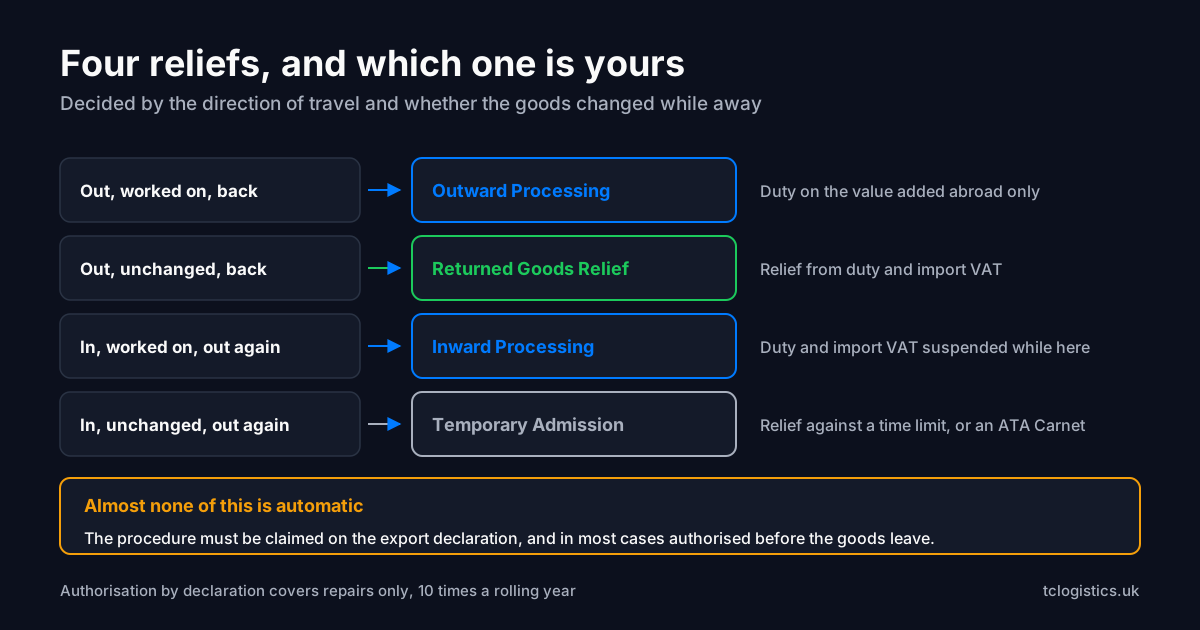
A machine goes abroad for repair. It comes back, and customs charges duty on the whole machine — the one you already imported and paid duty on years ago. Nothing went wrong at the border; the movement was simply declared as an ordinary export and an ordinary import, and the relief that would have stopped it was never claimed. This guide covers the four procedures that exist to prevent it, which one fits which movement, what you have to do before the goods leave, and the three conditions that decide most Returned Goods Relief claims.
What problem do these reliefs actually solve?
Paying duty twice on the same goods. A machine you already imported and paid duty on leaves the UK for repair; when it comes back, customs sees an import and charges duty on the full value all over again. The customs reliefs exist to stop that, and each one covers a different shape of movement. The distinction they all turn on is whether the goods changed: a repair is not a purchase, and a return is not an import, but the declaration looks identical unless you tell customs otherwise. None of this is automatic. Without the right procedure code on the declaration, and in most cases an authorisation obtained before the goods move, the relief is simply not claimed and the duty is due.
Which relief applies to your movement?
Start with the direction of travel and what happens to the goods while they are away.
| The movement | Relief | What it does |
|---|---|---|
| Goods leave the UK, are repaired or processed, and come back | Outward Processing | Duty charged only on the value added abroad |
| Goods leave the UK and come back unchanged | Returned Goods Relief | Relief from duty and import VAT |
| Goods come into the UK, are processed, and are re-exported | Inward Processing | Duty and import VAT suspended while they are here |
| Goods come in temporarily and leave again unchanged | Temporary Admission, or an ATA Carnet | Relief while they are here, against a time limit |
The two that catch UK businesses out are the first two, because both describe goods going out and coming back and the choice between them is decided entirely by whether work was done abroad.
What is Outward Processing Relief?
Outward Processing is the procedure for exporting goods to be processed or repaired and re-importing them with duty charged only on the work done, not on the whole article. It is the difference between paying duty on the whole machine and paying it on the repair alone, which on a serviceable capital asset is usually an order of magnitude.
It covers repair, replacement, calibration, refurbishment and manufacturing operations, and it applies whether the goods go to the EU or anywhere else. The rate the relief reduces is still the one attached to the goods' commodity code, so classification decides the size of the saving as much as the procedure does. What it does not do is apply itself: the goods must be declared to the procedure on export, and the re-import must reference that export. Our customs declaration glossary entry covers the mechanics, and the procedure is identified by a code on the declaration rather than by anything written on the invoice.
How is the duty calculated when the goods come back?
On the added value, which in practice means the repair or processing charge plus what it cost to get the goods home. Duty and VAT are calculated on slightly different bases, which is the detail most often got wrong.
| Charge | In the duty calculation? | In the import VAT calculation? |
|---|---|---|
| Repair or processing cost | Yes | Yes |
| Outward freight (goods leaving the UK) | No | Yes |
| Inward freight (goods returning) | Yes | Yes |
| Insurance on the return leg | Yes | No |
| The duty itself | — | Yes |
One case removes the charge entirely: a repair carried out free of charge under guarantee attracts no duty, because there is no added value to charge it on. A repair under a service contract or extended warranty you paid for is a different matter — you paid for the cover, so the cost counts.
Do you need authorisation before the goods leave?
Yes, in almost every case, and this is where the relief is most often lost. There are three routes in and they differ by how far ahead you have to think.
| Route | Covers | Timing |
|---|---|---|
| Full authorisation | Repairs and processing | Apply at least 30 days before you start exporting |
| Authorisation by declaration | Repairs only | Made at the border on the export declaration, up to 10 times in a rolling year |
| Retrospective authorisation | Where the goods have already moved | Reaches back 12 months, or 3 months for sensitive goods |
Authorisation by declaration is the one that suits an occasional repair and the one most people have never heard of. Note the two limits on it carefully: it does not cover processing, only repair, and the ten-movement cap is a rolling year rather than a tax year. A business repairing test equipment abroad every month will exhaust it and needs the full authorisation.
What is Returned Goods Relief, and where does it stop?
Returned Goods Relief covers goods that left the UK and come back unchanged — an exhibition stand, a demonstration unit, stock a customer rejected, tooling lent to a supplier. It gives relief from both customs duty and import VAT, and it has three conditions that decide almost every claim.
| Condition | Detail |
|---|---|
| Time | Re-imported within 3 years of export. HMRC can waive this in certain circumstances |
| State | Unaltered, apart from work carried out to keep them in working order. Upgrades that increase value break it |
| Person | For the import VAT relief specifically, the exporter and the importer must be the same person |
The third condition catches group companies constantly: goods exported by one entity and re-imported by a sister company get the duty relief and lose the VAT relief. The second catches anyone who had the goods "serviced while they were out there" — maintenance to keep them working is fine, an upgrade is not, and the line is whether the value went up.
How is Inward Processing the mirror image?
Inward Processing is the same idea pointed the other way: goods come into the UK to be processed or repaired and then leave again, and duty and import VAT are suspended while they are here rather than paid and reclaimed. It is the relief a UK repair shop or contract manufacturer needs when the customer is abroad.
The practical difference from Outward Processing is who carries the obligation. Under Inward Processing the UK business holds the authorisation and has to account for what came in, what went out and what was left over. Goods that never leave again fall out of the procedure and the suspended duty becomes payable — which makes the record-keeping the real cost of the relief, not the paperwork at the border.
When is Temporary Admission or an ATA Carnet the better route?
When the goods are coming to the UK for a defined purpose and leaving again untouched: a trade show, a demonstration, testing, a film shoot, professional equipment travelling with its operator. Temporary Admission gives relief against a time limit rather than against a process.
An ATA Carnet does the same job as a single document recognised across many countries, which replaces making a declaration in each one. It is issued by Chambers of Commerce rather than by HMRC, it is bought against a security deposit, and it has to be stamped at every border crossing in both directions. The stamp is the part that fails: an unstamped counterfoil on the way out looks exactly like goods that were sold abroad, and the deposit is claimed. If a Carnet is travelling with your consignment, the driver needs to know it exists and what to present.
What records do you have to keep?
Enough to reconstruct the movement years later, because that is when it will be asked about. Every one of these procedures is a conditional relief, and the condition has to be demonstrable long after the goods are back on the shop floor.
- The export declaration showing the procedure claimed, with its reference. This is the document that makes the return a return rather than an import.
- The repair or processing invoice, itemised. Duty is charged on this figure, so a lump-sum invoice that bundles freight into the repair cost inflates the duty.
- Freight invoices for both legs, separately. Outward freight is in the VAT calculation and out of the duty calculation, so they cannot be one line.
- Evidence the goods are the same goods — serial numbers, photographs, asset tags. For Returned Goods Relief this is the whole claim.
- The re-import declaration referencing the export.
Serial numbers are the cheapest insurance on the list and the one most often missing. A repaired item that comes back with a different serial number is a replacement, not a repair, and the relief changes shape with it.
What goes wrong, and what does it cost?
Almost always a declaration problem rather than a goods problem, and almost always discovered on re-import when it is too late to fix cheaply.
| What happens | Consequence |
|---|---|
| Goods exported with a normal export declaration, no procedure claimed | Duty on the full value on return; retrospective authorisation is the only route back |
| Authorisation by declaration used for processing rather than repair | Outside the scope — the relief does not apply |
| Eleventh repair movement in a rolling year | Over the cap; needs full authorisation |
| Goods return after three years | Returned Goods Relief lost unless HMRC waives the limit |
| Different group company re-imports | Duty relief survives, import VAT relief does not |
| Carnet counterfoil not stamped at the border | Treated as not re-exported; the security is at risk |
The first row is the expensive one. A machine that goes out on an ordinary export declaration carries no record that it was ever yours, and the only argument left on the way back is a retrospective application.
What does the carrier need to know before the vehicle moves?
Three things, and all three change what happens at the border rather than what happens on the road. First, whether the movement is under a customs procedure at all — a vehicle carrying goods under Outward Processing or a Carnet is a different proposition from one carrying a sale. Second, which documents are travelling physically with the goods, because a Carnet has to be presented and stamped and cannot be emailed. Third, whether the same vehicle is expected to bring them back.
T&C Logistics moves the consignment and the paperwork with it; the customs procedure is declared by you or your customs broker, who holds the authorisation and the liability. We collect and deliver across the UK and hand over landside at the port or cargo handler for the onward leg. Tell us at booking if a Carnet or a transit document is travelling — see our guide to customs transit under NCTS for how that document behaves on the road.
Questions
- Do I pay duty when my equipment comes back from repair abroad?
- Only on the repair, if you used Outward Processing. The duty is charged on the added value — the repair or processing charge plus the inward freight and insurance — rather than on the full value of the machine. Without the procedure claimed on the export declaration, customs treats the return as an ordinary import and charges duty on everything.
- Is a warranty repair free of duty?
- If the repair was carried out free of charge under guarantee, yes: there is no added value for duty to attach to. If you paid for the cover — a service contract or an extended warranty — then the repair cost counts as part of the value of the goods and duty is due on it. The question is not whether you were invoiced for the repair but whether you paid for the arrangement that covered it.
- How long do I have to bring goods back under Returned Goods Relief?
- Three years from export, and HMRC can waive that limit in certain circumstances. The goods must come back unaltered apart from work done to keep them in working order — maintenance is acceptable, an upgrade that increases their value is not. Exhibition stands, demonstration units and rejected stock are the usual cases.
- Can a different company in my group re-import the goods?
- For the customs duty relief, yes. For the import VAT relief under Returned Goods Relief, no: that specifically requires the exporter and the importer to be the same person. Group structures where one entity exports and another re-imports keep the duty relief and lose the VAT relief, which is a common and expensive surprise.
- What is authorisation by declaration, and when can I use it?
- It is a simplified route into Outward Processing made on the export declaration itself at the border, with no advance application. Two limits matter: it covers repairs only, not processing, and it is capped at ten movements in a rolling year. Beyond either limit you need full authorisation, which should be applied for at least 30 days before you start exporting.
- What is the difference between Outward and Inward Processing?
- Direction. Outward Processing is for goods leaving the UK to be worked on and returning, with duty charged on the value added abroad. Inward Processing is for goods arriving in the UK to be worked on and leaving again, with duty and import VAT suspended while they are here. A UK repair business serving overseas customers needs Inward Processing; a UK owner sending equipment out needs Outward.
- Do I need an ATA Carnet or Temporary Admission?
- Either can cover goods coming in temporarily and leaving unchanged. A Carnet is a single document recognised in many countries, issued by Chambers of Commerce against a security deposit, and it must be stamped at every crossing in both directions. Temporary Admission is a customs procedure declared to HMRC. For equipment touring several countries the Carnet usually wins; for a single movement the procedure often does.
- Can T&C Logistics handle the customs procedure for me?
- No — the authorisation and the declaration belong to you or your customs broker, who carries the liability for them. What we do is move the consignment and the documents with it: collection and delivery across the UK, landside handover at ports and cargo handlers, and carriage under transit where the movement needs it. Tell us at booking if a Carnet is travelling, since it has to be presented physically. Call 07963 400173 with the postcodes for a quote.
Explore more
More from the blog
- Heathrow Cargo: The Complete Guide for Freight Ship…
- Van Size Guide: Which Courier Vehicle Do You Need?
- UK Pharmaceutical Cold Chain Logistics: 2026 Compli…
- Heathrow Cargo: Complete Shipper's Guide to UK's La…
- Commodity Codes Explained: How to Classify UK Impor…
- Sending Large and Heavy Items by Courier: When a Pa…