
Commodity Codes Explained: How to Classify UK Imports and Exports
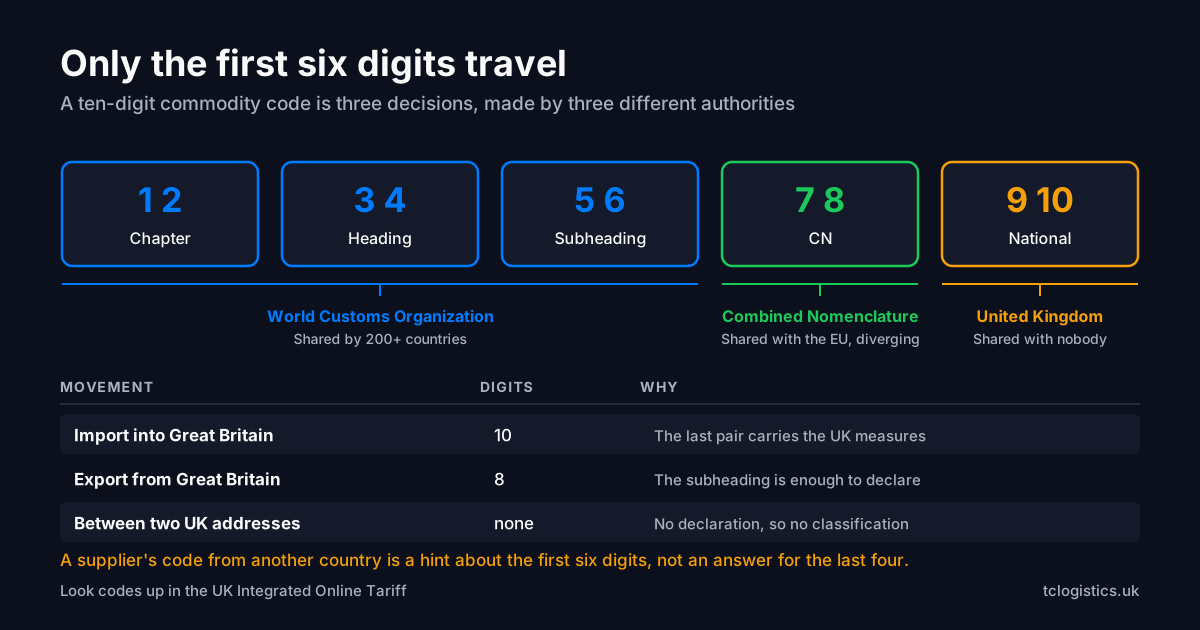
Almost every customs problem that looks like a duty problem is a classification problem. The commodity code decides what you pay, what you need a licence for and whether the declaration is accepted at all — and it is the one field on a declaration that a supplier cannot fill in for you, however confidently they email you a number. This guide covers what the digits mean, where to look them up, what the General Rules do when goods fit two headings, and how to get a classification HMRC cannot later dispute.
What is a commodity code, and what is it deciding?
A commodity code is the number that tells customs what your goods are. From that one classification follows the duty rate, the import VAT treatment, and every licence, quota, ban or safety measure that attaches to the product. It describes the goods and nothing else — which is the distinction that makes the rest of the paperwork legible. Your EORI number identifies the trader, an MRN identifies one declaration, a GMR identifies one vehicle crossing, and the commodity code identifies the product. Four references, four different jobs. The first six digits come from the Harmonised System maintained by the World Customs Organization and are the same in more than two hundred countries; everything after that is national. Our HS code glossary entry gives the short definition.
How many digits do you need, and why do imports and exports differ?
Ten digits for an import, eight for an export. The asymmetry is not an oversight: the last two digits carry import-specific measures — duty suspensions, anti-dumping measures, quota references — that have no meaning on the way out.
| Movement | Digits required | Why |
|---|---|---|
| Import into Great Britain | 10 | The final pair carries the UK measures that set what you pay and what you need |
| Export from Great Britain | 8 | Classification to the Combined Nomenclature subheading is enough to declare |
| Movement between two UK addresses | None | No declaration, so no classification |
Declaring an eight-digit code where ten are required will be rejected, and padding the missing pair with zeros is a guess, not a classification.
What do the digit groups actually mean?
A ten-digit commodity code is three decisions stacked on top of each other, each made by a different authority.
| Digits | Called | Set by | Shared with |
|---|---|---|---|
| 1–2 | Chapter | World Customs Organization | Every HS country |
| 3–4 | Heading | World Customs Organization | Every HS country |
| 5–6 | Subheading | World Customs Organization | Every HS country |
| 7–8 | Combined Nomenclature | Inherited from the EU nomenclature | The EU, divergent over time |
| 9–10 | National | The UK | Nobody |
Read the table the other way round and you have the single most useful fact about classification: only the first six digits travel. Digits seven to ten are a local decision, and they are the ones that set your duty.
Where do you look a UK commodity code up?
In the tariff that applies to the territory you are moving goods into. For Great Britain and the Isle of Man that is the UK Integrated Online Tariff; for Northern Ireland it is the Northern Ireland Online Tariff, which follows the EU nomenclature and will diverge from the GB answer for some goods. Searching by product description gets you to a chapter; from there the work is reading the section and chapter notes, which are legally part of the classification and routinely exclude the heading a plain-English search suggests. The tariff also shows what rides on the code: the duty rate, the VAT rate, any quota, and the document codes you will need on the customs declaration.
Why can't you just use the code your supplier gave you?
Because your supplier classified the goods in their tariff, not yours, and only the first six digits are common ground. A code from a manufacturer in China or the United States is typically correct where it was written and wrong in digits seven to ten here — and those are the digits that decide what you pay. The same applies in reverse to a code an EU customer sends you: the UK and EU nomenclatures started identical in 2021 and have been drifting apart since. Treat a supplier's code as a strong hint about the first six digits and verify the rest against the UK tariff yourself. The declarant carries the liability, not the person who emailed the number.
What happens when goods could sit under two headings?
The General Rules for the Interpretation of the Harmonised System decide, and they are applied in order — you do not pick the one that suits. There are six.
| Rule | Settles |
|---|---|
| 1 | Classification at heading level, by the wording of the heading and the section and chapter notes |
| 2 | Incomplete, unassembled and unfinished goods, and mixtures |
| 3 | Goods that genuinely fit two headings — the heart of most disputes |
| 4 | Goods that rules 1 to 3 cannot place, classified with what they most resemble |
| 5 | Cases, containers and packing materials |
| 6 | The same logic again, one level down, at subheading level |
Most arguments happen at rule 3, and most of those are settled by the chapter notes that rule 1 already pointed at.
How do you classify a product you have never shipped before?
Work down, not across. The tariff is a hierarchy and the commonest mistake is searching for a product name and accepting the first plausible hit six levels deep.
- Describe the goods the way the tariff does — what it is made of, what it does, how it is presented. Not the product name, not the SKU.
- Find the chapter, then read the chapter notes in full. They exclude goods as often as they include them, and an exclusion at this level ends the question.
- Pick the four-digit heading on the wording of the heading itself. This is rule 1, and it decides most classifications on its own.
- Go down to six digits, then to eight, then to ten, re-reading the notes at each level.
- Check the code is declarable. The tariff contains hierarchy entries that cannot be used on a declaration; the service tells you which.
- Record why. One line explaining which note or rule decided it turns an argument two years later into a filing.
Three traps recur: a part classified as an accessory, or the reverse; a set broken into components when the rules want it classified as one thing; and textiles classified by appearance rather than by fibre content, which the tariff cares about and the label often understates.
What does the wrong code actually cost?
More than the duty difference, and usually later rather than at the border. A classification error is a declaration error, so it stays correctable — and recoverable — after the goods have long since been delivered and sold.
| What goes wrong | How it shows up |
|---|---|
| Code with a lower duty rate than the correct one | HMRC can recover the underpaid duty retrospectively, with interest |
| Code with a higher rate | You overpaid; reclaiming it means amending the declarations |
| Code that misses a licensing requirement | Goods held or seized — the licence is attached to the code, not to the description |
| Code inconsistent across shipments of the same product | The pattern itself invites a review of the whole history |
| Code that does not exist, or is a non-declarable sub-division | Declaration rejected and the movement stops |
The last row catches people who copy a code out of the tariff's hierarchy without noticing it is a heading rather than a declarable commodity.
How do you get a classification HMRC is bound by?
Apply for an Advance Tariff Ruling. It is a legally binding decision on the commodity code for specific goods, and once you hold one, HMRC is bound by it.
| Advance Tariff Ruling | Binding Tariff Information | |
|---|---|---|
| Covers | Imports into and exports from Great Britain | Northern Ireland and the EU |
| Issued by | HMRC | The relevant customs authority |
| Time to decide | HMRC replies in 30 to 120 days | Varies by authority |
| Validity | Up to three years | Up to three years |
| Transferable | No — only the holder may rely on it | No |
Worth the wait for a product you will import repeatedly, or one whose classification you have already argued about once. Not worth it for a one-off consignment, where the wait exceeds the shipment.
Which documents carry the commodity code?
The commercial invoice and the customs declaration, at minimum, and they must agree. The invoice description should match the code rather than the marketing name — "cotton knitted jersey, men's, long sleeve" classifies; "Premium Heritage Tee" does not. If the goods move under customs transit the code also appears in the NCTS declaration, and if they cross through a port using the Goods Vehicle Movement Service the declaration reference, not the code itself, goes into the GMR. One product with several variants may need several codes on one consignment; one code per line, not one per shipment.
Where does the commodity code sit in the rest of the paperwork?
It is the second of five answers a customs declaration needs, and the one everything else prices off.
| Question | Answered by |
|---|---|
| Who is moving the goods? | EORI number |
| What are the goods? | Commodity code |
| Where do they originate? | Statement on origin, under the trade agreement |
| Who pays which costs and carries which risk? | Incoterms 2020 rule |
| How do they physically move? | Transit and GVMS references |
Origin and classification are often confused and are not the same test: the code says what a thing is, origin says where it became that thing, and only origin decides whether a trade agreement gives you a zero rate. Our guide to shipping to the EU after Brexit covers the origin side.
Where does a courier fit into this?
Not in the classification. T&C Logistics moves the consignment; the commodity code is declared by you or by your customs broker, who carries the liability for it. What we need from you is the paperwork already complete and consistent, because a vehicle held at a port over a mismatch between an invoice description and a declared code costs a day, not an hour. We collect and deliver across the UK, and hand over landside at the cargo handler or the port for the onward leg. If the goods are moving under transit, tell us at booking — the transit document has to travel with the vehicle.
Questions
- Is a commodity code the same as an HS code?
- Not quite, and the difference matters when someone sends you a number. An HS code is the first six digits, set by the World Customs Organization and shared internationally. A UK commodity code is that HS code plus national digits — eight for an export, ten for an import. So every commodity code contains an HS code, but an HS code alone is not enough to declare goods into Great Britain.
- Do I need a commodity code to send something within the UK?
- No. A movement between two UK addresses involves no customs declaration, so nothing is classified and no commodity code exists for it. Classification only starts when goods cross a customs border — into or out of Great Britain, or between Great Britain and Northern Ireland in the cases where a declaration is required.
- Who is legally responsible for the commodity code on a declaration?
- The declarant — the party in whose name the declaration is made. Using a broker does not move that liability, and nor does relying on a code supplied by the manufacturer. This is why a supplier's code should be verified rather than copied: if digits seven to ten are wrong, the consequences land on the importer, not on the person who emailed the number.
- Can one consignment have more than one commodity code?
- Yes, and most mixed consignments do. The code applies to the goods, not to the shipment, so a pallet carrying three different products carries three classifications and three declaration lines. Grouping unlike goods under one code to simplify the paperwork is a classification error even when the duty happens to come out the same.
- Does the commodity code set the VAT rate as well as the duty?
- It points at both. The tariff entry for a code shows the duty rate and the VAT treatment together, which is why a classification change can alter your landed cost even when the duty rate is zero. Zero-rated and reduced-rate goods are identified by classification, so a wrong code can mean VAT charged at the standard rate on goods that should not carry it.
- How often do commodity codes change?
- The Harmonised System itself is revised periodically by the World Customs Organization, and national digits change more often than that — new suspensions, quotas and measures arrive during the year. A code that was right for a product two years ago is worth re-checking before a new import programme, particularly if you hold no binding ruling.
- What if my product genuinely does not fit any heading?
- It will fit one: the General Rules are written so that everything classifies somewhere, with rule 4 placing goods alongside what they most resemble when rules 1 to 3 cannot. If you reach that point the classification is arguable, which is the clearest signal that an Advance Tariff Ruling is worth the 30 to 120 day wait.
- Can T&C Logistics classify my goods for me?
- No. Classification is a customs matter and the liability sits with the declarant, so it belongs with you or your customs broker. We move the consignment: collection and delivery across the UK, landside handover at ports and cargo handlers, and carriage under transit where the movement needs it. Call 07963 400173 or send us the collection and delivery postcodes for a quote.
Explore more
More from the blog
- Heathrow Cargo: The Complete Guide for Freight Ship…
- Top 10 UK Cities for Logistics Companies (2026)
- Van Size Guide: Which Courier Vehicle Do You Need?
- UK Pharmaceutical Cold Chain Logistics: 2026 Compli…
- Heathrow Cargo: Complete Shipper's Guide to UK's La…
- EORI Number Explained: GB, XI, and Who Actually Nee…