
Sending Large and Heavy Items by Courier: When a Parcel Network Is the Wrong Choice
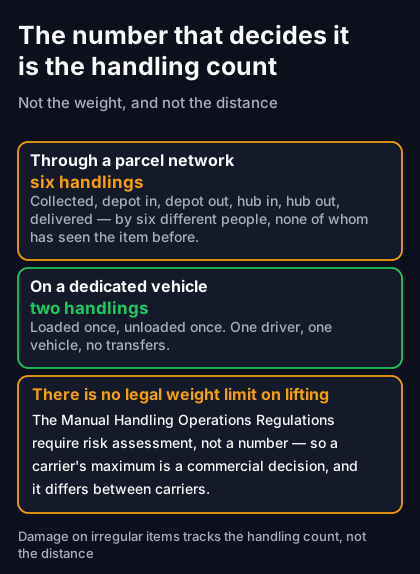
A parcel network is built to keep things moving on belts. The moment an item will not sit on one, it stops being a parcel and starts being a handling problem — lifted, carried and set down by a different person at every transfer. That is the real reason large items are damaged and delayed, and it is not about care. This guide covers what makes an item "large" to a carrier, why there is no legal lifting limit however often one is quoted at you, when a dedicated vehicle is the right answer, and the five things to say at booking that prevent a failed delivery.
What makes an item "large" to a courier?
Not weight on its own. A courier's definition of large is whatever stops the item being handled the way everything else is handled, and that is usually a dimension rather than a mass. A 4 kg curtain pole is a harder consignment than a 20 kg box, because the box fits a conveyor and the pole does not.
Three properties decide it. Length, because sortation equipment and roller cages have fixed geometry. Girth — the distance round the item — which most networks combine with length into a single limit. And shape: anything that will not sit flat, stack or be strapped is handled by hand at every stage. Weight matters last, and mainly because it interacts with the first three. Our volumetric weight glossary entry covers how space is converted into a billable figure.
What actually happens to an oversized item inside a parcel network?
It leaves the automation. A parcel network moves volume by keeping items on belts and in cages between hubs; an item that cannot go on a belt is pulled out, carried, set down somewhere, and picked up again at every transfer by a different person who has not seen it before.
That is the real risk, and it is not carelessness. Each hub transfer is a lift and a set-down. A consignment moving through two hubs is handled at least six times between collection and delivery, and the damage rate on irregular items rises with the count rather than with the distance. It is also why an oversized item that is accepted often arrives late: it misses the automated flow and travels with whatever has space.
Is there a legal weight limit on what one person can lift?
No, and this is the misconception behind most of the confusion. The Manual Handling Operations Regulations require employers to avoid hazardous manual handling so far as reasonably practicable, and to assess and reduce the risk of what cannot be avoided. The Health and Safety Executive states plainly that the law does not set specific weight limits.
So a carrier's ceiling — whatever number appears in their terms — is a commercial and operational decision, not a statutory one. That matters practically: the number is theirs to change, it differs between carriers, and an item a little over it is not illegal, it is simply outside what that carrier's process is built for. The question to ask is never "is this allowed" but "how will this be handled".
When is a dedicated vehicle the right answer?
When the handling is the risk rather than the cost. The shape of the item decides it more reliably than the price comparison does.
| The item | Network | Dedicated vehicle |
|---|---|---|
| Boxed, under a metre, regular shape | Yes — this is what it is for | Overkill |
| Long and thin, or awkward to grip | Risky — manual at every hub | Loaded once, unloaded once |
| Fragile, irreplaceable or one of a kind | No | Yes |
| Needed on a date that cannot move | No — a window, not an appointment | Yes |
| Heavy enough to need two people | Usually refused | Yes, with the handling arranged |
| Several items, one destination | Priced per item | Priced once for the vehicle |
The last row surprises people. Three awkward items to one address is often cheaper on a dedicated vehicle than through a network, because the network prices each one and the vehicle prices the journey.
How is a large item priced?
By the vehicle it forces, not by what it weighs. A dedicated run is sold as a vehicle and a driver for a journey, so the question is which size of vehicle the item makes necessary and how far it is going.
That has a useful consequence: between vehicle steps, size is close to free. A consignment that fits a long-wheelbase van costs what that van costs whether it half fills it or fills it. The jump comes when the item pushes you into the next vehicle up. Our van size guide sets out the load lengths and payloads of each class, and the pallet capacity guide covers how many pallets each one takes. Build the consignment to a vehicle step rather than to a round number.
What should you tell the carrier when you book?
Five things, and four of them are about the ends rather than the item. Most failed collections of large goods are not about the goods.
- Dimensions and weight, per item — not a total. The heaviest single piece selects the vehicle and the handling.
- Whether it is on a pallet, crated, or loose. Loose changes everything about loading.
- What equipment exists at the collection point — forklift, tail lift, loading bay, or nothing but a doorway.
- The same question for the delivery point. This is the one most often left blank and the one that most often fails.
- Access: parking, height restrictions, stairs, lift dimensions, and whether a large vehicle can physically reach the door.
A tail lift puts a load on the ground. It does not move it into a building, up a step, or through a doorway, and a driver arriving alone cannot carry what two people are needed for. Settling that at booking is the difference between a delivery and a second journey.
How should a large item be prepared?
So that it can be lifted, strapped and set down without anyone having to improvise. Four things do most of the work.
| Do | Why |
|---|---|
| Give it a flat base — a pallet, a skid, a crate | Turns an awkward item into a liftable one |
| Protect corners and edges, not just faces | Corners take the impact; faces rarely do |
| Make the centre of gravity obvious, and mark which way is up | A driver should not have to guess |
| Keep the wrapping inside the footprint | Overhang catches on frames and other loads |
Fragile markings help far less than people expect once an item has left the automated flow, because the handling is already manual. A flat base and an obvious lifting point help far more.
What about items that need two people?
They need to be booked as such, because a standard courier job dispatches one driver. Two-person handling is a different service with a different vehicle allocation, and it is the single commonest cause of a large-item delivery failing on arrival: the item is there, the vehicle is there, and there is nobody to take one end.
The threshold is not a weight. It is whether one person can lift, carry and set the item down safely given its shape, the distance and the access — which is exactly the assessment the Manual Handling Operations Regulations require of an employer. A 35 kg compact item down a level corridor may be a one-person job; a 25 kg mirror up a narrow staircase is not. Our two-man delivery glossary entry covers how it is arranged.
What about insurance on something valuable?
Ask what the cover actually is before you book, not after something happens. Goods-in-transit cover is carried by the carrier and has a limit per consignment; T&C Logistics carries goods-in-transit cover of £50,000, rising to £1,000,000 through partner carriers, and the terms are set out on our terms page.
Two things follow for a large item. A single high-value piece can exceed a standard limit on its own, where the same value spread over a dozen boxes would not — so the limit that matters is the one per consignment, not per item. And a dedicated vehicle narrows the exposure structurally rather than financially: the goods stay on one vehicle with one driver, so there is no transfer at which they can be mislaid. Tell us the value at booking if it is substantial, because it changes the conversation about cover before the job rather than after it.
Does a bigger vehicle bring extra charges with it?
Sometimes, and they are road charges rather than carrier surcharges. A delivery into central London picks up the Congestion Charge and, for a non-compliant vehicle, ULEZ; several cities outside London run Clean Air Zones that charge vans; and a route over the Dartford Crossing picks up the Dart Charge. None of these depends on the size of your item, but all of them depend on the route and the vehicle.
Our fleet is ULEZ-compliant, so a London delivery carries no ULEZ charge with us. The rest are route facts rather than vehicle facts, and we quote them in the price upfront rather than adding them afterwards. See our guide to road charges on a UK delivery for what each one costs and which journeys pick them up.
What goes wrong, and when?
Almost always at the far end, and almost always because of something that was knowable at booking.
| What happens | Root cause |
|---|---|
| Driver arrives, cannot unload | No equipment or second person at the delivery point |
| Vehicle cannot reach the address | Height barrier, weight restriction or no access for the size booked |
| Item damaged in a network | Handled manually at every transfer; a count problem, not a care problem |
| Item refused at collection | Larger or heavier than declared, so the wrong vehicle came |
| Delivery slips by days | Oversized items leave the automated flow and travel on space |
Four of those five are fixed by one email before the vehicle is allocated.
How do you book a large or heavy item with T&C Logistics?
Send the collection and delivery postcodes, the dimensions and weight of the heaviest single piece, and what equipment and access exist at each end. That is enough to select the vehicle and quote without a conversation.
We run dedicated vehicles from small van to flatbed across the UK mainland: one driver from collection to delivery, loaded once and unloaded once, with no hub transfers — which is the whole point for an item that does not want to be handled six times. Call 07963 400173 or send a WhatsApp message with the postcodes. Pricing starts from £50 (ex VAT); the final price depends on distance, vehicle, urgency and time, and is quoted in full upfront before you book.
Questions
- What counts as a large item for a courier?
- Usually a dimension rather than a weight. Most networks combine length and girth — the distance round the item — into a single limit, because sortation equipment has fixed geometry. Shape matters as much: anything that will not sit flat, stack or be strapped is handled by hand at every transfer. A long, light item is often a harder consignment than a heavy compact one.
- Is there a legal limit on how much one person can lift?
- No. The Manual Handling Operations Regulations require employers to avoid hazardous manual handling so far as reasonably practicable and to assess the risk of what cannot be avoided, and the Health and Safety Executive states that the law sets no specific weight limits. A carrier's maximum is therefore a commercial and operational decision rather than a statutory one, which is why it differs between carriers.
- Why do large items get damaged more often?
- Because they leave the automated flow. A parcel network keeps items on belts and in cages between hubs; anything that cannot go on a belt is lifted, carried and set down by hand at every transfer. A consignment moving through two hubs is handled at least six times, and the damage rate on irregular items tracks that count rather than the distance travelled.
- Is a dedicated van more expensive than a parcel service for one big item?
- On headline price usually yes, on total cost often not. A network prices each item, while a dedicated vehicle prices the journey — so three awkward items to one address frequently costs less on a vehicle. The vehicle is also loaded once and unloaded once, arrives on an appointment rather than in a window, and does not depend on the item fitting someone's sortation equipment.
- What do you need to know about the delivery address?
- Whether anything can get the item off the vehicle and into the building. A tail lift puts a load on the ground; it does not move it through a doorway or up a step. Tell us about parking, height restrictions, stairs, lift dimensions and whether a second person is available. Access at the far end is the single commonest cause of a failed large-item delivery.
- When do I need a two-person delivery?
- When one person cannot lift, carry and set the item down safely given its shape, the distance and the access — which is a judgement about the whole job, not a weight threshold. A compact 35 kg item along a level corridor may be fine for one; a 25 kg mirror up a narrow staircase is not. It has to be booked as a two-person job, because a standard courier job dispatches one driver.
- How should I package a large item for transport?
- Give it a flat base — a pallet, skid or crate — so it can be lifted mechanically rather than wrestled. Protect corners and edges rather than faces, since corners take the impact. Mark which way is up and make the lifting points obvious. Keep all wrapping inside the footprint: overhang catches on door frames and other loads and takes the first knock.
- Can you collect something that is not palletised or crated?
- Yes — a dedicated vehicle does not need the item to suit anyone's sortation equipment. What we need to know in advance is the dimensions and weight of the heaviest single piece and what equipment and access exist at both ends, because those select the vehicle and determine whether one driver or two are needed. Send the postcodes and those details for a quote.