
Time-Critical Logistics Solutions UK — When Every Minute Counts
Time-critical logistics represents the pinnacle of courier delivery urgency. Unlike standard same-day delivery, which operates within a broad window, time-critical shipments demand arrival within a precisely defined timeframe—often measured in hours, sometimes minutes. In the UK, this specialised service has become essential across multiple high-stakes industries where delays translate directly into significant financial loss, safety risks, or operational breakdown.
What is Time-Critical Logistics?
Time-critical logistics represents the pinnacle of courier delivery urgency. Unlike standard same-day delivery, which operates within a broad window, time-critical shipments demand arrival within a precisely defined timeframe—often measured in hours, sometimes minutes. In the UK, this specialised service has become essential across multiple high-stakes industries where delays translate directly into significant financial loss, safety risks, or operational breakdown.
Time-critical logistics isn't simply "fast delivery." It's a comprehensive operational approach involving dedicated vehicles, pre-planned routing, real-time communication, contingency protocols, and professional drivers trained to handle pressure situations. When you engage a time-critical service, you're purchasing certainty, not merely speed.
Industries Demanding Time-Critical Solutions
The diversity of sectors relying on time-critical logistics reflects the interconnected nature of modern business:
- Aviation and Aerospace: Aircraft on the ground (AOG) situations are measured in lost revenue per minute. A single engine component delayed can ground a £100 million aircraft. Heathrow, Gatwick, and Manchester airports depend on rapid parts delivery to maintain flight schedules.
- Automotive Manufacturing: Production lines halt instantly when critical components fail to arrive. Facilities like Jaguar Land Rover in Solihull operate on just-in-time inventory systems where a 2-hour delay can cost £250,000 in lost production.
- Pharmaceutical and Medical: Emergency medications, blood products, and diagnostic equipment require urgent delivery. Hospital pharmacies and emergency departments cannot function without reliable time-critical networks.
- Legal Services: Court deadlines are immovable. Time-critical document delivery to courts, tribunals, and regulatory bodies determines case outcomes.
- Construction and Engineering: Major projects operate on compressed timelines. A missing structural component or safety certification can halt work on multi-million-pound builds.
- Events and Entertainment: Live events require technical equipment, credentials, and materials to arrive precisely when needed. A delayed lighting rig for a major concert creates cascading problems.
What Qualifies as Time-Critical?
Shipment Categories
Time-critical classification depends on business impact rather than package size or weight. Here are the primary categories:
- Aircraft on Ground (AOG) Components: Any part required to return a grounded aircraft to service. A single defective seal, hydraulic line, or avionics unit can ground a commercial aircraft carrying 300+ passengers.
- Medical and Pharmaceutical Supplies: Emergency medications requiring same-day delivery to hospitals; blood products with 24-48 hour shelf lives; diagnostic equipment needed for urgent patient assessment.
- Production Line Components: Replacement parts, sub-assemblies, or raw materials required to prevent manufacturing halt. A single missing bearing can stop a production line worth thousands per minute.
- Legal Documents: Court filings with immovable deadlines; regulatory submissions; compliance documentation where late arrival means non-compliance with statutory requirements.
- Perishable Goods: Temperature-sensitive pharmaceutical compounds; fresh laboratory samples; organ transplant materials; specialty food products with narrow delivery windows.
- Security-Critical Materials: Confidential financial documents; security access credentials; encryption keys; safety certifications required before operations can commence.
- High-Value Equipment: Specialised instruments where replacement lead times exceed weeks or months; prototype components; bespoke manufacturing fixtures.
The common denominator: delay costs exceed premium delivery pricing by significant margins.
Time-Critical vs. Standard Same-Day Delivery
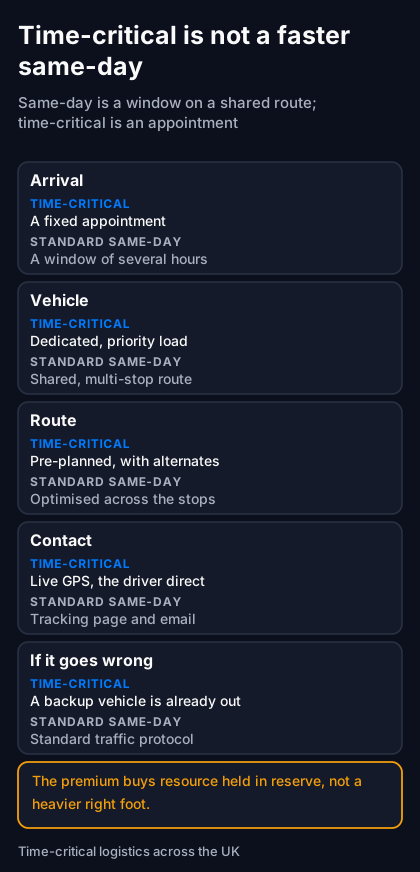
Understanding the distinction ensures you purchase the correct service level for your actual requirements. Standard same-day delivery and time-critical logistics operate on fundamentally different operational models.
Service Comparison
| Characteristic | Standard Same-Day | Time-Critical |
|---|---|---|
| Delivery Window | Morning, afternoon, or evening (4-6 hour window) | Fixed appointment time (within 30-60 minute window, often 2-4 hour turnaround) |
| Vehicle Assignment | Shared vehicle on multi-stop route | Dedicated vehicle; single or few priority loads |
| Routing | Optimised for efficiency across multiple stops | Pre-planned priority route; real-time traffic monitoring and contingency alternatives |
| Communication | Standard tracking; email notification | Real-time GPS tracking; direct driver mobile contact; hourly or sub-hourly updates to client |
| Contingency Planning | Standard traffic protocols | Pre-arranged alternative routes; backup vehicles positioned; direct courier supervisor oversight |
| Driver Training | Standard courier certification | Specialist training; AOG/medical experience; high-pressure situation management |
| Cost Structure | Distance and weight-based | Premium pricing reflecting resource allocation and risk mitigation |
Operational Differences in Practice
Dedicated Vehicle Deployment: Time-critical shipments travel on dedicated vehicles. This means your AOG part doesn't share space with fifteen other parcels on a round-robin route. The driver's sole objective is your delivery, not optimising stop density. This eliminates the variable of competing priorities.
Priority Routing: Before your shipment even departs, T&C Logistics analysts examine multiple route options, consider current traffic patterns, predict congestion zones, and pre-position vehicles strategically. For a Heathrow delivery at 3am, we might deploy from a North London location despite further distance, knowing motorway access patterns at that hour. Standard delivery planning doesn't accommodate this level of granularity.
Real-Time Communication: You receive GPS updates, driver mobile contact, and proactive notifications. If congestion emerges unexpectedly, your designated contact receives notification immediately. This transparency allows you to communicate with maintenance teams, surgical staff, or legal counterparts with confidence about actual arrival timing.
Contingency Protocols: Professional time-critical operators maintain backup vehicles, alternate routes pre-scouted, and supervisor oversight throughout the journey. If a vehicle experiences mechanical failure en route, a backup is already mobilising rather than reactive dispatch occurring post-incident.
Learn more about our time-critical delivery services and how we guarantee your urgent shipments arrive precisely when needed.
UK Infrastructure Advantages for Time-Critical Logistics
The United Kingdom possesses substantial infrastructure advantages that make time-critical logistics operationally feasible and increasingly reliable:
Strategic Motorway Network
The UK motorway system connects all major population centres within predictable timeframes. London to Birmingham (110 miles) takes approximately 2 hours via the M6. London to Manchester (200 miles) requires 3.5-4 hours. This interconnectivity enables same-day service across the entire country with reasonable margins for contingency.
Airport Proximity and Hub Concentration
London alone hosts five commercial airports: Heathrow, Gatwick, Luton, Stansted, and London City. Birmingham, Manchester, Edinburgh, and Glasgow provide regional hubs. For AOG scenarios, aircraft maintenance facilities cluster near major airports, minimising distribution distances. A component arriving at Heathrow cargo terminal can reach the maintenance hangar within 45 minutes.
Healthcare Infrastructure Clustering
Major hospital trusts concentrate in urban centres where same-day pharmaceutical delivery is operationally straightforward. London's 30+ major hospitals operate within one delivery zone, reducing route variability.
Manufacturing Concentration
Automotive manufacturing clusters (Midlands), pharmaceutical production (Berkshire/Hampshire), and aerospace facilities (Bristol/Derby) create identifiable zones where time-critical logistics operators can pre-position vehicles and maintain specialist knowledge of facility access protocols.
Cost Factors in Time-Critical Logistics
Time-critical delivery pricing reflects genuine operational costs, not arbitrary premiums. Understanding cost factors helps you evaluate value and make informed procurement decisions.
Distance and Geography
A 50-mile time-critical delivery costs substantially more than 50-mile standard delivery because vehicle utilisation differs fundamentally. A dedicated vehicle returning empty represents lost revenue; route optimisation becomes impossible. London to Heathrow (20 miles) might cost £200-300 for time-critical versus £50 for standard. London to Manchester (200 miles) might cost £800-1,200 for time-critical versus £150-200 for standard. Distance multiplies both fuel consumption and time investment.
Urgency Level and Timing
Standard hours (8am-6pm weekdays): Baseline pricing. Operations occur within established infrastructure, driver availability is predictable, and administrative oversight is routine.
Extended hours (6pm-11pm): 20-40% premium. Operations occur outside peak efficiency windows. Driver fatigue protocols apply. Supervisor oversight extends beyond standard hours.
Night service (11pm-6am): 50-100% premium. A 3am Heathrow AOG pickup requires vehicles pre-positioned the previous evening, supervisor on-call throughout night, and driver fatigue management protocols. Overnight congestion on motorways differs significantly from daytime patterns, requiring specialist route knowledge.
Vehicle Type and Specialisation
Standard courier vans cost less than temperature-controlled vehicles. Pharmaceutical shipments requiring 2-8°C environments necessitate specialised refrigeration units, adding £150-300 to delivery costs depending on duration. Hazmat-certified vehicles for dangerous goods command premiums. Secure vehicles with GPS tracking and immobiliser technology for high-value loads add equipment costs.
Load Size and Weight
A 5kg AOG component and a 500kg production line subassembly incur vastly different time-critical costs. Larger components require vehicle lift capacity, may necessitate two-person unloading, and sometimes specialist handling equipment. Weight affects fuel consumption and vehicle selection.
Contingency and Insurance
Professional time-critical operators factor contingency costs into pricing. Maintaining backup vehicles incurs operational expense. Insurance for time-critical shipments costs more due to higher declared values and specialist coverage requirements.
Case Study: AOG at Heathrow (3am Activation)
A Boeing 777 scheduled to depart London Heathrow at 7am develops a hydraulic system failure during pre-flight checks at 3:15am. The flight carries 350 passengers connecting to onward flights; delay costs the airline £50,000 per hour plus passenger compensation liability. The specific hydraulic accumulator unit has a 6-hour lead time from suppliers but T&C Logistics locates stock with a Manchester-based aerospace distributor.
Operational Response:
- 3:45am: Distributor confirms unit availability; T&C Logistics receives time-critical booking with 4:30am Heathrow delivery requirement.
- 3:50am: Vehicle already pre-positioned in North Manchester (we maintain overnight standby capacity for AOG scenarios) receives deployment instruction. Driver is notified; supervisor confirms route via M6/M25 corridor.
- 4:15am: Vehicle collects part from distributor with expedited handoff. Real-time GPS tracking confirms 92 miles to Heathrow, estimated 1 hour 45 minutes given overnight motorway conditions.
- 4:45am-5:30am: Hourly updates to airline maintenance control. Traffic conditions monitored; M25 congestion emerging near junction 14 triggers pre-planned diversion via A12 alternative (adding 12 minutes but avoiding 35-minute standstill).
- 5:55am: Vehicle arrives at Heathrow cargo gate. Part delivered to maintenance hangar by 6:10am, allowing 50-minute buffer before 7am departure.
- 7:02am: Aircraft departs on revised schedule. Delay: 2 minutes. Cost of time-critical delivery: £950. Cost of aircraft delay to airline: £50,000+ per hour.
This scenario illustrates why AOG time-critical logistics commands premium pricing while delivering exceptional ROI for customers.
Case Study: Production Line Stoppage at JLR Solihull
A precision hydraulic pump controlling assembly line operations at Jaguar Land Rover's Solihull facility fails at 10:30am. The production line halts immediately. Replacement pump stock is available from a supplier in Coventry (12 miles) but requires specific programming at the point of installation—approximately 45 minutes. Total downtime cannot exceed 4 hours without incurring penalty clauses on customer delivery commitments.
Operational Response:
- 10:35am: T&C Logistics receives time-critical booking: Coventry supplier to Solihull facility, with 11:15am deadline (40-minute window allowing 15-minute buffer).
- 10:40am: Vehicle dispatched from Birmingham depot (closer to Coventry than Solihull). Driver briefed on facility gate procedures; JLR maintenance supervisor contacts T&C Logistics coordinator with gate access codes and specific delivery location.
- 10:48am: Vehicle collects pump with expedited hand-off from supplier. Real-time tracking confirms transport to JLR.
- 11:04am: Vehicle arrives at JLR South Gate, navigates to engineering maintenance section, delivers pump directly to waiting technician.
- 11:06am: Part in-hand; technician begins 45-minute programming and installation sequence.
- 11:51am: Assembly line systems restored to operation. Production resumes with approximately 81-minute downtime (acceptable under contractual tolerance).
- Cost of time-critical delivery: £285. Cost of 4-hour production line shutdown: £250,000+.
This demonstrates why manufacturing facilities invest in time-critical logistics partnerships as insurance against production disruption.
Why Choose Professional Time-Critical Operators
Attempting time-critical logistics through generalist couriers or ad-hoc solutions introduces unacceptable risk. Professional operators like T&C Logistics provide:
- Proven Track Record: Years of AOG, medical, and manufacturing experience. We understand facility access protocols, customs procedures at airports, healthcare facility security requirements, and legal documentation handling.
- Infrastructure Investment: Pre-positioned vehicles, 24/7 operational supervision, real-time tracking technology, and contingency protocols cost substantial capital—investments justified only through specialisation.
- Regulatory Compliance: Pharmaceutical delivery requires
Time-Critical Delivery by Location
24/7 time-critical logistics: Heathrow Airport, London, Birmingham, Manchester, Manchester Airport, Glasgow.
Explore more
More from the blog
- Top 10 UK Cities for Logistics Companies (2026)
- Heathrow Cargo: The Complete Guide for Freight Ship…
- UK Pharmaceutical Cold Chain Logistics: 2026 Compli…
- Van Size Guide: Which Courier Vehicle Do You Need?
- Heathrow Cargo: Complete Shipper's Guide to UK's La…
- The nine ADR dangerous goods classes, and what they…