
ISPM 15: when your pallet needs a stamp, and when it does not
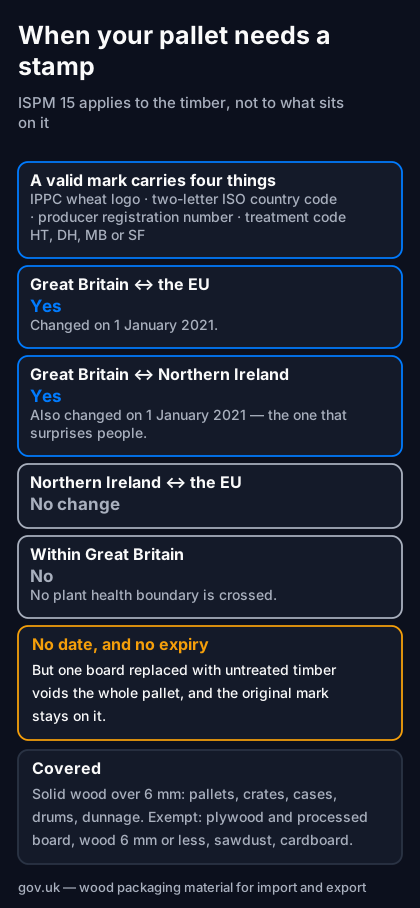
ISPM 15 applies to the pallet, not to what is on it, which is why consignments fail on it so often and so late. A pallet of perfectly documented goods can be stopped at a border because one broken board was replaced with an untreated offcut. Since 1 January 2021 the rule reaches movements from Great Britain to the EU and to Northern Ireland, both of which were exempt before. This sets out what is covered, what the mark must show, and the four checks worth doing before anything is loaded.
What is ISPM 15?
ISPM 15 is the international standard that stops timber packaging carrying forest pests across borders. The initials stand for International Standard for Phytosanitary Measures No. 15, issued under the International Plant Protection Convention, and it works by requiring solid wood packaging to be treated and then marked to prove it.
It is a plant health measure, not a customs or a safety one, and that distinction explains most of its behaviour. It attaches to the packaging rather than to the goods, so a consignment of steel can fail on its pallet while the steel itself is unremarkable. It applies at plant health boundaries rather than at tax boundaries, which is why it says nothing about a domestic job and a great deal about a movement to Dublin.
Which packaging is covered, and what is exempt?
Solid wood in, processed wood out. The gov.uk guidance draws the line on whether the material is raw timber and how thick it is.
| Covered | Exempt |
|---|---|
| Pallets, box pallets, pallet collars and other load boards | Processed, non-solid material such as plywood |
| Packing cases, boxes and crates | Raw wood 6 mm thick or less |
| Drums and similar containers | Barrels for wines and spirits |
| Dunnage — loose wood used to protect goods and their packaging | Gift boxes made from processed wood |
| — | Sawdust, shavings and cardboard |
Pallet dimensions are irrelevant to this: a quarter pallet and a full Euro pallet are judged identically, on the timber rather than the footprint. Dunnage is the one that catches people out. Battens wedged in to stop a load shifting are packaging for this purpose even though nobody ordered them and nobody will keep them, and a compliant pallet carrying non-compliant chocks is a non-compliant consignment.
What treatments are accepted?
Four, with parameters set by the standard rather than by the treatment provider. Heat is overwhelmingly the common one in the UK.
| Treatment | Code | Parameters |
|---|---|---|
| Heat treatment | HT | 56°C for at least 30 continuous minutes throughout the entire profile, including the core |
| Dielectric heating | DH | 60°C for one continuous minute throughout the profile, for wood not exceeding 20 cm across its smallest dimension |
| Methyl bromide fumigation | MB | Fumigation; being withdrawn in many markets on environmental grounds |
| Sulphuryl fluoride fumigation | SF | Fumigation |
Note what heat treatment measures. It is 56°C at the core for thirty continuous minutes, not 56°C in the kiln for thirty minutes, and a thick block takes considerably longer in the oven to reach that condition than a thin board. Kiln drying is not the same process and does not by itself satisfy the standard, although the two are routinely combined.
What does the mark have to show?
Four elements, and a mark missing any of them is not a valid mark. It must appear on at least two opposite sides of the item, be legible and permanent, and must not be handwritten.
- The IPPC logo — the stylised wheat symbol that identifies the scheme.
- The two-letter ISO country code, assigned by the National Plant Protection Organisation of the country concerned — in the UK, the UK Wood Packaging Material Marking Programme.
- The registration number of the producer or treatment provider.
- The treatment code: HT, DH, MB or SF.
What the mark does not carry is a date. There is no expiry on ISPM 15 treatment, so a correctly marked pallet from several years ago is still compliant provided it has not been repaired with untreated timber. Repair is the quiet failure mode: replacing one broken board with a plain offcut invalidates the whole pallet, and the original mark stays on it looking entirely convincing.
Does ISPM 15 apply to a UK domestic delivery?
No. A pallet moving from Birmingham to Glasgow crosses no plant health boundary, and nothing in the standard applies to it. Untreated, unmarked, repaired, improvised — from a phytosanitary standpoint none of it matters on a domestic job.
The same goes for the rest of the domestic chain — a pallet or a parcel, a full load or a part load, none of it changes the answer within Great Britain. This is worth stating plainly because over-compliance costs real money here. Treated pallets command a premium, and buyers who have been told "we only use ISPM 15 pallets" as a blanket policy are frequently paying it on consignments that will never leave the country. The question is not whether a pallet is good practice. It is whether the consignment crosses a boundary where plant health rules bite, and most UK consignments do not.
When does it apply to a movement involving the UK?
Since 1 January 2021 the answer changed for Great Britain, and it changed in a direction that caught exporters who had spent twenty years not thinking about it. Before that date, wood packaging moving within the EU was exempt; afterwards, Great Britain sits outside that exemption.
| Movement | ISPM 15 required? |
|---|---|
| Great Britain to or from the EU | Yes, since 1 January 2021 |
| Great Britain to or from Northern Ireland | Yes, since 1 January 2021 |
| Northern Ireland to or from the EU | No change from 1 January 2021 |
| Within Great Britain | No |
The Great Britain to Northern Ireland row is the one that surprises people, because it feels like a domestic movement and is priced like one. For wood packaging it is treated as a crossing, and a pallet that would be fine going to Carlisle is not fine going to Belfast. Our UK to Ireland pallet work runs into this constantly.
What happens if the packaging is not compliant?
The consignment is dealt with at the border rather than waved through with a warning, and the options available to the authorities all cost the importer money and time. Non-compliant wood packaging may be refused entry, required to be treated, re-exported or destroyed, and the goods inside travel wherever the packaging goes.
That last point is the expensive one. The pallet is the problem but the pallet is not what is being held. A time-critical consignment stopped over its dunnage is just as stopped as one stopped over its paperwork, and the remedy — repacking onto compliant timber at a border location, under supervision — is slower and dearer than getting it right before loading. There is no equivalent of a post-clearance correction here.
What if the packaging is arriving rather than leaving?
The same standard applies in the other direction, and the exposure sits with whoever is importing. Wood packaging entering Great Britain from the EU has needed to comply since 1 January 2021 in exactly the way it does leaving, so a supplier who has never had to think about it may be shipping on timber that was perfectly legal for twenty years of intra-EU trade and is not legal now.
That is worth raising with suppliers before a first shipment rather than after one. The cost of non-compliance falls where the goods are stopped, which means an importer can be paying to treat, re-export or destroy packaging it never chose. A line in the purchase order requiring ISPM 15 marked timber on all deliveries, with the four mark elements named, is cheaper than any of the alternatives — and it gives you something to point at when a pallet turns up bare.
Inbound or outbound, the test is the same: solid wood over 6 mm, crossing a plant health boundary, marked on two opposite sides. Only the party who pays for getting it wrong changes.
How do you check a pallet before it is loaded?
Four checks, none of which needs equipment, all of which take about a minute per pallet.
- Find the mark on at least two opposite sides. One side only is not compliant, and a mark on the top deck boards where a forklift has scraped it is a common failure.
- Confirm all four elements are present: logo, country code, producer number, treatment code.
- Look at every board for repairs. Fresh untreated timber against weathered treated timber is usually obvious by colour, and one replacement board voids the pallet.
- Check the dunnage, chocks and bracing separately, because they are packaging too and they rarely carry a mark at all.
If a consignment is going onto a vehicle bound for the EU or Northern Ireland and any of those four fails, the time to find out is in your own warehouse. Compliance here is a property of the timber, and no amount of documentation fixes a plain offcut.
What does your carrier need to know?
That the movement crosses a plant health boundary, and that the packaging has been checked — before the vehicle is allocated rather than when it arrives. We carry what is presented to us: we do not treat timber, we do not supply treated pallets, and nothing can be done at the kerb to make a non-compliant pallet compliant.
Tell us the destination, whether the load is palletised or crated, and whether loose timber is used for bracing. Where a consignment also needs customs work, ISPM 15 sits alongside it rather than inside it: the commodity code and the CMR note describe the goods, while the standard applies to the wood they are sitting on. Our pallet size guide covers how many of them fit in which vehicle, and the pallet delivery page covers the service itself.
Questions
- Do I need ISPM 15 pallets for a UK domestic delivery?
- No. ISPM 15 is a plant health measure that applies when wood packaging crosses a plant health boundary, and a movement within Great Britain crosses none. Untreated and unmarked pallets are entirely acceptable on a domestic job. This is worth checking against your own purchasing policy, because treated pallets carry a premium and blanket policies frequently pay it on consignments that never leave the country.
- Does ISPM 15 apply between Great Britain and Northern Ireland?
- Yes, since 1 January 2021. Wood packaging moving between Great Britain and Northern Ireland must be treated and marked to ISPM 15, even though the movement feels domestic and is usually priced like one. Movements between Northern Ireland and the EU saw no change from that date. A pallet that would be fine travelling to Carlisle is not fine travelling to Belfast, which is the single most common surprise in this area.
- Does an ISPM 15 mark expire?
- No. There is no date on the mark and no expiry on the treatment, so a correctly marked pallet from several years ago remains compliant. The thing that invalidates it is repair: replacing a broken board with untreated timber voids the whole pallet while the original mark stays in place looking entirely convincing. Checking the boards for fresh, unweathered timber is more useful than checking the age of the mark.
- What temperature and time does heat treatment require?
- 56°C for at least 30 continuous minutes, measured throughout the entire profile of the wood including its core. The core is the operative word: 56°C in the kiln for thirty minutes does not satisfy the standard if the centre of a thick block never reached it. Dielectric heating is a separate schedule requiring 60°C for one continuous minute, and applies to wood not exceeding 20 cm across its smallest dimension.
- What must the ISPM 15 mark show?
- Four elements: the IPPC wheat logo, the two-letter ISO country code assigned by the National Plant Protection Organisation, the registration number of the producer or treatment provider, and the treatment code — HT for heat treatment, DH for dielectric heating, MB for methyl bromide or SF for sulphuryl fluoride. It must appear on at least two opposite sides, be legible and permanent, and must not be handwritten.
- Is plywood packaging covered by ISPM 15?
- No. Processed, non-solid wood packaging such as plywood is exempt, as is raw wood 6 mm thick or less, along with barrels for wines and spirits, gift boxes made from processed wood, sawdust, shavings and cardboard. The exemption rests on the manufacturing process having already destroyed any pests, which is why engineered board is treated differently from sawn timber of the same thickness.
- What happens if wood packaging arrives non-compliant?
- It is dealt with at the border rather than waved through. Non-compliant wood packaging may be refused entry, required to be treated, re-exported or destroyed, and the goods inside travel wherever the packaging goes. A time-critical consignment stopped over its dunnage is as stopped as one stopped over its paperwork, and repacking onto compliant timber at a border location under supervision is slower and dearer than checking before loading.