
When your load is too big for a van: abnormal loads and who to call
A load stops being a van job at whichever comes first of weight, footprint or the ability to get it on and off — and most senders are caught by the second two. Past the ordinary construction and use limits a movement becomes an abnormal load, which means notification, route surveys and lead times measured in weeks. This sets out where the line falls, how project cargo differs, and the question worth asking first: can it be split?
When does a load stop being a van job?
At three limits, and the first one reached decides it: weight, footprint, or the ability to get it on and off. Most senders think about weight and are caught by the other two.
| Limit | Typical van ceiling | What happens past it |
|---|---|---|
| Gross vehicle weight | 3.5 tonnes, of which the payload is a fraction | 7.5-tonne or HGV, and an Operator's Licence |
| Single item length | Bounded by the load space, not the vehicle | Luton, box van or flatbed |
| Single item weight | What a tail lift and one person can manage | Forklift, crane or a Moffett-equipped vehicle |
| Width and height | Within the body | Flatbed, low loader, and possibly notification |
The practical sequence is to measure the largest single item first, because a consignment splits across vehicles but an indivisible item does not. Four pallets can go as two journeys; a six-metre steel beam cannot.
What counts as an abnormal load?
A load that cannot be carried within the ordinary construction and use limits for vehicles, at which point it moves out of the normal regime and into the special types regime.
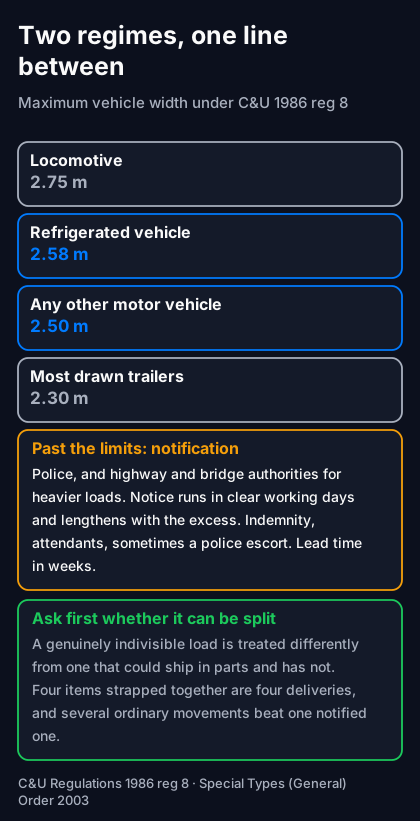
Those ordinary limits are set by the Road Vehicles (Construction and Use) Regulations 1986, and regulation 8 fixes maximum vehicle widths: 2.5 metres for a general motor vehicle, 2.58 metres for a refrigerated vehicle, 2.75 metres for a locomotive, and 2.3 metres for most trailers drawn by something other than a motor cycle.
Anything the regulations cannot accommodate runs instead under the Road Vehicles (Authorisation of Special Types) (General) Order 2003, usually shortened to STGO. That order is what makes a load lawful that would otherwise not be, and it comes with conditions attached rather than being a simple exemption.
What does the special types regime require?
Notification, and the point of it is that other people need to plan around you.
- The police are notified, because the movement affects traffic.
- Highway and bridge authorities are notified for heavier loads, because structures have to be checked.
- Notice periods run in clear working days and lengthen as the load exceeds the limits by more.
- An indemnity may be required for damage to the road or structures.
- Attendants or escorts may be required, and for the largest movements a police escort.
The operator handles all of it, and it is why abnormal load work is booked in weeks rather than hours. A movement that needs a bridge assessment and a route survey cannot be arranged the same afternoon, and an operator who says it can is one to be sceptical of.
Route planning is the real work. The question is not whether a vehicle can carry the load but whether a specific route can take the vehicle — headroom under bridges, swept paths at roundabouts, weight restrictions, and overhead cables.
How is project cargo different?
Project cargo is defined by the complexity of the operation rather than by any dimension. An abnormal load is a legal classification; project cargo is a job that needs engineering, and the two overlap without being the same thing.
| Abnormal load | Project cargo | |
|---|---|---|
| Defined by | Exceeding statutory limits | Complexity, value and coordination |
| Typical trigger | Width, length or weight | Lifting, multiple modes, a fixed installation date |
| Core skill | Route survey and notification | Lift planning, sequencing, method statements |
| Who runs it | Heavy haulage operator | Project forwarder or specialist contractor |
| Lead time | Weeks | Weeks to months |
A transformer going to a substation is both. A tall but light exhibition structure going to a venue with a booked crane slot is project cargo and not an abnormal load — see exhibition and events logistics for that case. A single wide steel section is an abnormal load and not a project.
Can the load be split instead?
Ask this before anything else, because the answer frequently removes the whole problem and the saving is large.
The regulations draw a hard line around indivisible loads. A load that genuinely cannot be divided without disproportionate expense or risk of damage is treated differently from one that could be shipped in parts and simply has not been. If your consignment is four items that happen to be strapped together, it is not an abnormal load; it is four deliveries.
Where splitting is possible the economics usually favour it decisively. Several ordinary vehicle movements with no notification, no escort and no route survey will normally beat one notified movement, and they can be booked in days rather than weeks.
What does it cost, and why the gap?
Several times an ordinary movement of the same distance, and the gap is almost entirely in the work that happens before a wheel turns.
| Cost sits in | Ordinary HGV job | Abnormal load |
|---|---|---|
| Route planning | A satnav | A survey of bridges, swept paths and headroom |
| Notification | None | Police and, for heavier loads, highway authorities |
| Vehicle | Standard trailer | Low loader, extendable or multi-axle |
| People | One driver | Driver, attendants, sometimes an escort |
| Timing | Any working day | Often night or off-peak, by condition |
Because the fixed costs dominate, the price does not scale with distance the way ordinary haulage does. A short abnormal movement is expensive out of proportion to its mileage, and that is worth knowing before you assume a twenty-mile job will be cheap.
It also means a second identical movement on the same route costs much less than the first, since the survey already exists. Where a project involves several similar loads, say so at the quoting stage rather than booking them one at a time.
What about the destination?
Site access decides more abnormal load jobs than the public road does, and it is assessed separately.
- The final approach — gate width, turning circle, and whether a long vehicle can swing in.
- Ground bearing, because a loaded multi-axle trailer on soft ground sinks.
- Overhead — cables, canopies, branches on the last hundred metres.
- The lift, and whether the crane has room to set up and outrigger.
- Somewhere to wait, since a notified movement arrives in a window, not on the minute.
Ground bearing is the one that catches new sites. A road that carries ordinary lorries will not necessarily carry 80 tonnes on a short wheelbase, and the damage is to the road as much as to the schedule — which is why an indemnity is often part of the notification in the first place.
What should you establish before calling anyone?
Five numbers and one fact, and an operator cannot quote without them.
- Dimensions of the largest single item — length, width and height, as it will travel.
- Its weight, and whether that is known or estimated.
- Whether it is genuinely indivisible.
- How it will be lifted at each end, and by whom.
- The delivery date, and how much of it is fixed.
- Access at both ends — gradients, surfaces, gate widths, overhead obstructions.
Access is the one most often left until last and most often fatal. A load that travels perfectly for 200 miles and cannot turn into the final yard has failed as completely as one that never left.
Who should carry it?
A heavy haulage operator for an abnormal load, a project forwarder for project cargo, and a crane contractor where the lift is the hard part. The selection question is which of those three the job actually is.
| If the difficulty is | Call |
|---|---|
| The load exceeds statutory limits | A heavy haulage operator with STGO experience |
| Coordination across modes and dates | A project forwarder |
| Getting it on and off | A crane or heavy-lift contractor |
| It is simply heavy but within limits | An ordinary HGV operator; this is not abnormal at all |
That last row catches a lot of enquiries. A heavy pallet is not an abnormal load, and buying heavy haulage for it is paying for notification and route survey that the job does not need. The quick test is whether any single dimension or the gross weight exceeds what an ordinary vehicle may lawfully carry. If none does, the load is heavy rather than abnormal, and an ordinary operator with the right trailer is both faster and very much cheaper.
Where do we stop?
At 3.5 tonnes. T&C Logistics runs dedicated vehicles at or under that weight and holds no Operator's Licence; HGV work requiring one is carried out by partner carriers operating their own vehicles under their own licence. We do not do abnormal loads, heavy haulage or project cargo, and we are not the people to ask about a route survey.
What we are for is the part of the same job that is van-sized and urgent: a component, a replacement part, a tool, a document, a sample that has to be there before the crane arrives. That work frequently sits alongside a project without being part of the heavy movement.
Everything we hold, and the public register that proves it, is on our licences page, including the list of what we do not. For the loads that do fit, see tail lifts, abnormal loads and project cargo for the definitions, and the Luton van for the largest vehicle we run.
Questions
- What counts as an abnormal load?
- A load that cannot be carried within the ordinary limits of the Road Vehicles (Construction and Use) Regulations 1986. Regulation 8 fixes maximum vehicle widths at 2.5 metres for a general motor vehicle, 2.58 metres for a refrigerated vehicle, 2.75 metres for a locomotive and 2.3 metres for most trailers drawn by something other than a motor cycle. Beyond what the regulations accommodate, the movement runs under the Special Types Order 2003 instead.
- What does moving an abnormal load involve?
- Notification, so that other people can plan around the movement. The police are notified because it affects traffic, and highway and bridge authorities for heavier loads because structures have to be checked. Notice periods run in clear working days and lengthen as the load exceeds the limits by more. An indemnity may be required, and attendants, escorts or a police escort for the largest movements.
- How long does an abnormal load movement take to arrange?
- Weeks, not hours. The notification periods alone rule out same-day arrangement, and the real work is route planning: whether a specific route can take the vehicle, meaning headroom under bridges, swept paths at roundabouts, weight restrictions and overhead cables. A movement needing a bridge assessment and route survey cannot be arranged the same afternoon, and an operator who says it can is one to be sceptical of.
- What is the difference between an abnormal load and project cargo?
- An abnormal load is a legal classification — the load exceeds statutory limits, so the core skill is route survey and notification and a heavy haulage operator runs it. Project cargo is defined by complexity, value and coordination rather than any dimension, so the core skill is lift planning and sequencing and a project forwarder runs it. They overlap: a transformer going to a substation is both, a single wide steel section is only the first.
- Can I split an oversized load instead?
- Ask this first, because the answer often removes the problem entirely. The regulations treat a genuinely indivisible load — one that cannot be divided without disproportionate expense or risk of damage — differently from one that could ship in parts and simply has not. If your consignment is four items strapped together it is four deliveries, not an abnormal load, and several ordinary movements with no notification or escort normally beat one notified movement on both cost and lead time.
- What information does a heavy haulage operator need?
- The dimensions of the largest single item as it will travel, its weight and whether that is known or estimated, whether it is genuinely indivisible, how it will be lifted at each end and by whom, the delivery date and how much of it is fixed, and access at both ends — gradients, surfaces, gate widths and overhead obstructions. Access is left until last most often and is fatal most often.
- Do you move abnormal loads?
- No. T&C Logistics runs dedicated vehicles at or under 3.5 tonnes and holds no Operator's Licence; HGV work requiring one is done by partner carriers under their own licence. We do not do abnormal loads, heavy haulage or project cargo. What we do is the van-sized urgent part of the same job — a component, a tool, a document or a sample that has to arrive before the crane does.