
Tail lifts: what one will actually lift, and whether you need it
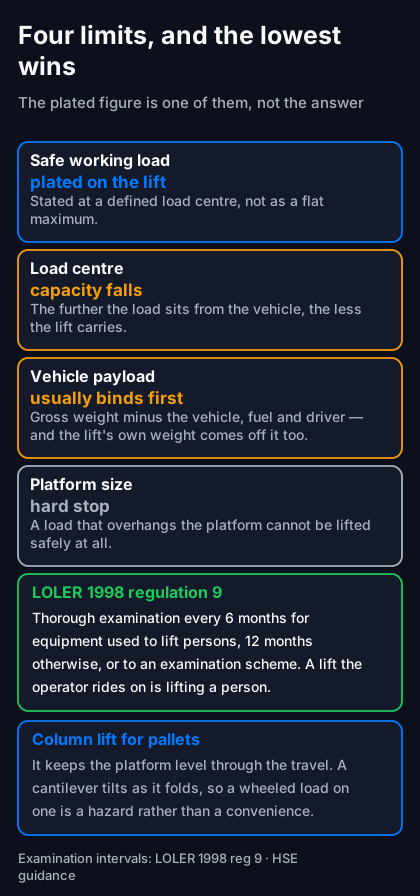
A tail lift raises a load from ground level to deck height, and it is what makes a delivery possible at an address with no loading dock. What it will actually lift is lower than the headline figure: the safe working load is plated on the lift, it falls as the load moves away from the vehicle, and on a van the payload usually binds first. This covers the four types, the LOLER examination intervals, and when you do not need one at all.
What does a tail lift actually do?
A tail lift is a powered platform at the rear of a vehicle that raises a load from ground level to deck height, so that goods too heavy to lift by hand can be loaded without a forklift at either end. It is the single piece of equipment that decides whether a delivery works at an address with no loading dock.
That is the whole case for it. A dock-height warehouse needs no tail lift because the floors already line up. A shop, a house, a building site or a car park has no dock, and without a lift the goods have to come off by hand — which for a pallet of anything dense is not a staffing problem, it is an impossibility.
What will a tail lift lift?
Less than its headline figure, and the number that governs is on a plate fixed to the lift itself. Three limits apply at once and the lowest one wins.
| Limit | Where it comes from |
|---|---|
| Safe working load (SWL) | Plated on the lift, stated at a defined load centre |
| Load centre derating | Capacity falls as the load sits further from the vehicle |
| Vehicle payload | Gross vehicle weight minus the vehicle itself, fuel and driver |
| Platform size | A load that overhangs the platform cannot be lifted safely at all |
The derating row is the one that surprises people. A lift rated at its SWL assumes the load is close in to the vehicle; the same lift carries materially less when the load sits at the outer edge of the platform, because the moment on the lift arms grows with the distance. A heavy, compact item near the deck is a different proposition from the same weight spread to the platform edge.
In practice the vehicle's payload is the limit that bites first on a van. Our payload and gross vehicle weight article covers why a 3.5-tonne van carries far less than a tonne and a half, and the tail lift's own weight is part of the reason.
What are the different types?
Four, and the choice is about where the vehicle has to go rather than what it carries.
| Type | How it works | Suits |
|---|---|---|
| Column | Platform runs up two vertical columns | Heavier loads, pallet work, stays level throughout |
| Cantilever | Folds out and down on arms | General distribution; the platform can double as a rear door |
| Tuck-away | Folds and slides under the chassis | Vehicles that also need dock access or a towbar |
| Slider | Retracts under the body | Low ground clearance and tight kerbside work |
Column lifts keep the platform horizontal through the whole travel, which is what makes them the pallet-truck choice. A cantilever lift tilts as it folds, so a wheeled pallet truck on an unlevel platform is a hazard rather than a convenience.
Tuck-away and slider types exist because a folded cantilever lift blocks the rear of the vehicle. If the same vehicle has to reverse onto a dock later in the day, the lift has to get out of the way.
Can a pallet truck go on the platform?
On a column lift usually yes, on a cantilever usually no, and the decisive factor is whether the platform stays level and whether it has edge protection.
A loaded pallet truck on a platform is a heavy object on wheels a metre or more above a hard surface. Column lifts are specified for this with roll-stops at the outer edge that raise automatically; a platform without them is not a place to put a wheeled load, however careful the operator.
The second question is the ground. A pallet truck needs a firm, level, hard surface to run on once it is down — gravel, grass, a steep camber or a dropped kerb all defeat it. A tail lift gets a pallet to the ground; it does not get it across a car park.
How often must a tail lift be examined?
Every 6 or 12 months depending on what it lifts, under regulation 9 of LOLER 1998.
- Every 6 months for lifting equipment used to lift persons, and for accessories for lifting.
- Every 12 months for other lifting equipment.
- Or in accordance with an examination scheme drawn up by a competent person, in either case.
- Additionally, each time exceptional circumstances liable to jeopardise safety have occurred.
A tail lift the operator rides on is lifting a person, so it falls in the six-month bracket. A goods-only lift is a twelve-month item. The distinction is about use rather than design, which is why the same lift can sit in either category depending on how it is worked.
Regulation 9(4) adds the part that matters commercially: lifting equipment must not leave an undertaking, or be used in one, without physical evidence that the last required thorough examination has been carried out. HSE guidance covers the duty in full. If a site asks to see the certificate, that is not bureaucracy — it is the regulation.
What is the driver allowed to do?
Operate the lift, if trained on it; and beyond that, it depends on the site rather than on the law.
Tail lift operation is a trained task, not an intuitive one, and the hazards are specific: feet under a descending platform, loads that shift as the platform meets the ground, and bystanders who walk into the arc. Many delivery sites bar anyone but the driver from the platform area for exactly this reason.
Whether the driver then moves the goods onwards is a separate question and a common source of dispute. A tail lift delivery is normally to the tail of the vehicle at ground level. Carrying goods into a building, upstairs or into a room is a different service with different risks, and it has to be agreed at booking rather than negotiated on the doorstep. Our white glove delivery page covers the version where it is included.
What slows a tail lift delivery down?
The cycle time, and it is longer than people budget for. A tail lift moves one platform-load at a time, and each cycle is load, lower, unload, raise, repeat.
| Step | Why it takes time |
|---|---|
| Positioning the vehicle | The platform needs clear, level ground behind it |
| Coning or signing | On a public road the working area has to be protected |
| Each platform cycle | One pallet at a time, both directions |
| Moving goods clear | The platform must be empty before it can rise again |
Four pallets on a tail lift is not four times a dock unload, it is considerably more, which is why waiting time on tail lift work runs longer than on dock-to-dock movements. Our waiting time article covers how that is charged and why it is charged separately.
The ground behind the vehicle is the constraint most often discovered on arrival. A platform cannot land on a kerb, a slope, a drain cover that will not take the load, or a parked car, and the delivery address that works perfectly at 06:00 may be impossible at midday.
What should you tell the carrier at booking?
Five things, and a carrier given them quotes the right vehicle first time instead of sending the wrong one.
- The heaviest single item and its footprint, not the total consignment weight.
- Whether it is on a pallet, and whether the pallet is standard size.
- What equipment exists at each end — dock, forklift, both, neither.
- The ground behind the delivery point: surface, gradient, kerb, obstructions.
- Where the goods have to end up, if it is not the tail of the vehicle.
Point three is the one that decides the price, because a tail lift vehicle costs more than a standard van and a job that does not need one should not be paying for one. Point five is the one that decides the dispute, because it is the only item on the list that is about scope rather than equipment.
When do you not need one?
More often than the question suggests, and establishing this before booking saves paying for capability you cannot use.
| At both ends you have | Then |
|---|---|
| A loading dock at deck height | No lift needed; the floors line up |
| A forklift or telehandler | No lift needed; the site unloads you |
| Items one person can carry | No lift needed; a standard van is cheaper |
| A pallet, no dock, no forklift | Lift required, and it decides the vehicle |
The fourth row is the real case, and it has to be true at both ends. A tail lift at collection and a forklift at delivery is fine; a forklift at collection and nothing at delivery still needs the lift, because the vehicle only has the equipment it leaves with.
Do you hire out tail lift vans?
No. A large share of the search for this is hire intent — people looking to rent a Luton with a lift and drive it themselves — and we are not a vehicle hire company. For that, a van hire firm is the right call and we will say so.
What we do is the driven job: a vehicle with a tail lift, a trained driver, collection and delivery to the tail of the vehicle at ground level, quoted as one price. The decision you need to make before booking anyone is the one in the table above, plus the weight and footprint of the heaviest single item.
Our tail lift van page sets out the vehicle, tail lift against no tail lift the comparison, and the glossary entry the definition. For loads that will not fit a van at all, see when your load is too big for a van.
Questions
- How much weight can a tail lift carry?
- Less than its headline figure, and the governing number is plated on the lift itself. Four limits apply at once and the lowest wins: the plated safe working load, the derating that happens as the load sits further from the vehicle, the vehicle's own payload, and the platform size. On a van the payload usually binds first — and the tail lift's own weight is part of why a 3.5-tonne van carries so much less than its gross weight suggests.
- What are the types of tail lift?
- Four. A column lift runs the platform up two vertical columns and keeps it level throughout, which suits pallets. A cantilever folds out and down on arms and can double as a rear door. A tuck-away folds and slides under the chassis so the vehicle can still use a dock or a towbar. A slider retracts under the body for low ground clearance and tight kerbside work. The choice is about where the vehicle must go, not what it carries.
- Can you put a pallet truck on a tail lift?
- On a column lift usually yes, on a cantilever usually no. The decisive factors are whether the platform stays level through its travel and whether it has automatic roll-stops at the outer edge. A loaded pallet truck is a heavy wheeled object a metre above hard ground, so a tilting platform without edge protection is not a place to put one. The ground at the bottom matters too — gravel, grass or a camber defeats a pallet truck.
- How often does a tail lift need a thorough examination?
- Every six months if it is used to lift persons, or twelve months for other lifting equipment, under regulation 9 of LOLER 1998 — or in accordance with an examination scheme drawn up by a competent person, and additionally after any exceptional circumstances liable to jeopardise safety. A tail lift the operator rides on is lifting a person, so it sits in the six-month bracket; a goods-only lift is a twelve-month item.
- Does a tail lift delivery include carrying goods inside?
- Not normally. A tail lift delivery is to the tail of the vehicle at ground level. Carrying goods into a building, upstairs or into a room is a different service with different risks and has to be agreed at booking rather than negotiated on the doorstep. Many sites also bar anyone but the driver from the platform area, because the hazards — feet under a descending platform, loads shifting as it grounds — are specific.
- When do I not need a tail lift?
- When both ends have a loading dock at deck height, or a forklift or telehandler, or when the items are light enough for one person to carry. It has to be true at both ends: a forklift at collection and nothing at delivery still needs the lift, because the vehicle only has the equipment it leaves with. A pallet with no dock and no forklift at either end is the case that genuinely requires one.
- Do you hire out vans with tail lifts?
- No — we are not a vehicle hire company, and a large share of the search for this is people wanting to rent a Luton with a lift and drive it themselves. For that, a van hire firm is the right call. What we provide is the driven job: a vehicle with a tail lift, a trained driver, collection and delivery to the tail of the vehicle at ground level, quoted as one price.
Explore more
More from the blog
- Bill of lading or CMR note: which one your shipment…
- Cabotage after Brexit: two jobs in, one job out
- Clinical trial logistics: who owns the obligation,…
- The CMR note: what it covers, and what it actually…
- The commercial invoice: what your customs declarati…
- Construction site deliveries: what the site demands…