
Cabotage after Brexit: two jobs in, one job out
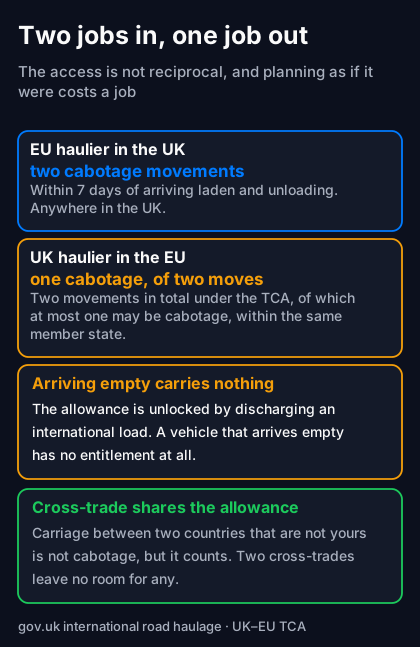
An EU haulier may do two cabotage jobs in the United Kingdom within seven days of unloading an international load. A UK haulier in the EU gets two movements of which at most one may be cabotage, within a single member state. The access is not reciprocal, and a UK operator planning European work on the assumption that it mirrors the inbound position plans one job too many. This sets out both allowances, what cross-trade does to them, and what changed for vans on 1 July 2026.
What is cabotage?
Cabotage is the carriage of goods between two points inside a country by an operator based somewhere else — a Dutch lorry collecting in Birmingham and delivering in Leeds, or a British lorry collecting in Lyon and delivering in Marseille. It is domestic carriage performed by a foreign vehicle.
Every country restricts it, for an obvious reason: unrestricted cabotage lets an operator with lower costs compete in a domestic market without being subject to that market's whole cost base. The restrictions are therefore about how many domestic jobs a visiting vehicle may do before it has to leave, and the arithmetic differs depending on which direction you are going.
What may an EU haulier do in the United Kingdom?
Up to two cabotage movements, within seven days of arriving laden and unloading the international load. After those two, the vehicle must leave the UK — empty, or with a load heading back towards the EU.
Two movements, seven days, and the clock is documentary rather than discretionary — a vehicle must be able to show the date it discharged the inbound load. The sequence matters as much as the count. The entitlement is triggered by arriving with an international load and discharging it; a vehicle that arrives empty has no cabotage entitlement at all. The seven days run from that unloading, not from entry.
What may a UK haulier do in the EU?
Less, and this is the part most UK operators get wrong by assuming symmetry. Under the UK–EU Trade and Cooperation Agreement, a UK operator making a laden journey from the UK may perform two movements within the EU — cabotage or cross-trade — of which at most one may be cabotage, within the same member state and within seven days of completing the outward trip.
| EU operator in the UK | UK operator in the EU | |
|---|---|---|
| Movements allowed | Two cabotage | Two in total, cabotage or cross-trade |
| Of which cabotage | Both | One at most |
| Window | 7 days from unloading | 7 days from completing the outward trip |
| Where | Anywhere in the UK | Within the same member state |
The asymmetry is real and it is structural rather than an oversight: the TCA gave the EU side better access to the UK market than UK hauliers obtained in the EU. For a UK operator the practical consequence is that a European trip has to be planned around one domestic job, not two.
How is the entitlement counted?
Per vehicle and per inbound journey, not per operator and not per week. A second vehicle from the same company arriving laden the next day brings its own fresh allowance; the same vehicle returning empty brings none.
| Scenario | Cabotage entitlement |
|---|---|
| Arrives laden, unloads the international consignment | Full allowance, counted from that unloading |
| Arrives empty | None |
| Second vehicle, separate laden arrival | Its own full allowance |
| Same vehicle, allowance used, has not left | None until it leaves and returns laden |
That structure is why a planner thinking in terms of "how many jobs can my fleet do this week" gets the wrong answer. The unit is the vehicle and the journey it just completed.
What is cross-trade, and why is it counted separately?
Cross-trade is carriage between two different countries, neither of which is the operator's own — a UK vehicle loading in Belgium and delivering in Germany. It is not cabotage, because it is not domestic carriage, but the TCA counts it against the same allowance.
That shared allowance is what makes the planning awkward. A UK operator who does one cabotage movement in France has one movement left, and it can be a cross-trade but not a second cabotage. One who does two cross-trades has used the allowance entirely and may do no cabotage at all on that trip.
What happens if the limits are exceeded?
The vehicle is operating unlawfully in that country, and enforcement is a matter for the host state rather than the operator's own authorities. Penalties, immobilisation and loss of access are all available to the enforcing country, and a record of breaches bears on an operator's standing at home as well.
Evidence is the operator's responsibility and it is documentary: proof of the inbound international movement, with dates, is what establishes the entitlement in the first place. A vehicle stopped doing a domestic job in a foreign country with nothing to show how it got there has no defence available, because the entitlement is conditional on a journey that has to be proved.
This is one of the places where a CMR consignment note earns its keep: it dates and documents the international leg that unlocks the allowance.
What changed for vans on 1 July 2026?
Cabotage was named explicitly. From that date, a van between 2.5 and 3.5 tonnes maximum authorised mass used for international commercial carriage or for cabotage must be fitted with a second-generation smart tachograph and must follow the EU-style hours rules.
So a weight band that was previously outside the tachograph regime altogether is now inside it the moment the work becomes international or domestic-in-another-country. A van doing UK-only work is unaffected and continues under GB domestic rules. The drivers' hours article sets out what the two regimes require.
Does cabotage apply to Ireland and the Common Travel Area?
The Republic of Ireland is an EU member state, so the EU rules apply to it in full: a UK operator carrying into Ireland has the same two-movement, one-cabotage allowance there as anywhere else in the union. The Common Travel Area governs the movement of people, not the carriage of goods for hire and reward, and it confers no haulage rights.
That catches operators out more often than the continental cases, because the journey feels domestic. A vehicle running Liverpool to Dublin and then picking up Dublin to Cork has performed a cabotage movement in another country, with everything that implies for the allowance and for the evidence. Our UK to Ireland pallet work is structured as point-to-point international carriage for exactly that reason.
Northern Ireland is a different case again, because it is part of the United Kingdom. A movement from Great Britain to Northern Ireland is domestic for cabotage purposes and involves no allowance at all — while still potentially requiring a customs process, which is the next question.
Does cabotage apply to Northern Ireland?
It applies in the ordinary way, but the customs position alongside it does not, and the two are separate questions that get conflated. Cabotage is about who may carry goods domestically; the Windsor Framework arrangements are about what customs process the goods themselves need.
A movement can therefore be unremarkable for cabotage purposes and still require a customs process, or the reverse. Treating them as one question is how operators discover a declaration requirement they had not planned for, or a vehicle entitlement they did not know they had used.
Why does an empty return leg matter so much?
Because the allowance is what turns a one-way international job into a viable round trip. A vehicle that carries a load out and returns empty has earned revenue on half its mileage; the cabotage and cross-trade allowance exists to let it earn on some of the other half.
The asymmetry therefore has a commercial consequence rather than only a regulatory one. A UK operator with one cabotage movement available has fewer ways to fill a return than an EU operator working the same corridor in reverse, which shows up in the rates each can quote for the same lane. Senders comparing a UK carrier against a continental one on price are frequently comparing two different allowances rather than two different levels of efficiency.
It is also why empty running persists on routes that look as though they should balance. The loads exist; the entitlement to carry them does not always.
What does this mean if you are the sender?
Three things, none of which require you to know the rules in detail, only to ask.
- A foreign vehicle already in the country may be the cheapest option, and it may also be at the end of its entitlement. A rate that looks unusually good on a domestic leg sometimes reflects a vehicle that needs a load to justify a journey it has to make anyway.
- A European trip with multiple domestic drops in one country is a planning question, not a pricing one. Under the TCA a UK operator gets one such movement, so a multi-drop domestic itinerary inside a member state needs a local carrier.
- Ask who is carrying, and where they are established. It determines which allowance applies and whether the plan is lawful.
We hold no Operator's Licence and do not run UK trucks on EU cabotage ourselves: HGV work requiring an operator licence is carried out by partner carriers under their own. Our own European road freight work is van-based and point to point, and the licences page lists what we hold. The gov.uk guidance on international road haulage is the authoritative source for permits and the current position, which has moved more than once since 2021.
Questions
- What is cabotage in road haulage?
- Carriage of goods between two points inside one country by an operator established somewhere else — a Dutch lorry collecting in Birmingham and delivering in Leeds, or a British lorry collecting in Lyon and delivering in Marseille. It is domestic carriage performed by a foreign vehicle, and every country restricts how much of it a visiting vehicle may do before it has to leave.
- How many cabotage jobs can an EU haulier do in the UK?
- Up to two, within seven days of arriving laden and unloading the international load. After those two movements the vehicle must leave the UK, either empty or with a load heading back towards the EU. The entitlement is triggered by arriving with an international load and discharging it, so a vehicle that arrives empty has no cabotage entitlement at all, and the seven days run from unloading rather than from entry.
- How many cabotage jobs can a UK haulier do in the EU?
- One, at most. Under the UK–EU Trade and Cooperation Agreement a UK operator making a laden journey from the UK may perform two movements within the EU — cabotage or cross-trade — of which no more than one may be cabotage, within the same member state and within seven days of completing the outward trip. The access is deliberately narrower than what EU operators have in the UK.
- What is the difference between cabotage and cross-trade?
- Cabotage is carriage between two points inside one country by a foreign operator. Cross-trade is carriage between two different countries, neither of which is the operator's own — a UK vehicle loading in Belgium and delivering in Germany. Cross-trade is not cabotage, but the TCA counts both against the same two-movement allowance, so two cross-trades leave no room for any cabotage on that trip.
- Do cabotage rules apply to vans?
- Yes, and since 1 July 2026 the compliance burden has grown. A van between 2.5 and 3.5 tonnes maximum authorised mass used for international commercial carriage or for cabotage must be fitted with a second-generation smart tachograph and follow EU-style drivers' hours. A van of the same weight doing only UK work is unaffected and continues under GB domestic rules.
- What happens if a haulier exceeds the cabotage limit?
- The vehicle is operating unlawfully in the host country, and enforcement belongs to that country rather than the operator's own authorities. Penalties, immobilisation and loss of access are all available, and a record of breaches bears on standing at home too. Evidence is the operator's responsibility: proof of the inbound international movement with dates is what establishes the entitlement, and a vehicle that cannot show it has no defence.
- Do cabotage rules affect Great Britain to Northern Ireland movements?
- Cabotage applies in the ordinary way, but it is a separate question from the customs process, and conflating the two causes problems. Cabotage governs who may carry goods domestically; the Windsor Framework arrangements govern what customs process the goods need. A movement can be unremarkable for cabotage and still require a declaration, or the reverse.