
Great Britain to Northern Ireland: what the rules actually say
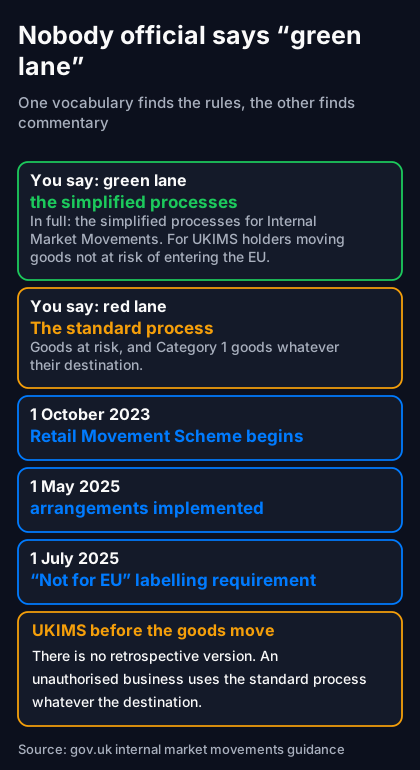
Everyone calls it the green lane and the red lane. The official guidance calls them the simplified processes for Internal Market Movements and the standard process, and uses no lane terminology at all — which is why searching one vocabulary finds forwarder commentary and searching the other finds the rules. The arrangements took their present shape on 1 May 2025. This sets out what UKIMS authorisation does, what an IMMI is, which goods are excluded whatever their destination, and what a Great Britain to Northern Ireland movement actually needs from a sender.
What is the Windsor Framework?
The Windsor Framework is the arrangement governing how goods move between Great Britain and Northern Ireland, agreed in February 2023 to replace the operation of the Northern Ireland Protocol. Its purpose is to let goods that will stay in the United Kingdom move with far less customs process than goods that might continue into the EU single market.
The current arrangements were implemented on 1 May 2025. That date matters more than the 2023 agreement date, because it is when the process a business actually follows settled into its present shape. Guidance written before it describes a system that has since changed.
Are there really a green lane and a red lane?
Not in the official language, and the mismatch causes genuine confusion. gov.uk does not use lane terminology at all. What exists are the simplified processes for Internal Market Movements, which is what people mean by the green lane, and the standard process, which is what they mean by the red lane.
| What people say | What the guidance calls it | Applies to |
|---|---|---|
| Green lane | Simplified processes for Internal Market Movements | Goods not at risk of entering the EU, moved by a UKIMS-authorised business |
| Red lane | The standard process | Goods at risk of entering the EU, and Category 1 goods |
Searching the lane language will find forwarder and accountancy commentary; searching the official language will find the guidance. Both describe the same system, and it is worth knowing which vocabulary you are reading so that a page written in one is not taken as contradicting a page written in the other.
What is UKIMS, and do you need it?
The UK Internal Market Scheme is the authorisation that lets a business use the simplified processes, and it has to be held before goods move. There is no retrospective version: a consignment moved by an unauthorised business goes through the standard process whatever its destination.
An authorised business can declare goods not at risk where they are brought into Northern Ireland for sale or final use by end consumers in Northern Ireland or Great Britain. That phrase does the work. The test is the destination of the goods in commercial reality, not the address on the delivery note, and a business that cannot evidence where its goods end up cannot sustain a not-at-risk declaration.
Applications are made through HMRC, and the authorisation carries record-keeping obligations that outlive the movement.
What is an IMMI, and when is it submitted?
Internal Market Movement Information is the simplified dataset that replaces a full customs declaration for a qualifying movement. It asks for materially less than a declaration, which is the practical benefit of the scheme — the saving is in data, not in the existence of paperwork.
There are two timings, and the choice is an operational one:
| Timing | How it works |
|---|---|
| Pre-movement | All the information for the movement is provided before the goods enter Northern Ireland |
| Post-movement | Submitted afterwards using the EIDR process, against records kept at the time |
Pre-movement suits consignments that need certainty at the port. Post-movement suits high-volume regular flows where stopping to file per load would be unworkable, and it trades that convenience for a stricter record-keeping regime.
Which goods cannot use the simplified processes?
Two categories, for two different reasons. Goods genuinely destined for the EU are at risk by definition and take the standard process, with the applicable EU rate of duty. Separately, Category 1 goods are excluded from the simplified processes outright and must move under the standard process regardless of where they are going.
So the question a sender has to answer is not only "where are these goods ending up" but also "are these goods in a category that is excluded anyway". Businesses that check only the first question find out about the second at the port.
Several of the regimes we have covered elsewhere intersect here. Wood packaging crossing GB to NI must comply with ISPM 15, which was not required before 1 January 2021, and that obligation is independent of which customs process the goods themselves use.
What records does the authorisation require?
Enough to prove the not-at-risk declaration was true, and that obligation runs long after the vehicle has unloaded. UKIMS is an authorisation with continuing conditions rather than a one-off registration, and the condition that matters is evidential: you declared goods were for end consumers in Northern Ireland or Great Britain, and you have to be able to show it.
In practice that means keeping the commercial trail that supports the declaration — who you sold to, what they did with the goods, and how the two connect to a specific movement. A business whose sales records cannot be tied back to individual consignments has an authorisation it cannot defend, which is a worse position than not having one, because the declarations have already been made.
This is the same shape as every other customs authorisation we have covered. Special procedures carry record-keeping obligations measured in years after the goods are disposed of, and the commercial invoice is usually the document that ties a movement to a sale. The authorisation is the easy part; the records are the work.
What about agri-food and retail goods?
They run under the Northern Ireland Retail Movement Scheme, which began operating on 1 October 2023 and covers pre-packaged retail agri-food moving from Great Britain to Northern Ireland. It replaces consignment-level certification with a scheme-level arrangement, which is why supermarket supply chains work at all.
The visible consequence is labelling. Products moving under the scheme carry "Not for EU" marking, phased in across product categories, with the broader labelling requirement taking effect on 1 July 2025. A retailer whose packaging predates that is a compliance problem rather than a transport problem, and it is not one a carrier can fix at a loading bay.
What changed for parcels?
Business-to-consumer parcels moved to a dedicated scheme on 1 May 2025, under which authorised carriers handle the information requirement so that consumers receiving parcels are not subject to customs declarations or duty. The obligation sits with the carrier rather than with the person who ordered the goods.
Business-to-business parcels are different and are treated as freight: they follow the same customs process as any other movement, which means a UKIMS-authorised business sending to another business can use the simplified processes, and one that is not authorised cannot. Firms that treated all parcels as consumer parcels because they fit in a van have been caught by this.
What does a GB to NI movement actually require of a sender?
Four things settled before booking, none of which a carrier can supply for you.
- UKIMS authorisation, or the acceptance that the standard process applies.
- A defensible not-at-risk position: evidence of where the goods end up, not an assertion.
- Whether the goods are Category 1, which excludes the simplified processes whatever the destination.
- Who submits the IMMI and when, pre-movement or post-movement.
The gov.uk guidance on internal market movements is the authoritative source and is updated as the scheme develops, which it still does. Commentary ages quickly here.
Why does so much guidance about this contradict itself?
Because the scheme has changed repeatedly and most commentary is not dated. The Northern Ireland Protocol, the February 2023 agreement, the October 2023 retail scheme and the May 2025 implementation are four different states of the same system, and an undated page describing any of them reads as current.
Three checks make the difference. Look for a date on the page and treat anything before 1 May 2025 as describing a superseded process. Check whether it uses lane language or the official terminology, because the lane language is almost always commentary. And where commentary and gov.uk disagree, gov.uk is the one that is maintained.
This matters more here than in most customs topics because the arrangements are still developing. A process that was right when a forwarder wrote about it in 2024 may simply not be the process now, and the cost of following the old one is a consignment stopped at a port rather than a correction made later.
What does this change about the transport?
Less than the paperwork suggests, and the difference is timing rather than handling. A GB to NI movement is a ferry sailing with a deadline, and the customs step has to be complete before the sailing rather than at it — so the controlling constraint is the information cut-off, not the drive.
We move goods between Great Britain and Northern Ireland as ordinary freight, with Belfast among the cities we cover across temperature-controlled, medical, hazardous and pallet work. We hold no customs-broker or customs-agent status, so the IMMI or declaration is submitted by you or your agent, and our part is getting the vehicle and the goods to the sailing with the paperwork already done.
Our Windsor Framework glossary entry covers the background, and the goods movement reference article covers the port mechanics that sit alongside it.
Questions
- Is there still a green lane and a red lane for Northern Ireland?
- The system exists but the names do not. gov.uk uses no lane terminology: what people call the green lane is the simplified processes for Internal Market Movements, and what they call the red lane is the standard process. Both describe the same arrangement, so a page using one vocabulary is not contradicting a page using the other. Searching the official language finds the guidance; searching the lane language finds commentary.
- Do I need UKIMS authorisation to send goods to Northern Ireland?
- You need it to use the simplified processes, and you need it before the goods move — there is no retrospective version. An unauthorised business moving goods to Northern Ireland uses the standard process whatever the destination. An authorised business can declare goods not at risk where they are brought into Northern Ireland for sale or final use by end consumers in Northern Ireland or Great Britain.
- What does 'not at risk' actually mean?
- That the goods are brought into Northern Ireland for sale or final use by end consumers in Northern Ireland or Great Britain, rather than continuing into the EU single market. The test is the commercial reality of where the goods end up, not the address on the delivery note. A business that cannot evidence the final destination of its goods cannot sustain a not-at-risk declaration if it is examined.
- What is an IMMI?
- Internal Market Movement Information: the simplified dataset that replaces a full customs declaration for a qualifying Great Britain to Northern Ireland movement. It requires materially less information than a declaration, which is the practical benefit of the scheme. It can be submitted pre-movement, with everything provided before the goods enter Northern Ireland, or post-movement using the EIDR process against records kept at the time.
- Which goods cannot use the simplified processes?
- Two sets. Goods genuinely destined for the EU are at risk by definition and take the standard process with the applicable EU rate of duty. Separately, Category 1 goods are excluded from the simplified processes outright and must move under the standard process regardless of destination. Checking only the destination question and not the category question is how businesses find out at the port.
- When did the current arrangements take effect?
- 1 May 2025 for the internal market movement arrangements and for the business-to-consumer parcels scheme. The Northern Ireland Retail Movement Scheme began operating earlier, on 1 October 2023, and the broader 'Not for EU' labelling requirement took effect on 1 July 2025. The Windsor Framework itself was agreed in February 2023, but the 2025 dates are when the process a business follows settled into its present shape.
- Do business-to-business parcels follow the consumer parcels scheme?
- No. Business-to-consumer parcels moved to a dedicated scheme on 1 May 2025 under which authorised carriers handle the information requirement, so the consumer faces no declaration or duty. Business-to-business parcels are treated as freight and follow the same customs process as any other movement. Firms that treated all parcels as consumer parcels because they fit in a van have been caught by that distinction.
Explore more
More from the blog
- The commercial invoice: what your customs declarati…
- Commodity Codes Explained: How to Classify UK Impor…
- Sending Large and Heavy Items by Courier: When a Pa…
- Customs Procedure Codes: What DE 1/10 and DE 1/11 A…
- Customs special procedures: inward processing, ware…
- Demurrage, detention and waiting time: three clocks…