
Customs special procedures: inward processing, warehousing and temporary admission
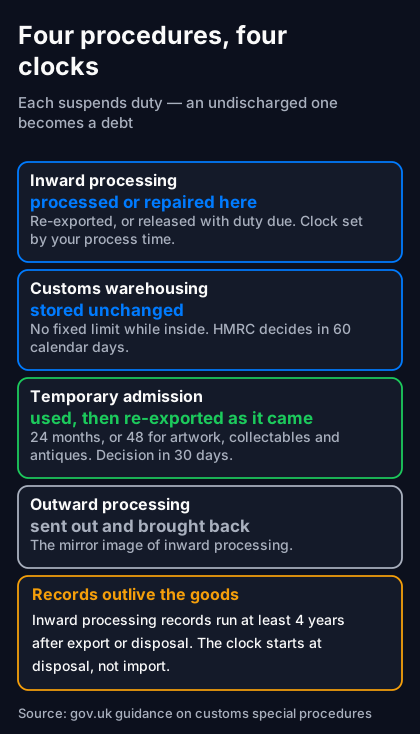
Four HMRC authorisations let goods enter the UK without paying full import duty and VAT, because they are not staying in the form they arrived in: inward processing for goods worked on here, customs warehousing for goods stored, temporary admission for goods used and taken away again, and outward processing for the reverse. Each has its own clock, and a procedure that is never discharged becomes a debt rather than lapsing quietly. This sets out what each does, the time limits, and what they change about moving the goods.
What are customs special procedures?
Customs special procedures are HMRC authorisations that let you delay, reduce or avoid import duty and VAT on goods that are not staying in the UK in their imported form. They exist because charging full import duty on goods that will be repaired and sent back, or stored and re-exported, taxes something that was never really imported in the commercial sense.
Each is a separate authorisation with its own application, its own conditions and its own clock. What they share is a structure: the goods enter under the procedure, something defined happens to them, and the procedure is discharged by re-export, by release to free circulation with duty paid, or by moving to another procedure. A procedure that is never discharged does not quietly lapse — it becomes a debt.
What does inward processing do?
Inward processing lets you delay or reduce import duty and VAT on goods you bring in to process or repair. If the processed goods are re-exported, no customs duty and no import VAT fall due. If you keep them in the UK, duty becomes payable — possibly at a reduced amount, where the duty rate on the processed product is lower than on what went in.
That last clause is the part worth understanding, because it turns the procedure from a cashflow tool into a duty-saving one. Importing a high-duty component, working it into a lower-duty finished article and then releasing that article to free circulation can cost less than importing the component outright. Which valuation applies is fixed at application, not chosen later.
How do you get authorised for inward processing?
Four routes, and they are not interchangeable.
| Route | Use |
|---|---|
| Full authorisation | Regular, ongoing processing work |
| Retrospective authorisation | Covering goods already imported, where HMRC accepts the case |
| Authorisation by declaration | Occasional use, declared on the import itself — security for duty and VAT is usually required |
| Authorisation covering Northern Ireland or EU sites | Where the processing happens across those locations |
A guarantee may be required against the duty and VAT being suspended, and for authorisation by declaration security is usually needed. Full authorisations run for up to five years, or three where the goods are sensitive. The application asks for the maximum time each process takes, which is how HMRC sets the window for discharging the procedure.
What is customs warehousing?
Customs warehousing lets you store non-UK goods with import duty and VAT suspended until they leave the warehouse. Charges fall due when the goods are released to free circulation, and not before, so stock can sit in the UK for months without the duty being paid on any of it.
There are two kinds, distinguished by whose goods are inside:
| Type | Stores |
|---|---|
| Public warehouse | Goods belonging to other people — the warehousekeeper and the depositors are different businesses |
| Private warehouse | The warehousekeeper's own goods |
HMRC's decision point for a customs warehousing authorisation is 60 calendar days from receipt of a complete application, which is the longest of the three procedures here and worth planning around. This is a customs warehouse, incidentally, not an excise one: duty-suspended alcohol and tobacco sit under a different approval and a different system.
What is temporary admission?
Temporary admission covers goods brought into the UK for a limited period and then re-exported in the same state — exhibition stock, demonstration equipment, professional kit, samples, goods for testing. No import duty and no import VAT are payable while the goods remain under the procedure.
The time limits are the defining feature, and they are not one number:
| Goods | Maximum period |
|---|---|
| Most goods, full authorisation | 24 months |
| Artwork, collectables and antiques | 48 months |
| Certain other categories | Shorter, as set in the authorisation letter |
The period applying to specific goods is stated in the authorisation itself, so the general figure is a ceiling rather than an entitlement. HMRC's decision point for temporary admission is 30 calendar days.
Can goods move from one procedure to another?
Yes, and that movement is itself a discharge. Goods in a customs warehouse can be entered to inward processing, processed goods can go back into storage, and a temporary admission can be ended by release to free circulation rather than by re-export. Each transfer is a declaration, and the procedure codes on it have to show both what the goods are leaving and what they are entering.
What determines the duty at every one of those points is the commodity code, because the rate attaches to the classification rather than to the procedure. A procedure decides when duty is paid and sometimes on what valuation; the code decides how much. Businesses that optimise the procedure and never revisit the classification are frequently solving the smaller half of the problem.
How do the three compare?
They answer different questions about the same imported goods: what is going to happen to them, and when will they leave.
| Procedure | What happens to the goods | Clock | HMRC decision |
|---|---|---|---|
| Inward processing | Processed or repaired, then re-exported or released | Set by the process time in your authorisation | — |
| Customs warehousing | Stored unchanged until released | No fixed limit while in the warehouse | 60 calendar days |
| Temporary admission | Used, then re-exported in the same state | 24 months, 48 for art and antiques | 30 calendar days |
| Outward processing | Sent out, worked on abroad, brought back | Set in the authorisation | — |
Outward processing is the mirror image of inward and is covered separately. Between them the four cover most of what a UK business does with goods that are only passing through.
What is authorised use, and how is it different?
Authorised use, still widely called end-use relief, lets a UK-established trader pay a reduced or zero rate of customs duty on imported goods on condition that the goods are put to a specific prescribed purpose within a specified period. It is the odd one out in this group: the others suspend duty pending a decision about where the goods go, while this one reduces duty because of what the goods are for.
The conditions are about the applicant rather than the cargo. You must be established in the UK, hold an EORI number, be financially solvent, have a good customs compliance history, and keep records of the goods and the use they were put to. Typical cases are parts for aircraft and ships, and goods for particular industrial processes, where a nil or reduced rate exists precisely to make the end product viable.
What records do you have to keep, and for how long?
More than the import entry, and longer than most businesses assume. The authorisation is a continuing obligation rather than a one-off permission, and HMRC's interest is in whether the goods did what the application said they would.
| Procedure | Retention |
|---|---|
| Customs duty reliefs generally | Commercial documents for at least 4 years |
| Inward processing | Records of all goods entered, at least 4 years after export or disposal |
| Authorised use | At least 3 years after disposal of all goods held under the authorisation |
Note where the clock starts. It is not the import date but the disposal or export date, so goods that sit under a procedure for two years carry their records for six. gov.uk's guidance on archiving trade documents sets out the wider position, and the record-keeping is the part most often underestimated when a business weighs whether a procedure is worth applying for.
What do these procedures change about moving the goods?
Less than people expect at the vehicle, and more than people expect at the paperwork. Goods under a special procedure are physically ordinary — they load and travel like anything else — but the declaration that put them there has to be matched by the declaration that takes them out, and the procedure codes on both have to correspond.
The practical consequence for transport is timing rather than handling. A procedure with a discharge deadline turns a delivery date into a compliance date, and a consignment that misses its window becomes a duty liability rather than a late job. That is the one thing worth telling a carrier at the point of booking, because it changes how the job is planned rather than how it is loaded.
Who can actually run these for you?
Not us, and the page would be worth less if it pretended otherwise. T&C Logistics holds no customs-warehousekeeper authorisation, no customs-broker or customs-agent status and no AEO status. We hold an EORI number, which registers us to move goods across the UK border; it is not an authorisation to store them under duty suspension and not a licence to make declarations on your behalf.
These authorisations are applied for by the importer, usually with a customs agent or broker preparing the application and running the records afterwards, because the record-keeping is where most of the ongoing obligation sits. What we do is the movement: collection, delivery and the legs between sites, to the deadline the procedure sets. Our customs broker glossary entry covers what a broker does, and the licences page lists what we hold with the register that proves each one.
Questions
- What is inward processing relief?
- An HMRC authorisation that lets you delay or reduce import duty and VAT on goods brought into the UK to be processed or repaired. If the processed goods are re-exported, no customs duty or import VAT falls due. If they stay in the UK, duty becomes payable, possibly at a reduced amount where the duty rate on the finished product is lower than on the goods that went in. Which valuation applies is fixed when you apply, not chosen afterwards.
- How long can goods stay under temporary admission?
- Up to 24 months in most cases under a full authorisation, with artwork, collectables and antiques allowed 48 months. Some categories have shorter maximum periods, and the limit that applies to your goods is stated in your authorisation letter rather than being a general entitlement. No import duty or import VAT is payable while the goods remain under the procedure, provided they are re-exported in the same state.
- What is the difference between a public and a private customs warehouse?
- Whose goods are inside. A public warehouse is run by a warehousekeeper storing goods that belong to other businesses, the depositors. A private warehouse stores the warehousekeeper's own goods, so the keeper and the depositor are the same business. Both suspend import duty and VAT until the goods are released to free circulation. HMRC's decision point on a customs warehousing authorisation is 60 calendar days from a complete application.
- Do I need a guarantee for inward processing?
- You may. HMRC can require a guarantee covering the duty and VAT being suspended, and for authorisation by declaration — the occasional-use route declared on the import itself — security for customs duty and import VAT is usually required. Full authorisations run for up to five years, or three years where the goods are sensitive. The application asks for the maximum time each process takes, which sets the window for discharging the procedure.
- What happens if a special procedure is never discharged?
- It becomes a debt. These procedures suspend duty rather than removing it, so goods that are neither re-exported nor released to free circulation within the authorised period leave a liability attached to the authorisation holder. This is the same failure as an undischarged transit movement: the goods have long since been used or sold, and the record still shows a suspended consignment with duty outstanding against it.
- Is a customs warehouse the same as a bonded warehouse?
- Not quite, and the terms get used interchangeably when they should not be. A customs warehouse suspends import duty and VAT. An excise warehouse — what people usually mean by bonded — suspends excise duty on alcohol, tobacco and energy products, under a separate approval and tracked through a different system. A single site may hold both approvals, but they are distinct authorisations covering distinct taxes.
- Can you apply for these authorisations on my behalf?
- No. T&C Logistics holds no customs-warehousekeeper authorisation, no customs-broker or customs-agent status and no AEO status. Our EORI number registers us to move goods across the UK border; it is not an authorisation to store them under duty suspension and not a licence to make declarations for you. These applications are made by the importer, usually with a customs agent preparing them and maintaining the records afterwards. We do the movement.
Explore more
More from the blog
- The nine ADR dangerous goods classes, and what they…
- Bill of lading or CMR note: which one your shipment…
- The CMR note: what it covers, and what it actually…
- Commodity Codes Explained: How to Classify UK Impor…
- Sending Large and Heavy Items by Courier: When a Pa…
- Customs Procedure Codes: What DE 1/10 and DE 1/11 A…