
Customs Procedure Codes: What DE 1/10 and DE 1/11 Actually Do
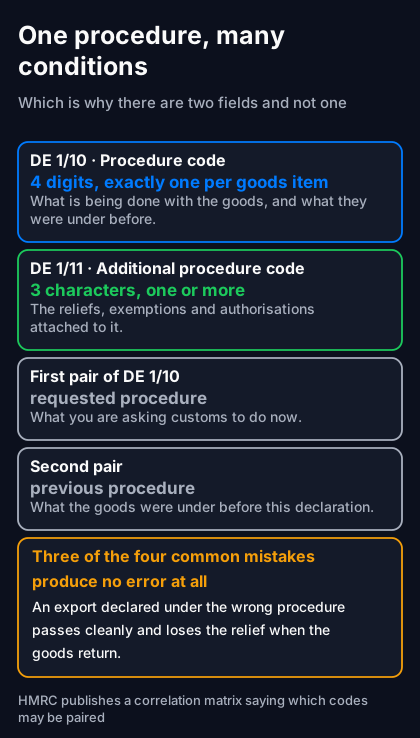
The procedure code is the field that decides whether a movement claims a relief or pays duty twice, and it is the one most often left to whoever is filling in the declaration. It is not hard — four digits answering two questions, plus a second field for the conditions — but the official material is a set of reference tables that say outright they are not guidance, which is why two of the top ten results for this term are videos of someone reading them aloud. This guide covers what each field does, where the reliefs are claimed, and why three of the four common mistakes never produce an error message.
What is a customs procedure code?
A customs procedure code tells customs what is being done with the goods — not what they are, and not who is moving them. It is the field that distinguishes a permanent import from a temporary one, a re-import after repair from a fresh purchase, and goods entering a warehouse from goods released for sale. The commodity code says what the goods are; the procedure code says what is happening to them, and the two together decide what is payable.
It is also the field that claims a relief. Outward processing, returned goods relief and inward processing are not applied for on the day the goods arrive — they are declared, through a procedure code, and a movement declared under the wrong one has not claimed anything.
Why does everyone find them hard?
Because the official material is a reference, not an explanation. The gov.uk appendices are index pages of codes that state plainly they do not constitute full guidance on completing a declaration, and they assume you already know which procedure you are in. The structure is simple once seen; finding it stated anywhere is the difficulty.
The second reason is historical. Older guidance and a good deal of forwarder shorthand still describes a single seven-digit code. Under the Customs Declaration Service it is not one field any more — it is two, and they do different jobs.
What is in Data Element 1/10?
The procedure code itself: four digits, made of two pairs, and only one may be declared per goods item.
| Digits | Called | Answers |
|---|---|---|
| First two | Requested procedure | What you are asking customs to do now |
| Last two | Previous procedure | What the goods were under before this declaration |
Reading it as two questions rather than one number is the whole trick. A code ending in 00 means there was no previous procedure — the goods arrive from outside and this is the first thing that happens to them. A non-zero second pair means the goods are moving between procedures, which is what a re-import after repair is.
What is in Data Element 1/11?
The additional procedure code: three characters, and unlike DE 1/10 more than one may be declared. Its job is to tailor a single four-digit procedure to the particular circumstances, which is why it exists at all.
Because only one procedure code is allowed per goods item, every variation — a relief, an exemption, a specific authorisation, a particular category of goods — has to be expressed somewhere else. That somewhere is DE 1/11. A declaration can carry one procedure code and several additional codes, each adding a condition to it.
Which additional codes may be used with which procedure is not free choice: HMRC publishes a correlation matrix between DE 1/10 and DE 1/11, and a pairing outside it is rejected.
How do the two fields work together?
One says what procedure, the others say under what conditions. Reading a declaration in that order makes it legible.
| Field | Length | How many | Decides |
|---|---|---|---|
| DE 1/10 | 4 digits | Exactly one per goods item | The procedure, and what preceded it |
| DE 1/11 | 3 characters | One or more | The conditions, reliefs and authorisations attached |
The consequence worth holding on to: if the circumstances of your movement are unusual, the unusual part is almost certainly expressed in DE 1/11 rather than in the procedure code, and asking "which procedure code" when you mean "which relief" is how people end up in the wrong appendix.
Where do the reliefs live?
In the procedure code, and this is the practical reason a customer should care about a field their broker completes. Each of the reliefs that stop you paying duty twice is claimed by declaring the movement to the right procedure.
| What you are doing | Declared as |
|---|---|
| Exporting goods temporarily, to come back | A temporary export procedure, which is what preserves the relief on return |
| Re-importing goods that went out and came back unchanged | A re-import procedure referencing the export |
| Importing goods to process and re-export | An inward processing procedure, which suspends the duty |
| Importing permanently, duty paid | Release to free circulation, the ordinary case |
Our guide to sending goods abroad for repair covers which relief fits which movement; this is the field through which each of them is actually claimed.
What does a previous procedure code actually track?
A chain, and whether it was closed. Customs procedures are not isolated events: goods can enter a warehouse, leave it for processing, come back and then be released for sale, and each of those steps is a declaration that has to say what the goods were under before it.
That is what the second pair of digits is for. It lets customs follow a consignment from one procedure to the next and see that the earlier one was discharged — the same discharge logic that governs a transit movement and its guarantee. A declaration that claims no previous procedure when there was one leaves the earlier procedure open, and an open procedure is a liability sitting on somebody's account waiting to be asked about.
The practical consequence is that the procedure code on a later declaration can be wrong because of what was declared on an earlier one. If goods were put into a procedure months ago by somebody else, whoever declares the next step inherits that history whether they know it or not.
Do procedure codes apply to exports as well as imports?
Yes, and the export side is where the money is usually lost. An import declared under the wrong procedure announces itself: the duty is wrong, or the declaration is rejected, and somebody notices that week.
An export declared under the wrong procedure does nothing at all at the time. The goods leave, the paperwork clears, everybody is satisfied — and the consequence arrives weeks or months later when the same goods come back and there is no record that they were ever temporarily exported. The relief that would have charged duty on a repair bill instead charges it on the whole machine.
That asymmetry is worth stating plainly because it inverts where attention usually goes. Import declarations get checked because they cost money immediately; export declarations get waved through because they do not. The expensive procedure-code error is almost always on the way out.
What goes wrong with procedure codes?
Four things, and the first is by far the most expensive because it is only discovered later.
| What happens | Consequence |
|---|---|
| Export declared under an ordinary procedure when it should have been temporary | Nothing fails at the time; the relief is simply lost when the goods return |
| Additional procedure code not paired with the procedure code | The declaration is rejected at submission |
| Previous procedure left as 00 when goods were already under a procedure | The chain is broken and the earlier procedure is never discharged |
| Relief assumed rather than declared | Duty payable in full, with a retrospective application the only way back |
Notice that only one of the four produces an error message. The other three go through cleanly and cost money later, which is why procedure codes are checked before a movement rather than after it.
Who chooses the code?
The declarant, which in practice means you or your customs broker — and the liability follows the declaration, not the advice. A broker will ask what you are doing with the goods and choose accordingly, which is why the answer they are given matters more than the code they pick.
The question to answer precisely is not "what are the goods" but "what is happening to them, and what happened to them before". A machine going out for repair, a demonstration unit going to a trade show, stock being returned to a supplier and a replacement being sent under warranty are four different procedures, and from the outside they can look like one lorry with a crate on it.
What does a carrier need to know?
Whether the movement is under a procedure at all, and whether a document has to travel physically with the goods. Those are the two facts that change what happens on the road rather than in the paperwork.
A movement under customs transit carries a transit accompanying document that has to be presented; a Carnet has to be stamped at each crossing; an ordinary export under a temporary procedure may need nothing in the cab at all. T&C Logistics moves the consignment and the documents with it — the procedure code is declared by you or your broker, who holds the authorisation and the liability for it.
How does this fit the rest of a declaration?
It is one of the five answers a customs declaration gives, and the only one about the movement rather than the goods, the trader or the money.
| Question | Answered by |
|---|---|
| Who is moving the goods? | EORI number |
| What are the goods? | Commodity code |
| Where are they from? | Proof of origin |
| What is being done with them? | Procedure code, DE 1/10 and DE 1/11 |
| Who settles the tax, and when? | Import VAT route |
Get the first two right and the wrong procedure code still costs you the relief. They are independent fields answering independent questions, and a declaration is only as good as the weakest of them.
How do you book a movement that is under a procedure?
Tell us at booking that it is, and tell us what has to travel with it. We do not complete your declaration — that is yours or your broker's, and the liability sits there — but a vehicle carrying goods under a customs procedure is a different job from one carrying a sale, and the difference is in what the driver has to present and where.
Send the collection and delivery postcodes, what the goods are, and whether a transit document or Carnet is travelling. Call 07963 400173 or send the details by WhatsApp. Pricing starts from £50 (ex VAT); the final price depends on distance, vehicle, urgency and time, and is quoted in full upfront before you book.
Questions
- What is a customs procedure code?
- The field that tells customs what is being done with the goods rather than what they are. It distinguishes a permanent import from a temporary one, a re-import after repair from a fresh purchase, and goods entering a warehouse from goods released for sale. It is also how a relief is claimed: outward processing, returned goods relief and inward processing are all declared through a procedure code rather than applied for separately.
- What is the difference between DE 1/10 and DE 1/11?
- DE 1/10 is the procedure code itself: four digits, a two-digit requested procedure followed by a two-digit previous procedure, and exactly one may be declared per goods item. DE 1/11 is the additional procedure code: three characters, and more than one may be used. Because only one procedure code is allowed, every variation — reliefs, exemptions, authorisations — has to be expressed in DE 1/11.
- Why is a procedure code four digits?
- Because it answers two questions, not one. The first pair is what you are asking customs to do now; the second is what the goods were under before this declaration. A code ending in 00 means there was no previous procedure, so the goods are arriving from outside and this is the first thing happening to them. A non-zero second pair means the goods are moving between procedures, which is what a re-import after repair is.
- Can I use any additional procedure code with any procedure code?
- No. HMRC publishes a correlation matrix between DE 1/10 and DE 1/11, and a pairing outside it is rejected at submission. That is the one procedure-code error that announces itself; the expensive ones go through cleanly and are discovered when a relief turns out not to have been claimed.
- What happens if the wrong procedure code is used?
- Usually nothing, at the time. An export declared under an ordinary procedure when it should have been a temporary one passes without complaint, and the relief is simply lost when the goods come back and duty is charged on their full value. Only an invalid DE 1/10 to DE 1/11 pairing produces an error at submission. The other failures cost money later, which is why procedure codes are checked before a movement rather than after it.
- Who is responsible for choosing the procedure code?
- The declarant — you or your customs broker — and the liability follows the declaration rather than the advice. The question to answer precisely is not what the goods are but what is happening to them and what happened to them before. A machine going out for repair, a demonstration unit going to a trade show and stock returning to a supplier are three different procedures that look identical from outside the lorry.
- Does my courier need to know the procedure code?
- Not the code, but whether the movement is under a procedure and what has to travel physically with the goods. A movement under customs transit carries a document that must be presented; a Carnet must be stamped at each crossing; an ordinary export under a temporary procedure may need nothing in the cab. Those are the facts that change what happens on the road rather than in the paperwork.
- Where do I find the right procedure code?
- In HMRC's appendices for DE 1/10 and DE 1/11, and in the correlation matrix that says which may be used together. They are reference tables rather than guidance — the index pages say as much — so the practical route is to describe the movement accurately to whoever is declaring it and let them map it. Describing the movement wrongly is how the wrong code gets chosen correctly.