
The commercial invoice: what your customs declaration is built from
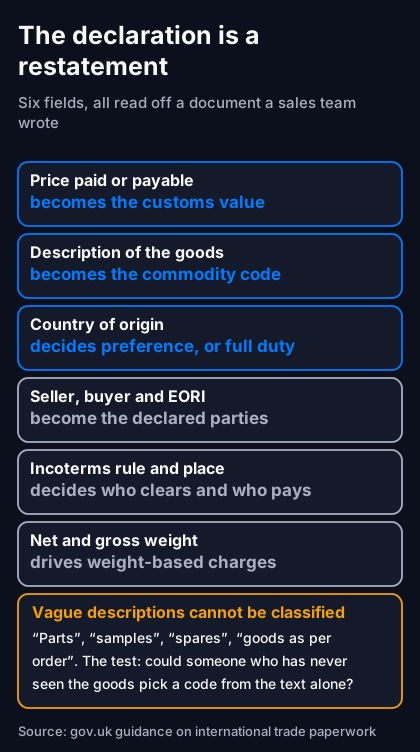
The commercial invoice is the document a customs declaration is built from. Classification, value, origin, parties and delivery terms are all read off it, which means an invoice written loosely by a sales team becomes a declaration that is wrong, queried, or quietly more expensive than it needed to be. This sets out what a declaration takes from the invoice, what each field has to say, and the six errors that account for most of the delays.
What is a commercial invoice?
A commercial invoice is the seller's record of what was sold, to whom, for how much, and on what terms — and in international trade it is also the document customs reads to work out what duty is owed. It is a commercial document doing a regulatory job, which is why it causes so much trouble: it is written by a sales function and read by a border.
It is not a pro forma invoice. A pro forma is a quotation dressed as an invoice, issued before a sale is agreed, and it is not evidence of a transaction. Presenting one where a commercial invoice is required is among the commonest reasons a consignment is queried, because the value on it is an estimate rather than a price actually paid or payable.
What does a customs declaration take from it?
Almost everything that determines the charge. A declaration is largely a structured restatement of the invoice, which is why an invoice that is vague produces a declaration that is wrong.
| Declaration field | Read from the invoice |
|---|---|
| Customs value | The price actually paid or payable, plus or minus adjustments |
| Classification | The description of the goods, which drives the commodity code |
| Origin | The country of origin stated for each line |
| Parties | Seller, buyer and their EORI numbers |
| Delivery terms | The Incoterms rule and named place |
| Quantity and weight | Units, net and gross weight per line |
Four of those six are judgement calls that the seller makes and the border audits. Nobody at customs is going to improve a bad description, and a declarant working from "parts" and a total value has no choice but to guess.
What has to be on it?
There is no single statutory template, which is why templates proliferate. What there is instead is a working set that every declaration needs, and the gov.uk guidance on trade paperwork describes the shape of it.
- Invoice number and date, and the seller's and buyer's full names and addresses.
- EORI numbers for both parties where they trade with the UK.
- A line-by-line description of the goods in plain language that identifies what they actually are.
- Commodity code and country of origin, per line.
- Quantity, unit price, line total, and the currency.
- Net and gross weight, per line and in total.
- The Incoterms rule with its named place — "DAP Rotterdam", not "DAP".
- The reason for export, where the goods are not a straightforward sale.
The last one catches people out. Samples, warranty replacements, goods going for repair and goods returning from repair are all exports, and each has a different customs treatment that depends entirely on the sender saying which it is.
Why does the description matter more than anything else?
Because it is the only field a classifier cannot work around. A commodity code assigns a duty rate to a precise article, and a description that could cover twenty articles cannot produce one code.
"Parts", "samples", "spares", "machinery" and "goods as per order" are all unusable. A usable description names the article, what it is made of, and what it is for: "stainless steel ball bearings, 25 mm, for industrial pumps" classifies; "bearings" does not. The test is whether somebody who has never seen the goods could pick a code from the text alone.
This is also where the invoice meets the rest of the chain. The description feeds the code, the code decides the duty rate, and under a special procedure it decides whether the relief applies at all.
What value goes on the invoice?
The price actually paid or payable for the goods, in the currency of the sale — not a nominal figure, not a book value, and not zero. Goods sent free of charge still have a customs value, and the invoice has to show one with a note explaining the basis.
| Situation | Value shown |
|---|---|
| Ordinary sale | The price paid or payable |
| Free samples | Value for customs purposes only, with that stated |
| Warranty replacement | Value for customs purposes only, with the reason for export |
| Goods going for repair | Value of the goods, with the repair intention stated |
| Goods returning after repair | Value of the repair, where the relief applies |
"Value for customs purposes only, no commercial transaction" is a legitimate and common annotation. Declaring a nil value is not: it invites a valuation query and can produce a duty assessment on a figure the border picks rather than one you provided.
Do you need a packing list as well?
For anything beyond a single carton, yes — and it does a different job from the invoice. The invoice answers what the goods are worth and on what terms; the packing list answers what is physically in which box. A consignment of one line item on one pallet does not need one. A consignment of forty lines across six pallets is unverifiable without it.
It matters at exactly two moments. The first is a customs examination, where an officer opening the third pallet of six needs to know what should be in it. The second is a damage claim, where the question is which box held the broken item and what else was in it.
A usable packing list cross-references the invoice line numbers, and gives per package: the package number, its contents by invoice line, the quantity, and the net and gross weight. A list that merely repeats the invoice totals adds nothing, because the point of it is the breakdown.
How many copies travel, and where?
Enough for everyone who has to read it, which for a road movement to Europe is usually three: one inside the consignment, one with the driver, and one sent electronically to the clearing agent ahead of the vehicle.
The electronic copy is the one that matters for timing. Clearance is prepared from the invoice before the vehicle reaches the border, and an invoice that travels only inside the box cannot be used until somebody opens the box. For a time-critical job this is frequently the difference between a release waiting for the vehicle and a vehicle waiting for a release.
The paper copies still earn their place. A CMR note describes the goods for carriage purposes but carries no values and no codes, so a driver stopped at a roadside check has the invoice and nothing else to show what is on board.
What goes wrong most often?
Not fraud. Ordinary carelessness, applied to a document nobody treats as regulatory until it stops a vehicle.
| Error | Consequence |
|---|---|
| Description too vague to classify | Declaration delayed or classified wrongly, with duty consequences |
| Pro forma used instead of a commercial invoice | Value treated as an estimate; valuation query |
| Incoterms rule without a named place | Ambiguity about who pays duty and where risk passes |
| Country of origin left off, or confused with country of dispatch | Preference claim fails; full duty applies |
| Gross and net weight missing | Blocks the declaration and any weight-based charge |
| Invoice inside the box only | Clearance cannot start until the goods are opened |
Origin and dispatch are worth separating explicitly, because they look interchangeable and are not. Goods made in Vietnam and shipped from a Dutch warehouse have Vietnamese origin and Dutch dispatch, and only the first decides the tariff. Our proof of origin article covers how that is evidenced.
What currency should the invoice be in?
The currency the sale was actually made in, and nothing else. Converting to sterling to be helpful is unhelpful: customs applies its own published exchange rate for the period, so a seller's conversion introduces a discrepancy between the invoice and the declaration that has to be explained.
State the currency explicitly with an ISO code rather than a symbol. A dollar sign covers at least a dozen currencies and a consignment valued in Canadian dollars declared as US dollars is a valuation error of about a third. Where the sale genuinely involved more than one currency, show each line in its own and do not total across them.
Who prepares it, and who is responsible for it?
The seller prepares it and the declarant relies on it, which means the accuracy risk sits with the party least likely to be reading customs guidance. A customs agent making a declaration on your behalf works from what you give them; they do not verify that your description matches the goods in the box.
We are not that agent. T&C Logistics holds no customs-broker or customs-agent status, and our EORI registers us to move goods across the border rather than to make declarations for you. What we can do is tell you when an invoice will not survive the border before the vehicle leaves, because we see the ones that do not.
There is one more thing worth saying about who carries the risk. A customs agent acting as a direct representative declares in your name, and the liability for an inaccurate declaration stays with you. Acting as an indirect representative, the agent becomes jointly liable alongside you. Which of the two you have engaged is written in your agreement with them, and a surprising number of importers do not know which it is until something is queried.
Three checks, in the thirty seconds before a job is booked: does every line have a description somebody could classify, does every line have an origin, and is the Incoterms rule followed by a place name? Those three account for most of the delays we see. Our commercial invoice glossary entry covers the definition, and the European road freight page covers the movement itself.
Questions
- What is the difference between a commercial invoice and a pro forma invoice?
- A pro forma is a quotation in invoice form, issued before a sale is agreed, and it is not evidence of a transaction. A commercial invoice records a sale that has happened, at a price actually paid or payable. Presenting a pro forma where a commercial invoice is required is a common reason for a consignment to be queried, because the value on it is an estimate rather than a price, and customs value is built on the price.
- What makes a goods description good enough for customs?
- It has to let somebody who has never seen the goods pick a commodity code from the text alone. That means naming the article, what it is made of and what it is for: 'stainless steel ball bearings, 25 mm, for industrial pumps' classifies, while 'bearings' does not. 'Parts', 'samples', 'spares', 'machinery' and 'goods as per order' are all unusable, and nobody at the border will improve them for you.
- What value do I put on free samples?
- A realistic value, annotated 'value for customs purposes only, no commercial transaction'. Goods sent free of charge still have a customs value and still attract duty on it. Declaring a nil value does not avoid the charge; it invites a valuation query and can produce an assessment on a figure the border picks rather than one you provided. The same applies to warranty replacements and goods moving for repair.
- Is country of origin the same as where the goods were shipped from?
- No, and conflating the two is expensive. Origin is where the goods were produced or last substantially transformed; dispatch is simply where the vehicle or vessel loaded. Goods manufactured in Vietnam and shipped from a Dutch warehouse have Vietnamese origin and Dutch dispatch, and only origin decides whether a trade agreement's preferential rate applies. Getting it wrong means full duty.
- Do I need to write the Incoterms rule on the invoice?
- Yes, and with its named place. 'DAP' alone is incomplete; 'DAP Rotterdam' is a term. The rule decides who clears export and import, who pays duty, and where risk passes, and a rule without a place leaves all three ambiguous. Incoterms 2020 is the current edition, and stating the edition alongside the rule removes a second ambiguity that occasionally matters in disputes.
- How many copies of the invoice should travel with a shipment?
- Usually three for a road movement to Europe: one inside the consignment, one with the driver, and one sent electronically to the clearing agent ahead of the vehicle. The electronic copy is the one that affects timing, because clearance is prepared from the invoice before the vehicle arrives. An invoice that travels only inside the box cannot be used until somebody opens the box.
- Can you prepare the commercial invoice or make the declaration for me?
- No. T&C Logistics holds no customs-broker or customs-agent status, and our EORI number registers us to move goods across the border rather than to declare them on your behalf. The invoice is the seller's document and a customs agent declares from what you give them. What we can do is flag an invoice that will not survive the border before the vehicle leaves, because we see the ones that do not.