
Proof of Origin: The Four Ways to Prove Where Goods Come From
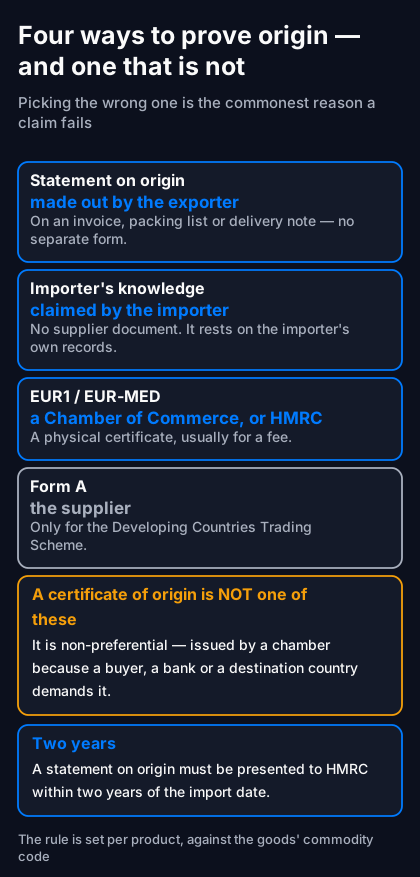
Origin is the only field on a customs declaration that can take the duty rate to nothing on its own, and it is the one most often assumed rather than proved. It does not mean where the goods were shipped from, where the supplier is based, or what the commodity code calls them — it means where they were made or last substantially transformed, and there are four separate ways to evidence that, with different issuers and different burdens. This guide covers all four, why a certificate of origin is not one of them, the two-year rule that catches people, and which of these documents actually travels with the lorry.
What is proof of origin, and why does it matter?
Proof of origin is the evidence that goods come from where you say they come from, and it is what turns a trade agreement's zero tariff from a theoretical rate into one you actually pay. Without it the agreement is irrelevant and the ordinary duty applies. It is the only one of the five fields on a declaration that can take the rate to nil on its own.
It is also distinct from everything around it, and the distinctions are where the money goes. Origin is not where the goods were shipped from, not where the supplier is based, and not what the commodity code says they are. It is where they were produced or last substantially transformed, and the paperwork proves that specific thing.
What are the four ways to prove it?
Four, with different issuers and different evidence behind them. Picking the wrong one is the commonest reason a preference claim fails.
| Route | Made out by | Where it lives |
|---|---|---|
| Statement on origin | The exporter | On a commercial document — invoice, packing list or delivery note |
| Importer's knowledge | The importer | Nowhere — it rests on the importer's own records |
| EUR1 or EUR-MED certificate | Chambers of Commerce, Institute of Chartered Shipbrokers offices, or HMRC digitally | A certificate, and a fee may be charged |
| Form A | The supplier | Only for countries in the Developing Countries Trading Scheme |
Two of the four need nothing from a third party, which is why most UK–EU trade runs on them. The other two involve an issuing body, a lead time and usually a cost.
What is a statement on origin?
A declaration the exporter writes onto a commercial document, stating that the goods qualify. It does not need its own form: it goes on an invoice, a packing list or a delivery note, provided that document carries enough detail to identify the goods it refers to.
That last condition is the one that gets missed. A statement on an invoice that describes goods as "assorted parts" has not identified anything, and a statement referring to a consignment the document does not itemise is unusable. The statement and the description have to point at the same goods.
The timing matters too: a statement on origin must be presented to HMRC within two years of the date the goods were imported. That is long enough to be forgotten about and short enough to matter, and it is the reason origin paperwork is filed rather than discarded once a shipment clears.
What is importer's knowledge?
A claim made on the importer's own evidence, with no document from the supplier at all. It exists for the case where you know how the goods were made because you are closely enough involved to prove it.
The burden moves accordingly. An importer claiming on their own knowledge has to hold records covering the commodity codes of the goods and their materials, the production processes used, and the origin of the materials that went into them. That is a supply-chain file, not a shipping file — and it has to exist before the claim, not be assembled after a question.
The practical test is simple: could you demonstrate, from documents you already hold, how this product came to qualify? If the honest answer is that you would have to ask the supplier, you are not claiming on importer's knowledge — you need a statement from them instead.
Is a certificate of origin the same thing?
No, and this is the single most common confusion in the field. The documents above prove preferential origin, to claim a reduced or zero tariff under a trade agreement. A certificate of origin is a non-preferential document: it states where goods come from for purposes that have nothing to do with tariff preference.
| Preferential proof | Certificate of origin | |
|---|---|---|
| Purpose | Claim a reduced or zero tariff | State origin for customs, banking or a buyer's requirement |
| Issued by | The exporter or importer, or a chamber for EUR1 | A Chamber of Commerce |
| Needed because | A trade agreement allows it | A destination country, a letter of credit or a contract demands it |
| Cost | Nothing for a statement on origin | A fee |
A business can need both on the same shipment, and a business that has been told to "get a certificate of origin" by a customer may not need one for the tariff at all. Ask which problem the document is solving before paying for it.
What does origin actually depend on?
Where the goods were produced or last substantially transformed — and what counts as substantial is set per product, by the trade agreement, against the goods' commodity code. There is no single rule, no universal percentage and no shortcut that applies across a catalogue.
Two things follow. Assembly in a country does not automatically confer origin on it: whether it does depends on the rule written for that specific commodity code. And a product can change origin when its specification changes, because a different input mix can take it across or back over its own rule. Classification and origin are therefore linked without being the same question: you cannot look up the origin rule until you know the code.
What is a supplier declaration, and when do you need one?
A statement from your supplier about the origin of what they sold you, which is what lets you make a claim about the finished product. It is the upstream half of the chain and it is where most origin files break.
If you buy components and sell an assembly, your right to call the assembly originating depends on what went into it. You cannot establish that from your own records alone, because the question is about your supplier's production, not yours. Without their declaration you have no basis for the claim — and gathering them after an audit begins is the hardest possible moment to do it.
This is why origin is an ongoing administrative job rather than a shipment-by-shipment one. The statement you put on an invoice today rests on declarations collected weeks earlier from people with no particular reason to prioritise your paperwork.
What happens if a claim is challenged?
You are asked to produce the evidence, and the answer is settled on what you already hold rather than on what you can obtain afterwards. That is the whole reason the records requirement exists in the form it does.
Where preference was claimed on a statement on origin, the question goes to the statement and the document it sits on — and behind that, to the supplier declarations that justified it. Where it was claimed on importer's knowledge, the question goes straight to your own file: commodity codes, production processes, material origins. In both cases a claim that cannot be supported means the duty was underpaid, and underpaid duty is recoverable retrospectively with interest, long after the goods were sold.
The asymmetry worth noticing is that nothing fails at the border. A preference claim is accepted on the declaration and tested, if at all, much later — which is exactly the shape of the procedure-code errors that also pass cleanly and cost money afterwards. Both are audited rather than enforced, and both reward a file kept at the time.
What goes wrong with origin claims?
Rarely the arithmetic. Almost always the documents.
| What happens | Consequence |
|---|---|
| Preference claimed with no statement and no importer's knowledge | Duty payable at the normal rate |
| Statement on a document that does not identify the goods | Unusable; the claim has no support |
| Supplier declarations never collected | No basis to call the finished product originating |
| Origin assumed from where the goods shipped | Wrong test entirely — shipment point is not origin |
| Statement not produced within two years of import | Out of time |
The fourth row is worth a second look. Goods consolidated in a warehouse in one country and forwarded from there have the origin of where they were made, not of the warehouse — and a quick glance at a shipping document will often suggest otherwise.
Which of these travels with the goods?
Usually none of them, and that is the part nobody explains. Origin paperwork is a documentary matter settled between the exporter, the importer and customs — it is not something a driver presents at a barrier.
| Document | Travels with the vehicle? |
|---|---|
| Statement on origin | It is on the invoice, so it travels with the paperwork rather than being presented |
| Importer's knowledge | Nothing travels — it lives in the importer's records |
| EUR1 certificate | Yes, where one is used — it is a physical certificate |
| Transit accompanying document | Yes, always, and must be presented |
The distinction matters at booking. A consignment whose paperwork is documentary is a normal road job; one carrying a certificate or a transit document is a job where something has to be in the cab and handed over intact.
Where does origin sit among the other declaration fields?
Third of five, and the only one that can take the rate to nothing.
| Question | Answered by |
|---|---|
| Who is moving the goods? | EORI number |
| What are the goods? | Commodity code — and it decides which origin rule applies |
| Where are they from? | Proof of origin |
| What is being done with them? | Procedure code |
| Who settles the tax, and when? | Import VAT route |
The second row is the dependency worth remembering: you cannot find the origin rule for a product until you have classified it, so a classification error quietly becomes an origin error.
What does T&C Logistics do with this?
Carry the goods and the documents that travel with them. Origin is declared by you or your customs broker, who holds the liability for the claim — we are not a customs agent and do not make origin declarations.
What we need to know at booking is whether anything has to be presented physically: a EUR1 certificate or a transit document is a different proposition from an invoice emailed ahead. Send the collection and delivery postcodes and say what is travelling. Call 07963 400173 or send the details by WhatsApp.
Questions
- What are the ways to prove origin for a preferential tariff?
- Four. A statement on origin made out by the exporter on a commercial document; importer's knowledge, where the importer claims on their own records with no supplier document; a EUR1 or EUR-MED movement certificate issued by a Chamber of Commerce, an Institute of Chartered Shipbrokers office or HMRC digitally, usually for a fee; and Form A, which applies only to countries covered by the Developing Countries Trading Scheme.
- What is the difference between a statement on origin and a certificate of origin?
- They solve different problems. A statement on origin is preferential: it supports a claim for a reduced or zero tariff under a trade agreement, costs nothing and is written by the exporter onto an invoice or similar document. A certificate of origin is non-preferential, issued by a Chamber of Commerce for a fee, and exists because a destination country, a letter of credit or a contract demands proof of where goods came from. A shipment can need both.
- Where does a statement on origin go?
- On a commercial document that carries enough detail to identify the goods — an invoice, a packing list or a delivery note. It needs no form of its own. The condition people miss is the identification: a statement attached to an invoice describing “assorted parts” has not identified anything, and the statement and the goods description have to point at the same consignment.
- How long do I have to produce a statement on origin?
- It must be presented to HMRC within two years of the date the goods were imported. That is long enough to be forgotten and short enough to matter, which is why origin paperwork is filed rather than discarded once a shipment clears customs.
- What does importer's knowledge require?
- Records, held before the claim rather than assembled after a question. An importer claiming on their own knowledge must hold evidence covering the commodity codes of the goods and their materials, the production processes used, and the origin of those materials. The practical test: could you demonstrate from documents you already hold how the product qualifies? If you would have to ask the supplier, you need a statement from them instead.
- Does assembling goods in the UK make them UK origin?
- Not automatically. Whether an operation confers origin depends on the rule written for that specific commodity code in the relevant trade agreement — there is no single threshold that applies across products. It also means classification and origin are linked: you cannot look up the origin rule until you know the code, so a classification error quietly becomes an origin error.
- Why do I need supplier declarations?
- Because your right to call a finished product originating depends on what went into it, and that is a fact about your supplier's production rather than yours. Without their declaration you have no basis for the claim. Collecting them is an ongoing administrative job: the statement you put on an invoice today rests on declarations gathered weeks earlier from people with no particular reason to prioritise your paperwork.
- Does origin paperwork travel with the vehicle?
- Usually not. A statement on origin sits on the invoice and is a documentary matter between exporter, importer and customs; importer's knowledge lives entirely in the importer's records. A EUR1 certificate is a physical document and does travel, as does a transit accompanying document, which must be presented. Tell us at booking if anything has to be in the cab — that changes the job.
Explore more
More from the blog
- Shipping to EU After Brexit 2026: Complete UK Busin…
- Time-Critical Logistics Solutions UK — When Every M…
- UK Government Spends £166B on Logistics: What It Me…
- Best Courier for Pharmacy Stock Transfers UK [2026]
- How to Send Biological Samples by Courier UK [2026…
- UK Courier Industry: 10,776 Companies and Counting