
Demurrage, detention and waiting time: three clocks, three parties
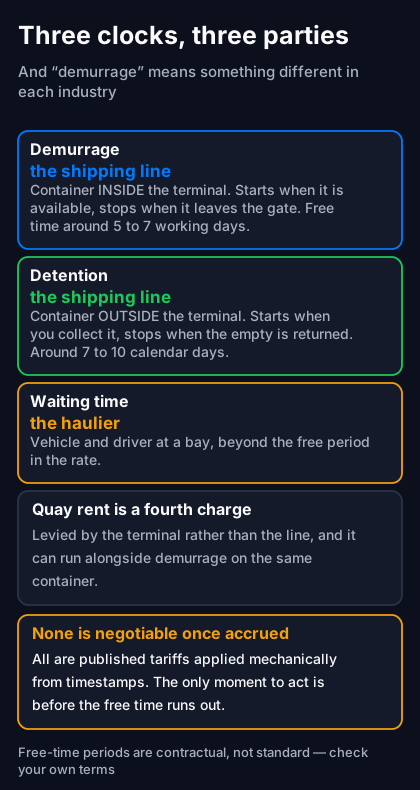
Demurrage, detention and waiting time are three charges that sound like one. Two are levied by a shipping line on a container and one is levied by a haulier on a vehicle, and an importer who brings in a box by sea and delivers its contents by road meets all three in the same week from unrelated parties. The word demurrage itself means different things in the two industries. This sets out which clock is which, when each one starts, and which party can actually stop it.
What is demurrage?
Demurrage is a charge for keeping a container inside a port terminal beyond the free time allowed. The clock starts when the container becomes available for collection, not when the vessel docks and not when you are told about it, and it runs until the container leaves the terminal gate.
It is charged by the shipping line, it is calculated per container per day, and it typically escalates: the daily rate after the first week is higher than the rate in it. The escalation is deliberate, because the terminal's constraint is space rather than money and the charge exists to clear the yard.
How is detention different?
Detention is the mirror image: a charge for keeping the container outside the terminal beyond the free time allowed, measured from when you collected it until you return the empty to the line's nominated depot. Demurrage is time inside the gate; detention is time outside it.
| Demurrage | Detention | |
|---|---|---|
| Where the container is | Inside the terminal | Outside, with you |
| Clock starts | When the container is available for collection | When you collect it |
| Clock stops | When it leaves the terminal | When the empty is returned to the depot |
| Typical free time at UK ports | Around 5 to 7 working days | Around 7 to 10 calendar days |
| Rate structure | Usually escalating | Usually a flat daily rate |
Both are charged by the shipping line and both are avoidable by planning. Port storage or quay rent is a third charge again, levied by the terminal rather than the line, and it can run alongside demurrage on the same container.
Why does the same word mean something else in road haulage?
Because the concept is the same and the asset is not. In road transport, demurrage means the charge for detaining a vehicle and driver beyond the loading or unloading time included in the rate — what most UK operators call waiting time or standing time.
So a business importing a container by sea and delivering its contents by road meets both uses in the same week, from unrelated parties, for unrelated reasons. The container demurrage is owed to the shipping line for yard space. The road waiting time is owed to the haulier for a vehicle and a driver standing idle at a bay. Netting one against the other, which people attempt, is a conversation with two parties who have nothing to do with each other.
What is waiting time on a road delivery?
The period a vehicle and driver spend at a collection or delivery point beyond the free time included in the price, charged by the hour or part hour. It exists because a dedicated vehicle cannot do anything else while it waits: the cost of waiting is the cost of the job it is not doing.
| Cause | Who controls it |
|---|---|
| Site induction or escorted access | The site |
| Goods not ready, or paperwork not signed | The sender or consignee |
| Booking-in slot missed or not held | Usually the sender |
| Loading bay queue | The site |
| Customs release not through | The declarant |
Every row on that list is outside the carrier's control, which is exactly why it is charged separately rather than priced in. A rate that absorbed unlimited waiting would have to assume the worst case for every job, and every punctual customer would pay for it.
How do you avoid demurrage on an import?
By working backwards from the free time rather than forwards from the arrival. The common failure is treating the vessel's arrival as the start of the process, when the useful date is the last day before charges begin.
- Establish the free time on your bill of lading or contract before the vessel arrives, in days and from which event.
- Get the customs entry prepared in advance, from the commercial invoice, not after arrival.
- Confirm the container is actually available, which is a separate event from the vessel berthing.
- Book the haulage against the availability, not against the arrival.
- If the goods cannot be delivered on time, strip the container and return the empty rather than holding it loaded.
Step five is the one that saves the most. Demurrage and detention run on the container, not on the cargo, so moving the goods into a warehouse and returning the box stops both clocks even when the onward delivery is still weeks away.
Is there an equivalent in air freight?
Yes, and it moves far faster because the asset is scarcer. A cargo handler charges storage on freight left in the shed beyond a free period measured in hours and days rather than the days and weeks a container gets, because shed space at an airport is a fraction of a port's yard.
The sequence is also different in a way that catches importers. Air freight lands, is broken down by the handler, is presented to customs and only then is released — and the storage clock typically starts at availability rather than at release. A consignment held up by an outstanding entry accrues storage while nobody can collect it, which feels unjust and is nonetheless how the charge works.
The defence is the same as at a port and has to happen earlier. Prepare the entry before the aircraft lands, book collection against the release notification rather than the flight arrival, and treat the two as separate events. Our air waybill article covers what a driver needs at a handler's counter, and the air freight page covers the landside collection itself.
Who is liable for these charges?
Whoever the contract says, and the answer usually traces back to the Incoterms rule published by the International Chamber of Commerce. A rule that puts import clearance and delivery on the buyer puts the demurrage exposure there too, and a seller selling on delivered terms carries it themselves.
The common surprise is that the carrier is rarely the party who can stop the clock. A haulier booked to collect a container cannot do so before customs has released it, and the demurrage accruing in the meantime is not caused by the haulage and is not the haulier's to absorb. The party that can stop the clock is the one who can produce the entry.
That is also the honest answer on road waiting time, from the other side: we can tell you a vehicle is waiting, but we cannot sign your paperwork or open your bay.
What is a quay rent, and why is it a third charge?
Quay rent, or port storage, is levied by the terminal rather than by the shipping line, for the physical occupation of ground. It is genuinely separate from demurrage and can run at the same time on the same container, which is why a single late collection sometimes produces two invoices from two companies for what looks like one delay.
The distinction is easiest to hold by asking who is being compensated. Demurrage compensates the line for a container it cannot redeploy. Quay rent compensates the terminal for a slot it cannot sell. Detention compensates the line again, this time for the box being off-site. Three parties with three different assets tied up by the same consignment.
None of them is negotiable once accrued, which is the practical point. All three are published tariffs applied mechanically from timestamps, so the only effective moment to act is before the free time runs out rather than after the invoice arrives.
What is the free time actually for?
Yard turnover, not customer convenience, and understanding that explains the rate structure. A terminal's capacity is measured in ground slots, and a container that sits is a slot that cannot be sold. Free time is the period the line judges reasonable for an organised importer; everything after it is priced to make sitting more expensive than moving.
The same logic sets road waiting time. A dedicated vehicle is a day of capacity, and an hour at a bay is an hour of that day. Operators include a short free period because some wait is normal and pricing it per minute would be petty, and charge beyond it because the alternative is pricing every job for the worst site on the round.
How do we handle waiting time?
We charge it, and we say so before the driver sets off rather than after. That is the whole of our position and it is deliberately dull: a charge disclosed in advance is a commercial term, and the same charge disclosed on an invoice is an argument.
Where a site is known to be slow — a regulated site requiring supervised loading, a hospital with an escort requirement, a bonded facility with a release window — we would rather price it into the quote than surprise you with it afterwards. Telling us at booking that a site needs an induction costs nothing and changes the quote; discovering it at the gate costs an hour.
Our demurrage glossary entry covers the short definition, and the bonded warehouse deliveries page covers the case where a release window and a waiting charge most often meet.
Questions
- What is the difference between demurrage and detention?
- Where the container is. Demurrage is charged for keeping a container inside the port terminal beyond the free time, running from when it becomes available for collection until it leaves the gate. Detention is charged for keeping it outside the terminal beyond the free time, running from when you collect it until the empty is returned to the line's depot. Both are charged by the shipping line, per container per day.
- How much free time do you usually get at a UK port?
- Around five to seven working days for demurrage, measured from when the container becomes available, and around seven to ten calendar days for detention, measured from collection. The exact periods are contractual rather than standard, so they sit in your bill of lading or your rate agreement and are worth establishing before the vessel arrives rather than after. Demurrage rates usually escalate after the first week; detention is more often a flat daily rate.
- Does demurrage mean the same thing in road haulage?
- No, and this trips up importers regularly. In road transport demurrage means the charge for detaining a vehicle and driver beyond the loading or unloading time included in the rate — what UK operators usually call waiting time or standing time. The sea charge is for yard space and is owed to the shipping line; the road charge is for a vehicle standing idle and is owed to the haulier. They are unrelated charges from unrelated parties.
- Can a haulier be charged for causing demurrage?
- Rarely, because the haulier is seldom the party who can stop the clock. A vehicle booked to collect a container cannot do so until customs has released it, and demurrage accruing while an entry is outstanding is not caused by the haulage. The party that can stop the clock is the one who can produce the customs entry. Liability for the charge itself usually follows the Incoterms rule agreed between seller and buyer.
- How do I avoid demurrage on an import?
- Work backwards from the last free day rather than forwards from the vessel arrival. Establish the free time before arrival, prepare the customs entry from the commercial invoice in advance, confirm the container is actually available — a separate event from the vessel berthing — and book haulage against availability rather than arrival. If delivery cannot happen in time, strip the container and return the empty: the clocks run on the box, not the cargo.
- Why is waiting time charged separately instead of being in the rate?
- Because almost every cause of it is outside the carrier's control: site inductions, goods not ready, a missed booking-in slot, a loading bay queue, a customs release still outstanding. A rate that absorbed unlimited waiting would have to assume the worst case for every job, which means every punctual customer subsidising the slowest site on the round. Charging it separately keeps the base rate honest.
- Will you tell me about waiting time before or after the job?
- Before. We charge waiting time and we say so before the driver sets off rather than after, because a charge disclosed in advance is a commercial term while the same charge on an invoice is an argument. Where a site is known to be slow — supervised loading, an escort requirement, a bonded release window — we would rather price it into the quote. Telling us at booking costs nothing; discovering it at the gate costs an hour.