
Drivers' hours: the number that decides your delivery window
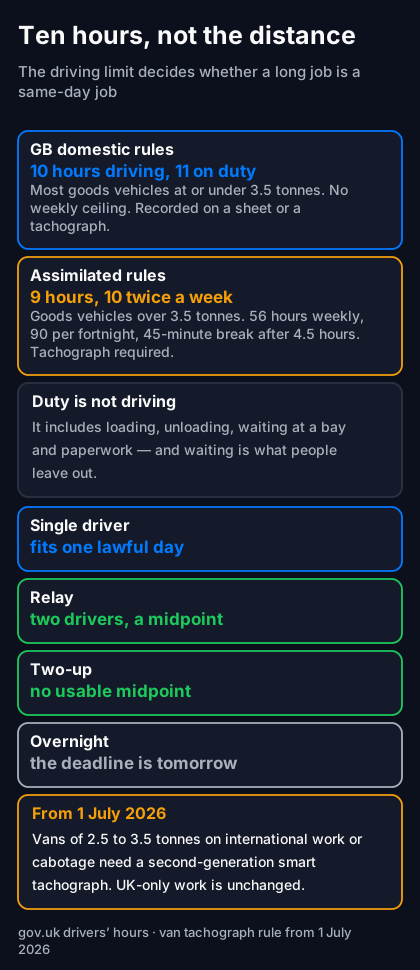
A dedicated vehicle is driven by one person, and that person may not drive more than ten hours in a day under GB domestic rules. That single number, not the distance, decides whether a long job is a same-day job. This sets out the two regimes a UK goods vehicle can be in, what changed for vans on 1 July 2026, the medical exemption most people have never heard of, and how to work out before booking whether a plan fits inside a lawful day.
Why do drivers' hours decide your delivery window?
Because a dedicated vehicle is driven by one person, and that person may not drive more than a fixed number of hours in a day. No amount of urgency changes it. The legal driving limit, not the distance, is what decides whether a job can be done in one day or needs two.
That is the practical content of a rulebook most senders never read. A 500-mile delivery is not a question of whether a van is fast enough; it is a question of whether the mileage, the loading, the unloading and the breaks fit inside a lawful day. Where they do not, the honest answer is a second driver or an overnight, and a carrier that promises otherwise is promising something it cannot lawfully do.
What are the GB domestic rules?
They apply to most goods vehicles operating in England, Wales and Scotland that do not have to follow the assimilated rules — which is the term gov.uk now uses for what everyone still calls the EU rules. Two limits matter.
| Limit | GB domestic rules |
|---|---|
| Daily driving | No more than 10 hours |
| Daily duty | No more than 11 hours, and the limit does not apply on a working day with no driving |
| Records | A weekly record sheet, or a tachograph |
Driving means driving. Duty means everything else as well: loading, waiting, paperwork, a site induction. A job with four hours of driving and seven hours standing at bays is as constrained by the duty limit as a long run is by the driving limit, and it is the one people forget to count.
Which vehicles have to follow the assimilated rules instead?
Broadly, goods vehicles over 3.5 tonnes. Those run under the assimilated rules, which are tighter than GB domestic in every dimension and require a tachograph rather than a paper record.
| Limit | Assimilated rules | GB domestic |
|---|---|---|
| Daily driving | 9 hours, extendable to 10 twice a week | 10 hours |
| Weekly driving | 56 hours | No weekly driving limit |
| Fortnightly driving | 90 hours | No fortnightly limit |
| Break | 45 minutes after 4.5 hours of driving | No prescribed driving break |
| Recording | Tachograph | Weekly record sheet or tachograph |
The counter-intuitive line is the first one: GB domestic allows an hour more driving a day than the assimilated rules do. What it does not give is a weekly ceiling, which is why the two regimes cannot be compared on a single day in isolation.
What changed for vans on 1 July 2026?
Vans between 2.5 and 3.5 tonnes maximum authorised mass came into scope for international work. From 1 July 2026, a van in that weight band used for international commercial freight or for cabotage must be fitted with a second-generation smart tachograph and must follow the EU-style hours rather than GB domestic ones.
What did not change is as important. A van of the same weight operating only within the United Kingdom has no tachograph requirement and continues under GB domestic rules. The trigger is the journey, not the vehicle, so the same van can be in two regimes in two weeks.
For anyone sending goods to Europe by van this is a live question to ask a carrier, because the answer determines both the compliance position and how far the vehicle can get in a day. It connects directly to cabotage, which the same rule explicitly covers.
Does our fleet need tachographs?
Not for UK work. Our vehicles are vans at or under 3.5 tonnes and our domestic work runs under GB domestic drivers' hours rules, recorded rather than tachographed. We hold no Operator's Licence: HGV work requiring one is carried out by partner carriers operating their own vehicles under their own licence, and those vehicles are tachographed because they are over 3.5 tonnes.
Our drivers hold Driver CPC as the law requires, which is a qualification rather than a recording device and is frequently confused with one. The full list of what we hold, with the register that proves each, is on our licences page.
Is there an exemption that applies to medical work?
There is, and it is not widely known. Under the GB domestic rules, goods vehicles under 3.5 tonnes used as medical or veterinary transport are exempt from the daily duty limit — though not from the driving limit, which still applies in full.
The distinction matters on exactly the jobs where it bites. A medical run that involves long waits at hospital bays, escorted access and multiple sites can breach an 11-hour duty limit while nowhere near 10 hours of driving, and that is the case the exemption exists for. It does not create a licence to drive longer, and nobody should read it as one. Our medical logistics work operates inside both limits regardless, because fatigue is not a paperwork question.
The other universal exemption is emergencies. All drivers are exempt from the rules when dealing with one, which is narrower than it sounds: a commercial deadline is not an emergency.
How do you work out whether a job fits in a day?
Add the parts rather than the miles, and do it before promising a time. Five figures, in this order:
- Driving time at realistic motorway and urban speeds, not at the distance divided by 60.
- Loading and unloading, including any site induction or booking-in slot.
- Waiting, which is duty time and is the component most often left out — see our waiting time article.
- Breaks, prescribed under the assimilated rules and a practical necessity under GB domestic ones.
- The return leg, where the driver has to get back.
If the total runs past 10 hours of driving or 11 hours of duty, the job needs a second driver, an overnight, or a relay. Those are the only three answers, and a carrier that gives a fourth is not describing a lawful plan.
Does night driving change the limits?
Not under GB domestic rules, which set one daily ceiling regardless of when it is used. Ten hours of driving is ten hours whether it starts before dawn or in the evening.
What night work changes is the surrounding plan. A driver who has already worked a day cannot simply continue into the night: the limit is per working day, and starting a second shift without a proper rest period is the breach people fall into when a job overruns. Night running is useful for a different reason — an empty motorway turns a theoretical driving time into a real one — and a long job planned to run overnight frequently fits inside the limits when the same job in daylight does not.
Separate regimes exist for night work under the assimilated rules, where night time is defined and limits apply to it specifically. For a van under GB domestic rules they do not bite, which is one of the few respects in which the lighter regime is genuinely lighter.
What is a relay, and when is it the right answer?
Two drivers meeting at a midpoint, each driving one half and returning. It converts a journey that cannot be done lawfully by one person into two journeys that can, without an overnight and without a second vehicle on the road for the whole distance.
| Answer | Works when | Cost shape |
|---|---|---|
| Single driver | Total driving and duty fit one lawful day, including the return | One vehicle, one driver |
| Relay | The route has a workable midpoint and both halves fit a day | Two vehicles, two drivers, roughly half the distance each |
| Two-up | No usable midpoint; the vehicle must keep moving | One vehicle, two drivers |
| Overnight | The deadline is the next day rather than today | One vehicle, one driver, plus a rest |
Which one applies is geography, not preference. A Birmingham to Glasgow job has obvious midpoints; a job to a remote site may have none, which is why two apparently similar distances can produce very different quotes.
What counts as a rest, and why does it end the day?
A daily rest period, taken away from the wheel, and it is what separates one working day from the next. The point people miss is that a day does not end because a clock rolls over: it ends when a qualifying rest has been taken, so a driver who finishes late and starts early has not begun a new day in the sense the rules mean.
This is the mechanism behind most accidental breaches. A job overruns, the driver gets home late, and a booking the following morning assumes a fresh ten hours that are not legally available yet. The carrier who declines that second job is not being unhelpful; they are the only party in the chain who can see the first one.
What should you ask a carrier before booking a long job?
Three questions that take a minute and settle the whole thing.
| Question | Why it matters |
|---|---|
| Which regime is this vehicle under? | GB domestic and assimilated rules give different daily ceilings |
| Does the plan fit inside a single driver's day, including the return? | A plan that assumes a one-way journey is only half a plan |
| If it does not, is it a second driver, an overnight or a relay? | These are the only lawful answers |
We quote on the plan rather than on the mileage, which is why a job to Inverness and a job to Exeter at similar distances can price differently: one of them has a usable return and the other does not. Our same-day courier page covers how that is scoped, and the tachograph glossary entry covers the device itself.
Questions
- How many hours can a driver drive in a day in the UK?
- Under GB domestic rules, no more than 10 hours of driving in a day, with a separate limit of 11 hours on duty. Duty covers everything else as well: loading, unloading, waiting and paperwork. Under the assimilated rules, which apply to goods vehicles over 3.5 tonnes, the daily driving limit is 9 hours, extendable to 10 twice a week, with weekly and fortnightly ceilings that GB domestic rules do not impose.
- Do vans under 3.5 tonnes need a tachograph?
- Not for UK-only work. A van at or under 3.5 tonnes operating solely within the United Kingdom has no tachograph requirement and runs under GB domestic drivers' hours rules, with hours recorded on a weekly record sheet. From 1 July 2026 a van between 2.5 and 3.5 tonnes used for international commercial freight or cabotage must be fitted with a second-generation smart tachograph and follow the EU-style hours.
- What changed for vans on 1 July 2026?
- Vans between 2.5 and 3.5 tonnes maximum authorised mass came into scope for international work. Those used for international commercial carriage or cabotage must now carry a second-generation smart tachograph and follow EU-style hours: 9 hours daily driving extendable to 10 twice a week, 56 hours weekly, 90 per fortnight, and a 45-minute break after 4.5 hours. Vans doing UK-only work were not affected.
- Is duty time the same as driving time?
- No, and conflating them is how plans go wrong. Driving time is time at the wheel. Duty time includes everything else done for the employer: loading, unloading, waiting at a bay, site inductions and paperwork. A job with four hours of driving and seven hours standing at loading bays is constrained by the 11-hour duty limit rather than the 10-hour driving limit, and waiting is the component most often left out of a plan.
- Is there an exemption for medical transport?
- Yes, a narrow one. Under GB domestic rules, goods vehicles under 3.5 tonnes used as medical or veterinary transport are exempt from the daily duty limit — but not from the daily driving limit, which still applies in full. It exists for exactly the case where it bites: long waits at hospital bays and multiple sites can breach an 11-hour duty limit while nowhere near 10 hours of driving. It is not a licence to drive longer.
- Why can't you promise a same-day delivery 500 miles away?
- Because the plan has to fit inside one driver's lawful day, and the return leg counts. Five components decide it: realistic driving time, loading and unloading, waiting, breaks, and getting the driver back. Where the total passes 10 hours of driving or 11 hours on duty, the only lawful answers are a second driver, an overnight, or a relay. A carrier offering a fourth answer is not describing a plan that complies.
- Is Driver CPC the same as a tachograph?
- No, and they are frequently confused. Driver CPC is the Certificate of Professional Competence — a qualification held by the individual driver and maintained by periodic training. A tachograph is a device fitted to the vehicle that records driving and rest. One is about who is driving; the other is about what the vehicle did. Our drivers hold Driver CPC as the law requires, and our UK work needs no tachograph.
Explore more
More from the blog
- UK Pharmaceutical Transport: GDP Compliance Guide […
- Aerospace AOG Support: Emergency Parts Delivery Acr…
- Top 10 UK Cities for Logistics Companies (2026)
- Heathrow Cargo: The Complete Guide for Freight Ship…
- UK Pharmaceutical Cold Chain Logistics: 2026 Compli…
- Van Size Guide: Which Courier Vehicle Do You Need?