
Line stops: just-in-time moves the risk, it does not remove it
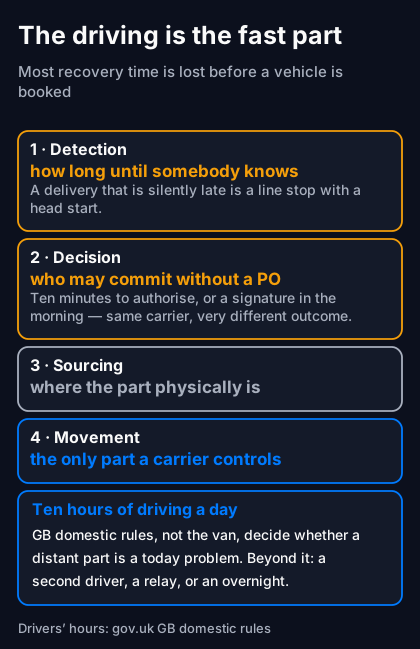
Just-in-time does not remove risk, it moves it. The buffer that used to absorb a late delivery becomes a timing exposure in the supply chain, and the recovery plan becomes the buffer. What decides how quickly a stopped line restarts is rarely the vehicle — it is how long before somebody knows, who can authorise a movement without a purchase order, and whether the journey fits inside one driver's lawful day.
What does just-in-time actually remove?
Inventory, and with it the buffer that used to absorb a late delivery. Just-in-time is a production method in which parts arrive as the line needs them rather than being held in stock, and its whole economic case is the working capital and the space that holding stock consumes.
What is less often said is what the method transfers rather than removes. The risk that a buffer used to absorb does not disappear; it moves to the supply chain and becomes a timing risk. A plant running three days of stock survives a missed delivery by not noticing. A plant running two hours does not, and that is the trade the method makes deliberately.
What is a line stop?
The point at which production halts because a part is not there. It is the failure mode just-in-time exists in tension with, and it is binary rather than gradual: a line either has what it needs or it is stopped.
The cost is not the part. It is the idle labour, the restart sequence, the downstream schedule and, where the plant supplies someone else's line, the contractual consequences of stopping theirs too. That is why a plant will pay for a vehicle whose cost looks absurd against the value of what it carries: the comparison is not against the part, it is against the hour.
What is the recovery plan made of?
Four components, and the first is the one most often missing.
- Detection. How long between the part not arriving and somebody knowing. A delivery that is silently late is a line stop with a head start.
- Decision. Who is authorised to commit to an emergency movement in the middle of the night without a purchase order.
- Sourcing. Where the replacement part physically is — another plant, a supplier, a stockist.
- Movement. Getting it there, which is the only part a carrier controls.
Most recovery time is lost in the first two. A plant that can authorise a vehicle in ten minutes and one that needs a signature in the morning have the same carrier and very different outcomes, and nothing in the transport arrangement fixes the difference.
Why is a dedicated vehicle the usual answer?
Because a shared network optimises for cost per consignment and an emergency optimises for one consignment. The two are structurally opposed, and the difference is not service quality but routing.
| Shared network | Dedicated vehicle | |
|---|---|---|
| Route | Via a hub, with other freight | Point to point, nothing else on board |
| Timing | Fixed departures and sort windows | Leaves when the goods are ready |
| Cost basis | Shared across the load | The whole vehicle and driver |
| Failure mode | Misses a window, waits for the next | Traffic and drivers' hours only |
The sort window is the decisive row. A part that misses an overnight cut-off does not arrive a little late; it arrives the next day, which on a stopped line is the same as not arriving.
What limits how fast a part can get there?
The law, not the vehicle. A single driver may drive no more than ten hours in a day under GB domestic rules, and that ceiling — not the speed of the van — decides whether a distant part is a today problem or a tomorrow problem.
Where the journey will not fit, the lawful answers are a second driver, a relay at a midpoint, or an overnight. Our drivers' hours article sets out how that arithmetic works. A carrier that promises a time the rules do not permit is promising something it will either break or breach.
The second limit is the part itself. Anything heavy, awkward or fragile needs the right vehicle and the right restraint on board before it leaves, which is a question to settle at booking rather than at the kerb — see load securing.
What should a plant have agreed before it needs this?
Five things, none of which can usefully be arranged during the incident.
| Agreed in advance | Why it cannot wait |
|---|---|
| Who may authorise, and up to what value | The authorisation delay is usually longer than the drive |
| A number that is answered out of hours | Line stops do not respect office hours |
| Collection points already known | Finding the part is slower than moving it |
| Vehicle and handling requirements | The wrong van arriving is a second delay |
| Site access and delivery constraints | A goods-in bay that shuts before the vehicle can arrive defeats the whole plan |
None of that is a contract. It is a page of information held by somebody who answers the phone, and it is the difference between a two-hour recovery and a six-hour one.
Does any of this change for a service engineer rather than a line?
The shape is the same and the clock is different. A machine down at a customer site is a line stop with a contract attached: there is usually a response commitment, the engineer is already dispatched or waiting, and the part is the only missing element.
What changes operationally is the delivery point. A plant has a goods-in bay and a person; a customer site may have neither, and the part frequently has to meet an engineer rather than an address. That turns a delivery into a rendezvous, which needs a mobile number and a confirmed location rather than a postcode, and it is worth saying at booking because it changes how the job is run.
Is emergency logistics expensive?
Against the part, absurdly. Against the hour it prevents, it is usually the cheapest line in the incident, and that is the comparison a plant manager is actually making when they call.
It follows that the question worth asking is not "what does a dedicated vehicle cost" but "what does an hour of this line cost, and how many hours does this remove". A business that knows its own figure decides in minutes; one that does not spends the time arguing about the quote instead, which is time the line is still stopped.
Our pricing is one fixed price per dedicated job, from £50 (ex VAT), quoted in full before you book. Final price depends on distance, vehicle, urgency and time — quoted in full upfront before you book.
Why does the part always seem to be far away?
Because the near ones are already on the line. The whole point of just-in-time is that local, fast-moving stock is consumed, so the part that stops a line is by selection the one nobody had spare nearby — a long-lead item, a low-runner, or something only one plant in the group holds.
That selection effect is worth naming because it changes planning. The emergency journeys a plant actually needs are not average journeys; they are the long tail, and a carrier arrangement scoped around typical distances will be wrong exactly when it is used. The useful question at set-up is not "who covers our area" but "who can reach the three sites we would have to go to in the worst case, inside a day".
What goes wrong with the vehicle itself?
Rarely the vehicle. The recurring failures are at the two ends, and both are known in advance to somebody.
| Failure | What prevents it |
|---|---|
| Nobody at the collection point to release the part | A named contact who knows the driver is coming |
| Part not ready, or still being located | Confirming it is physically in hand before dispatching a vehicle |
| Wrong vehicle for the weight or dimensions | Weight and size at booking, not at the kerb |
| Goods-in closed on arrival | Telling the carrier the site's access window |
The second row is the expensive one. A vehicle dispatched towards a part that has not been found yet converts a sourcing delay into a sourcing delay plus a wasted journey, and it happens because sending the van feels like progress.
What do we actually do in one of these?
Collect and deliver, to the deadline, with the vehicle committed to nothing else. Our just-in-time courier work is point-to-point dedicated running, and the just-in-time manufacturing page covers the scenario in detail.
What we are not is a stockholder or a sourcing agent. We do not hold spares, we do not find parts, and we cannot shorten a decision that has not been made. Where the part is hazardous our drivers hold ADR for classes 2, 3, 4, 5, 6, 8 and 9; what we hold and what we do not is listed on our licences page.
One practical note on how we quote these. An emergency job is priced on the plan rather than on the mileage, because the plan is what varies: a run with a usable return leg and one without are different jobs at the same distance, and a relay is two vehicles rather than one. That is why a quote for a job to a remote site can look disproportionate next to a longer run to a well-connected one — the geography, not the distance, is doing the work.
Enquiries are answered between 06:00 and 22:00, seven days a week. For the definition and the background, the just-in-time glossary entry covers the method itself.
Questions
- What is a line stop?
- The point at which production halts because a part is not there. It is binary rather than gradual: a line either has what it needs or it is stopped. The cost is not the part but the idle labour, the restart sequence, the downstream schedule and, where the plant supplies someone else's line, the consequences of stopping theirs too. That is why the comparison is against the hour, not against the component.
- Why not just use an overnight network for an urgent part?
- Because of the sort window. A shared network routes via a hub with fixed departures, and a part that misses the cut-off does not arrive a little late — it arrives the next day, which on a stopped line is the same as not arriving. A dedicated vehicle leaves when the goods are ready and goes point to point, so its only failure modes are traffic and drivers' hours.
- What actually slows down an emergency delivery?
- Usually not the driving. Most recovery time is lost before a vehicle is booked: the delay between a part not arriving and somebody knowing, and the delay in finding a person authorised to commit to a movement without a purchase order. A plant that can authorise in ten minutes and one that needs a signature in the morning get very different outcomes from the same carrier.
- How far can a part realistically travel in a day?
- That is set by drivers' hours rather than by the vehicle. Under GB domestic rules a driver may not drive more than ten hours in a day, with a separate eleven-hour duty limit covering loading and waiting. Where a journey plus its return will not fit, the lawful answers are a second driver, a relay at a midpoint, or an overnight. A carrier promising a time the rules do not permit will either break it or breach them.
- What should we agree with a carrier before we need one?
- Five things, none of which is a contract: who may authorise an emergency movement and up to what value, a number that is answered out of hours, the collection points you are likely to use, your vehicle and handling requirements, and your site access constraints. It is a page of information held by somebody who answers the phone, and it is the difference between a two-hour recovery and a six-hour one.
- Is a dedicated vehicle worth it for a small part?
- That depends on a number only you have: the cost of an hour of the stopped line. Against the value of the part a dedicated vehicle is usually absurd; against the hour it prevents it is normally the cheapest line in the incident. Businesses that know their own hourly figure decide in minutes. Those that do not spend the time arguing about the quote, which is time the line is still stopped.
- Can you source the part as well as move it?
- No. We are a carrier, not a stockholder or a sourcing agent: we do not hold spares and we do not find parts. What we do is collect and deliver to the deadline with the vehicle committed to nothing else. Where the part is hazardous our drivers hold ADR licences for classes 2, 3, 4, 5, 6, 8 and 9, and everything we hold is listed with its register on our licences page.
Explore more
More from the blog
- Same-Day vs Next-Day Delivery: A Data-Driven Decisi…
- Pharmaceutical Cold Chain Logistics UK: A Growing M…
- Commodity Codes Explained: How to Classify UK Impor…
- Shipping to EU After Brexit 2026: Complete UK Busin…
- UK Government Spends £166B on Logistics: What It Me…
- Time-Critical Logistics Solutions UK — When Every M…