
Load securing: 100% forward, 50% sideways, and who is responsible
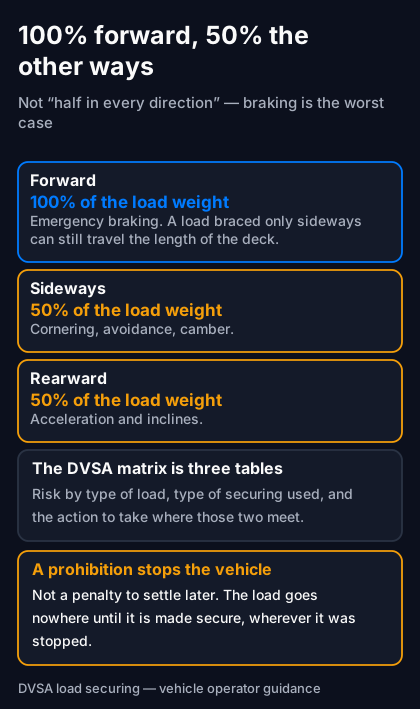
A restraint system has to hold 100% of the load weight acting forward and 50% acting sideways and rearward. The asymmetry is the whole point and it is the part most often misremembered as “half in every direction” — which understates the one direction that matters most, because emergency braking is far more violent than cornering. This sets out the standard, how DVSA decides at the roadside, who is responsible when the sender loaded the vehicle, and the four facts a carrier needs before it sends one.
What does the law actually require of a secured load?
That the restraint can hold the load against the forces a vehicle generates, and those forces are not equal in every direction. DVSA's load securing guidance sets the standard: a restraint system should withstand forces equivalent to 100% of the load weight acting forward, and 50% acting sideways and rearward.
The forward figure is double the others because emergency braking is the worst case. A vehicle stopping hard decelerates far more violently than it corners or accelerates, so a load that is adequately braced against sideways movement can still travel the length of the deck into the bulkhead under braking. "Half the weight in every direction" is the version most people remember, and it is wrong in the direction that matters most.
What does 100% forward mean in practice?
That a one-tonne load needs restraint capable of resisting a tonne of force towards the front of the vehicle. Not a strap that looks adequate — a system rated for it.
| Direction | Restraint must withstand | Caused by |
|---|---|---|
| Forward | 100% of the load weight | Emergency braking |
| Sideways | 50% of the load weight | Cornering, avoidance, camber |
| Rearward | 50% of the load weight | Acceleration, inclines |
Weight is therefore the first thing a carrier needs, and it is the figure most often given as an estimate — our payload and gross vehicle weight article covers why that estimate matters twice over. Headboards, bulkheads and load-rated racking all count towards the forward figure, which is why a load pushed up against a rated bulkhead needs less strapping than the same load sitting in the middle of a deck. Positioning is part of the restraint system rather than a convenience.
What is the DVSA load security matrix?
The tool an examiner uses at the roadside to decide what to do about a load that might not be secure. It is three tables rather than one: the risk represented by the type of load, the type of securing used, and the action to take based on where the first two intersect.
The examiner reaches it by asking a short sequence of questions — essentially, can this load slide, and can it topple. If the answer to either is yes, the matrix decides whether the outcome is advice, a delayed prohibition or an immediate one. That structure is worth understanding because it explains why two loads that look similar get different outcomes: a heavy, rigid load that cannot topple is treated differently from a lighter one that can.
What happens at a roadside check?
A prohibition stops the vehicle where it stands. It is not a fine to be dealt with later: the load cannot continue until it is made secure, which on a motorway hard shoulder or in a check site means the consignment is going nowhere for some hours.
Industry safety campaigns report in the order of 2,000 prohibitions a year for insecure loads. The cost of one of them is rarely the penalty. It is the failed delivery, the vehicle and driver tied up, the re-strapping, and on a time-critical job the fact that the deadline has gone.
Responsibility is shared rather than sitting with the driver alone. The operator, the driver and — where they loaded the vehicle or specified how it should be loaded — the consignor can all be in scope, which is the part senders are usually surprised by.
Who is responsible when the sender loaded the vehicle?
Everyone who contributed to the situation. A driver who accepts an unsafe load is responsible for driving it; a sender who loaded it, or who instructed how it should be loaded, has contributed to the defect and cannot hand the whole of it over with the keys.
In practice this is why a driver may refuse a load, or insist on re-strapping something a warehouse considered finished. That is not obstruction and it is not a comment on the warehouse: the person who will stand at the roadside explaining the restraint is the driver, and they are entitled to be satisfied by it.
The workable arrangement is to settle it at booking. Tell the carrier what the load is, what it weighs, whether it can topple and how it is presented, and the vehicle that arrives will have the right equipment on it.
What makes a load harder to secure than it looks?
Shape and rigidity, far more than weight. A dense, square, rigid load is the easy case. The difficult ones share properties that are not obvious from a weight figure.
- A high centre of gravity — anything tall and narrow topples long before it slides.
- Smooth or coated surfaces, which defeat friction and make the load dependent entirely on the restraint.
- Crushable packaging, where tightening a strap enough to restrain the load destroys the goods.
- Loose or irregular items that cannot be treated as a single mass.
- Part loads, where the deck is not full and the load can move before anything stops it.
The last is the quiet one. A full deck restrains itself to a degree because there is nowhere to go; a single pallet in the middle of an empty van has the whole length to accelerate across. Our large and heavy items article covers the handling side, and pallet sizes covers what fits where.
Does friction count towards the restraint?
It does, and it is the part of the system nobody specifies. A load sitting on a clean steel deck slides far more readily than the same load on a rubber anti-slip mat, and the difference is large enough to change how much strapping is needed to meet the standard.
That cuts both ways. A warehouse that relies on friction without providing it — a smooth plastic pallet base on a smooth deck, nothing underneath — has effectively removed a component of the restraint and may not realise it. Conversely, a mat costing very little can take a load from marginal to comfortable.
Friction cannot do the whole job on its own, and nothing in the guidance permits relying on it alone. It is a contribution to the total rather than an alternative to strapping, and treating it as a substitute is a common and expensive misreading.
What about loads that cannot be strapped?
They get restrained some other way, and the answer is usually containment rather than tension. Loose items, fragile goods and anything with crushable packaging are secured by filling the space around them so they cannot move, by using a cage or a stillage, or by blocking against rated structures.
- Blocking — positioning the load against a bulkhead, headboard or other rated structure so the force is transferred rather than resisted.
- Bracing — load bars and struts that fill a gap and stop movement starting.
- Containment — cages, stillages and purpose-built frames that make an irregular load behave as one mass.
- Friction — anti-slip matting, as a contribution rather than a substitute.
Dunnage used for bracing is packaging in its own right, which matters if the movement crosses a border: solid timber over 6 mm has to meet ISPM 15 whether or not anybody ordered it.
Does the standard change for a van?
No. The forces a load generates are a function of the load and the vehicle's deceleration, not of the vehicle's size, so a van carrying a tonne has to restrain that tonne against the same proportions as a lorry carrying it. There is no lighter standard for lighter vehicles.
What does change is the margin for error. A van has less deck to play with, fewer anchor points than a curtainsider, and no second chance if a load shifts into a bulkhead designed for a smaller force. The absence of a tachograph and an operator licence on a 3.5-tonne van is sometimes read as an absence of regulation generally, and load security is one of the places that reading is simply wrong.
Roadside enforcement treats them alike too. A van stopped with an insecure load gets the same matrix applied to it as anything else on the road.
What should you tell a carrier before the vehicle arrives?
Four facts that decide the equipment, and all of them are known to you before you book.
| Tell them | Because it decides |
|---|---|
| Weight, per item and in total | The rating of the restraint required |
| Dimensions, especially height | Whether the load can topple |
| Whether it is palletised, crated or loose | Whether it can be treated as one mass |
| Whether packaging is crushable | Whether strapping alone will work |
A carrier told these sends a vehicle with the right straps, bars, mats or blankets. A carrier told "a pallet" sends a van and finds out at the kerb, which is how a job that should have taken an hour becomes a conversation about whether it can be carried at all.
Our vehicles carry restraint equipment as standard and our drivers hold Driver CPC as the law requires; for anything unusual the same-day courier page sets out how a job is scoped, and drivers' hours covers the other constraint on a long load-and-run.
Questions
- What forces does a load restraint have to withstand?
- Forces equivalent to 100% of the load weight acting forward, and 50% acting sideways and rearward. The forward figure is double because emergency braking decelerates a vehicle far more violently than it corners or accelerates. 'Half the weight in every direction' is the version most people remember and it understates the one direction that matters most: a load braced adequately against sideways movement can still travel the length of the deck under braking.
- What is the DVSA load security matrix?
- The tool a DVSA examiner uses at the roadside to decide what to do about a load that may not be secure. It is three tables: the risk represented by the type of load, the type of securing used, and the action to take where those intersect. The examiner gets there by asking whether the load can slide and whether it can topple, and the matrix then decides between advice, a delayed prohibition and an immediate one.
- Who is responsible for an insecure load — the driver or the sender?
- Potentially both, plus the operator. A driver who accepts an unsafe load is responsible for driving it, and a sender who loaded the vehicle or specified how it should be loaded has contributed to the defect and cannot pass the whole of it over with the keys. This is why a driver may refuse a load or insist on re-strapping something a warehouse considered finished: they are the one who will explain it at the roadside.
- What happens if DVSA finds an insecure load?
- A prohibition stops the vehicle where it stands. It is not a penalty to settle later — the load cannot continue until it is made secure, which at a check site means some hours at best. Industry safety campaigns report in the order of 2,000 prohibitions a year for insecure loads. The real cost is rarely the penalty: it is the failed delivery, the vehicle and driver tied up, and a deadline that has gone.
- Why is a part load harder to secure than a full one?
- Because a full deck restrains itself to a degree — there is nowhere for anything to go. A single pallet in the middle of an empty van has the whole length of the deck to accelerate across before anything stops it, so it depends entirely on the restraint system and on positioning. Pushing a load up against a rated bulkhead is part of the restraint, not a convenience.
- What makes a load difficult to secure?
- Shape and rigidity far more than weight. The difficult properties are a high centre of gravity, which topples before it slides; smooth or coated surfaces that defeat friction; crushable packaging, where tightening a strap enough to restrain the load destroys the goods; loose or irregular items that cannot be treated as one mass; and part loads with room to move. A dense, square, rigid load is the easy case.
- What should I tell a courier about my load before booking?
- Four facts, all of which you already know: weight per item and in total, which sets the rating of restraint needed; dimensions and especially height, which decides whether it can topple; whether it is palletised, crated or loose, which decides whether it is one mass; and whether the packaging is crushable, which decides whether strapping alone will work. A carrier told 'a pallet' finds out at the kerb.
Explore more
More from the blog
- Proof of Delivery: What It Actually Proves, and Wha…
- Proof of Origin: The Four Ways to Prove Where Goods…
- Reverse logistics: why a return costs more than the…
- Road Charges on a UK Delivery: What They Are, and W…
- UN3480 vs UN3481: which number applies to your lith…
- What a Van Can Legally Carry: Gross Vehicle Weight,…