
What a Van Can Legally Carry: Gross Vehicle Weight, Payload and Overloading
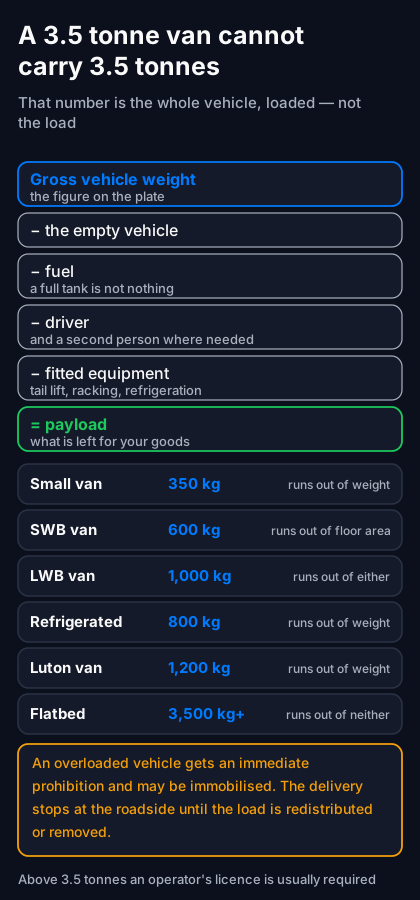
A van described as "3.5 tonne" cannot carry 3.5 tonnes. That number is how much the vehicle is allowed to weigh in total — itself, its fuel, its driver, its tail lift and your goods, all together — and what is left for the load is a good deal less than people expect. This guide covers how to work out the real payload, why the brochure figure is never the one you get, what changes at the 3.5 tonne line, how a load can be legal on total weight and illegal on an axle, and what actually happens when a vehicle is stopped overloaded.
What is gross vehicle weight?
Gross vehicle weight is the most the vehicle is allowed to weigh with everything in it — the vehicle, the fuel, the driver, the equipment and the load, all together. The legal term is maximum authorised mass, which gov.uk defines as the weight of a vehicle or trailer including the maximum load that can be carried safely when it is being used on the road. You will also see it called permissible maximum weight, and it is stamped on a plate fixed to the vehicle.
The number people mean when they say a van is "a 3.5 tonne van" is this one. It is not how much the van can carry. That distinction is the whole of this article, and it is where almost every overloading problem starts.
How do you work out what a van can actually carry?
Subtract the weight of the vehicle as it stands from its gross vehicle weight. What is left is the payload, and it is always smaller than the headline figure suggests.
| Start with | Gross vehicle weight from the plate |
|---|---|
| Subtract | The vehicle itself, empty |
| Subtract | Fuel — a full tank is not nothing |
| Subtract | The driver, and a second person where the job needs one |
| Subtract | Fitted equipment: tail lift, racking, refrigeration unit, straps |
| What remains | The payload available for your goods |
A tail lift alone can take a substantial bite out of the figure, which is why the same model of van has a different payload depending on how it is specified. Ask for the payload of the actual vehicle being sent, not the model.
Why is the payload always less than the brochure says?
Because a brochure quotes the lightest build of the vehicle and a working van is never that. Refrigeration, a tail lift, interior racking, a bulkhead, a second seat row and a toolkit are all weight that was not in the brochure figure, and every one of them is subtracted from the same total.
The effect compounds on the vehicles most likely to be carrying heavy goods. A refrigerated van carries its cooling unit everywhere it goes, so the payload available for your pallets is lower than the equivalent dry van — which is why our van size guide lists the refrigerated van's payload separately rather than lumping it with the box van of the same length.
What changes at 3.5 tonnes?
Quite a lot, and it is the line that decides what kind of operation is carrying your goods. Above 3.5 tonnes gross plated weight, a goods vehicle operator's licence is usually required to carry goods for hire or reward or in connection with a trade or business — or, where there is no plated weight, above an unladen weight of 1,525 kg.
| Up to 3.5 tonnes | Above 3.5 tonnes | |
|---|---|---|
| Operator's licence | Not usually required | Usually required |
| Vehicle class | Van | Heavy goods vehicle |
| Typical payload | Up to about 1,200 kg | Thousands of kilograms |
| Who runs them | Most courier operators | Licensed haulage operators |
T&C Logistics does not hold an operator's licence; HGV work that needs one is carried out by partner carriers that hold their own, which is set out on our licences page. For a consignment near the line, that is worth knowing before you book rather than after.
What can each vehicle class carry?
These are the payload figures for our own fleet, which is the number that actually constrains a booking.
| Vehicle | Max payload | Pallets | What it runs out of first |
|---|---|---|---|
| Small van | 350 kg | — | Weight, on anything dense |
| SWB van | 600 kg | 1 | Floor area, on bulky goods |
| LWB van | 1,000 kg | 2 | Either, depending on the load |
| Refrigerated van | 800 kg | 2 | Weight — the cooling unit is permanent |
| Luton van | 1,200 kg | 3–4 | Weight, on pallets |
| Flatbed | 3,500 kg+ | 6+ | Neither, usually |
Read the last column first. Light bulky goods run out of space long before weight, and dense goods do the reverse — a pallet of tiles and a pallet of pillows occupy the same floor and behave completely differently. Our pallet capacity guide covers the footprint side of the same decision.
What happens if a vehicle is overloaded?
The journey stops. An overloaded vehicle receives an immediate prohibition and may be immobilised; officers can direct it to somewhere nearby where the load can be redistributed or removed. It is a serious offence to move a vehicle while a prohibition is in force, and an officer has to lift the prohibition before the journey can continue.
That is the consequence that matters to a consignment. Whatever the financial penalty, the delivery is now at the side of a road with a load that has to be taken off it before anything moves — and the goods are not going to arrive today. DVSA examiners do allow a 5% leeway before issuing a fixed penalty or prohibition, but that leeway does not apply where the relevant weight is exceeded by a tonne or more.
Can a vehicle be within its gross weight and still be illegal?
Yes, and this is the trap that catches careful people. Individual axles have their own limits, and a load that is within the gross figure can still put too much weight over one axle — which is why enforcement officers can require a load to be redistributed rather than simply reduced.
In practice it happens when a heavy item is loaded at one end of the deck. A single 800 kg machine against the bulkhead of a van rated for 1,000 kg is legal on paper and can still be over on the front axle. The fix is loading practice rather than arithmetic: heavy items low and central, weight spread along the deck, nothing concentrated at one end. This is a driver's job, and it is a reason to tell the carrier the weight of the heaviest single item rather than only the total.
What about loads that are legal but awkward?
Weight is only one of the two limits, and it is the one people check. A consignment can sit comfortably inside the payload and still be the wrong job for the vehicle because of what it is rather than what it weighs.
| The load | What actually binds |
|---|---|
| One dense item, well under the payload | Whether one person can move it — see large and heavy items |
| Light but long | Load length and door aperture, not weight |
| Within payload, nothing to unload it at the far end | Equipment and access at the delivery point |
| Within payload, needs temperature control | The refrigerated van's lower payload |
The third row is the one that fails most often. A load inside every limit still does not arrive if there is no tail lift, no pallet truck and no second person where the vehicle stops.
Does the weight change the price?
Only where it changes the vehicle. A dedicated run is sold as a vehicle and a driver for a journey, so between vehicle steps extra weight is close to free — 400 kg and 900 kg in the same long-wheelbase van cost the same thing. The jump comes when the weight forces the next class up.
That is the opposite of a parcel network, where weight is priced continuously, and it is why a consignment that looks expensive per kilogram on a network can be cheaper on a dedicated vehicle. Our pricing report covers how the rest of the figure is built, and the road charges a route picks up are in the road charges guide.
Who is responsible for an overloaded vehicle?
More people than expect to be. The driver is responsible for not taking an overloaded vehicle onto the road, and the operator is responsible for the vehicle going out in that state — and a fixed penalty for overloading affects the operator's compliance record, not just the day.
What follows for a customer is less obvious and more useful: the figures you give at booking are what the carrier plans the vehicle against. A consignment declared at 400 kg and presented at 900 kg does not become legal because the declaration was wrong; it becomes a job the wrong vehicle arrived for. Declaring the weight accurately is not paperwork — it is what makes the booking deliverable.
How do you know your load is within the limit?
Weigh it, or get the figures from whoever supplied it. Estimating by eye is where this goes wrong, because density varies far more than volume suggests.
- Get a weight per item, not a total. The heaviest single piece decides the handling and the axle loading as well as the total.
- Use the supplier's figures where goods are still packaged — a pallet label usually carries a gross weight.
- Add the packaging. A wooden pallet is around 25 kg before anything goes on it, and crating adds more.
- Tell the carrier the heaviest item separately. It is what selects the vehicle and decides whether one person can handle it.
- Say if you are unsure. A carrier would far rather send the next size up than send the wrong vehicle twice.
How does this change what you book?
It moves the question from "what will fit" to "what will fit and weigh". Those are different constraints and they bind at different times: light bulky goods exhaust the floor, dense goods exhaust the payload, and only one of them is visible when you look at the load.
Send us the collection and delivery postcodes, the dimensions, and the weight of the heaviest single item, and we will tell you which vehicle that forces before you book rather than when the driver arrives. We run dedicated vehicles from small van to flatbed across the UK mainland; work above 3.5 tonnes runs through partner carriers that hold their own operator's licence. Call 07963 400173 or send the details by WhatsApp. Pricing starts from £50 (ex VAT), and the final price depends on distance, vehicle, urgency and time — quoted in full upfront before you book.
Questions
- What is the difference between gross vehicle weight and payload?
- Gross vehicle weight — legally, maximum authorised mass — is the most the vehicle may weigh with everything in it, including the vehicle itself, fuel, driver, equipment and load. Payload is what is left for your goods once all of that is subtracted. A “3.5 tonne van” is described by its gross weight, not by what it can carry, and the gap between the two is where most overloading starts.
- How much can a Luton van carry?
- About 1,200 kg of payload on our fleet, across three to four UK standard pallets. Whether weight or floor space runs out first depends on the goods: dense loads such as tiles or machinery exhaust the payload long before the deck, and light bulky loads do the opposite. Ask for the payload of the actual vehicle being sent rather than the model, because a tail lift or refrigeration unit comes out of the same total.
- Why is a van's real payload lower than the brochure figure?
- Because a brochure quotes the lightest build and a working van is never that. A tail lift, interior racking, a bulkhead, refrigeration, a second seat row and a toolkit are all weight that was not in the brochure number, and each one is subtracted from the same gross figure. A refrigerated van carries its cooling unit everywhere, so its payload is lower than an equivalent dry van of the same length.
- What happens if a van is stopped overloaded?
- It receives an immediate prohibition and may be immobilised, and officers can direct it somewhere nearby where the load is redistributed or removed. Moving a vehicle while a prohibition is in force is a serious offence, and an officer has to lift the prohibition before the journey continues. Whatever the penalty, the practical outcome is that the delivery is stopped at the roadside and is not arriving that day.
- Can a vehicle be legal on total weight but still over the limit?
- Yes. Individual axles have their own limits, so a load inside the gross figure can still put too much weight over one axle — which is why officers can require a load to be redistributed rather than reduced. A single heavy item loaded against the bulkhead is the usual cause. Telling the carrier the weight of the heaviest single item, not just the total, is what prevents it.
- What changes above 3.5 tonnes?
- A goods vehicle operator's licence is usually required above 3.5 tonnes gross plated weight for carrying goods for hire or reward or in connection with a trade or business — or above an unladen weight of 1,525 kg where there is no plated weight. T&C Logistics does not hold one; HGV work that needs it is carried out by partner carriers that hold their own.
- Who is liable if a consignment overloads the vehicle?
- The driver is responsible for not taking an overloaded vehicle onto the road and the operator for it going out in that state, and a penalty affects the operator's compliance record rather than just the day. For a customer the practical point is different: the weights you give at booking are what the vehicle is planned against, so a consignment declared at 400 kg and presented at 900 kg is simply a job the wrong vehicle arrived for.
- How do I work out what my load weighs?
- Get a weight per item rather than a total, use the supplier's figures where goods are still packaged — a pallet label usually carries a gross weight — and add the packaging, since a wooden pallet is around 25 kg before anything goes on it. Then tell us the heaviest single item separately, because that selects the vehicle and decides whether one person can handle it.