
Reverse logistics: why a return costs more than the delivery did
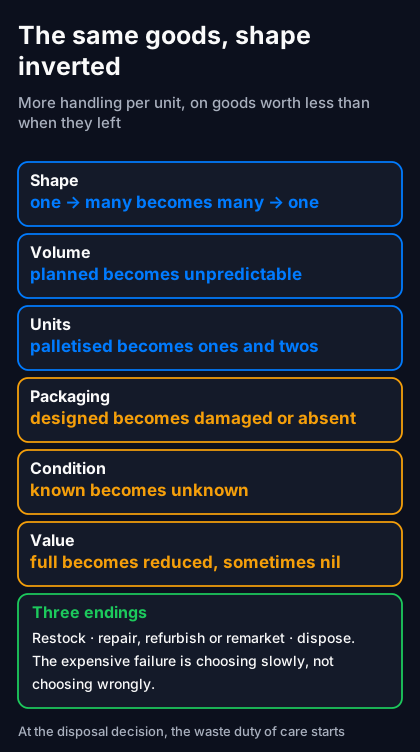
Forward logistics is designed; reverse logistics accumulates. One origin and many destinations becomes many origins and one destination, planned volume becomes unpredictable volume, and uniform palletised units become ones and twos in damaged packaging — so the reverse chain spends more handling per unit on goods worth less. That is the structure rather than a failure, and what a business controls is how fast each item reaches one of three endings.
What is reverse logistics?
Reverse logistics is everything that happens to goods travelling back up the chain: returns, exchanges, recalls, end-of-life equipment, reusable packaging and warranty repairs. It is the same goods and often the same vehicles as the forward chain, running in the opposite direction, and almost nothing else about it is the same.
The reason it gets treated as an afterthought is that it is an afterthought in most systems. Forward logistics is designed; reverse logistics accumulates. Businesses build a distribution model deliberately and then discover that things come back, which is why the reverse flow is usually running on processes nobody chose.
Why does the reverse flow cost more per unit?
Because its shape is inverted, and every efficiency the forward chain relies on depends on that shape. Forward is one origin to many destinations with known volume; reverse is many origins to one destination with unknown volume.
| Forward | Reverse | |
|---|---|---|
| Shape | One origin, many destinations | Many origins, one destination |
| Volume | Planned and known | Unpredictable, arrives when it arrives |
| Units | Uniform, palletised, scannable | Ones and twos, mixed, often loose |
| Packaging | Designed for the journey | Opened, damaged or absent |
| Condition | Known | Unknown until inspected |
| Value | Full | Reduced, sometimes to nil |
Read the last two rows together and the economics are plain: the reverse chain spends more handling per unit on goods worth less than the forward chain spent on them at full value. That is not inefficiency, it is the structure, and the only thing a business controls is how much of it happens.
What are the three decisions at the end of it?
Every returned item ends in one of three places, and the cost of the whole operation is dominated by how quickly it gets to the right one.
- Restock. Resaleable as it stands, back into inventory at close to full value.
- Repair, refurbish or remarket. Recoverable value, at a processing cost.
- Dispose. No recoverable value, and from this point a waste obligation rather than an inventory one.
The expensive failure is not choosing wrongly, it is choosing slowly. An item awaiting a decision occupies space, depreciates and blocks the throughput behind it, and goods that sit in a returns area for a month are usually worth less than the handling they have already consumed.
When does a return become waste?
At the moment the disposal decision is made, and a different regime starts there. From that point the waste duty of care applies under its statutory code of practice: the right transfer document, a registered carrier, and an authorised destination.
This is where returns operations most often acquire a second compliance problem behind the first. Electrical items fall under the WEEE regulations as well, and screens, batteries and anything containing oil or solvent will usually classify as hazardous — which means a consignment note rather than a transfer note, and a longer retention period.
The trap is treating a returns area as inventory storage when some of what is in it has already been decided against. Stock is stock until somebody writes it off; after that it is waste sitting in the wrong building.
How is a recall different from a return?
A return is driven by a customer and a recall by an obligation, and that changes what success means. A returns operation succeeds when the goods come back efficiently. A recall succeeds when you can prove completeness against what was distributed, whether or not the goods come back at all.
The transport looks identical and the record does not. Our product recall article covers what a recall collection has to capture at each site, and why the reconciliation rather than the collection is the hard part. A returns process repurposed for a recall will move the goods perfectly and fail the audit.
What does a carrier need for a reverse job?
More than for the forward equivalent, because the uncertainty sits on the collection end rather than the delivery end.
| Tell the carrier | Because |
|---|---|
| How many collection points, and their access | Reverse is many origins; each is a stop with its own constraints |
| Whether anyone is expecting the driver | An unannounced collection is a wasted journey |
| What condition and packaging to expect | Unpackaged or damaged goods need different handling and restraint |
| Whether anything is hazardous | Batteries, aerosols and solvents decide the driver and the vehicle |
| Where it is all going | One destination, several, or a treatment facility |
The second row costs more wasted journeys than the rest combined. A delivery fails when nobody is in; a collection fails when nobody knows, which is a different and more common problem because the instruction travelled through a head office rather than to a stockroom.
Why does consolidating collections save so much?
Because the cost of a reverse journey is dominated by stops rather than by distance. A vehicle collecting from eight sites in a cluster drives barely further than one collecting from two, and the difference in cost per unit recovered is large enough to change whether the operation is worth running at all.
Forward logistics gets this for free: deliveries are generated by orders, which arrive continuously, so routes fill themselves. Reverse volume arrives when customers decide, which means a collection run that waits a few days to accumulate is usually far cheaper per unit than one that goes as soon as a single item is flagged.
The tension is holding cost against transport cost. Goods waiting to be collected are depreciating at the site that holds them and occupying somebody's floor, so the right interval is a real calculation rather than a default. What is almost never right is collecting singles on demand, which is the shape most returns operations drift into because each individual request looks urgent.
What does reusable packaging change?
It converts a cost into an asset, and an asset has to be tracked. Pallets, cages, totes and stillages that go out with goods and come back empty are reverse logistics that nobody calls reverse logistics, and the losses are usually invisible until somebody counts.
The economics are different from returned goods in one important way: the value is known and constant rather than unknown and declining. That makes the decision simple — recovering a cage is worth it if recovery costs less than replacement — and makes the measurement essential, because an equipment pool leaks steadily and silently. A business that cannot say how many cages it owns is already losing them.
What can be designed out?
Most of the volume, and none of it by the logistics function. Returns are generated by sizing information, product description accuracy, packaging that survives the outbound journey, and a checkout that sets honest expectations — all of which sit upstream of anyone who moves anything.
What logistics can do is make the remaining flow cheaper: consolidate collections rather than running singles, get the decision made at the point of collection where possible, and keep the disposal stream separated from the restock stream so that neither waits for the other. Those are worth doing and they are second-order. A business whose return rate is a product problem will not fix it with a better carrier.
What record should a collection produce?
Enough to settle the question the collection exists to answer, which is rarely just "it was picked up". A signature proves a handover and nothing else — not quantity, not condition, not what remained at the site.
For an ordinary return the useful minimum is quantity, a brief condition note and whether packaging was present, because the condition assessment at the destination is faster if the obvious cases were flagged at the kerb. For a recall it is materially more, since the reconciliation runs against what was distributed rather than what came back.
The common and costly shortcut is a photograph of a signed sheet. It is evidence that somebody signed something, and six months later, when the question is how many units left a particular site, it answers nothing. Deciding the fields before the first collection costs a conversation; reconstructing them afterwards is usually impossible.
What do we do here?
The collection, on a dedicated vehicle, to a plan agreed before the first drop. Multi-site collection rounds, single urgent retrievals, and the acute case where a recall needs every site visited to a deadline.
Where returns are electrical or end-of-life, our IT equipment collection and WEEE collection work covers the waste side, and we hold waste carrier registration CBDU654368, which is on the Environment Agency public register. Where goods are hazardous our drivers hold ADR for classes 2, 3, 4, 5, 6, 8 and 9.
Collections are scoped on the number of stops and their access rather than on the mileage, because that is what actually drives the cost of a reverse round. What we are not is a returns processor: we do not inspect, grade, refurbish or restock, and we hold no stock on anyone's behalf. The returns collection page covers the scenario, the reverse logistics glossary entry the definition, and the licences page what we hold with the register that proves each one.
Questions
- What counts as reverse logistics?
- Everything travelling back up the chain: customer returns, exchanges, recalls, end-of-life equipment, reusable packaging and warranty repairs. It is often the same goods and the same vehicles as the forward chain running the other way, and almost nothing else about it is the same — the shape, the volume, the unit size, the packaging and the condition are all different.
- Why is handling a return more expensive than the original delivery?
- Because the shape is inverted and every forward efficiency depends on that shape. Forward is one origin to many destinations with planned volume and uniform palletised units. Reverse is many origins to one destination, unpredictable volume, ones and twos, packaging that has been opened or damaged, and condition that is unknown until inspected — spent on goods now worth less than full value.
- What are the possible outcomes for a returned item?
- Three. Restock, where it is resaleable as it stands and goes back into inventory near full value. Repair, refurbish or remarket, where value is recoverable at a processing cost. Or dispose, where there is none. The expensive failure is not choosing wrongly but choosing slowly: an item awaiting a decision occupies space, depreciates, and blocks the throughput behind it.
- When does a return become waste legally?
- At the moment the disposal decision is made. From that point the waste duty of care applies — the right transfer document, a registered carrier and an authorised destination. Electrical items fall under the WEEE regulations as well, and screens, batteries and anything containing oil or solvent usually classify as hazardous, which means a consignment note rather than a transfer note and a longer retention period.
- Is a recall just a large return?
- No. A return is driven by a customer and a recall by an obligation, which changes what success means. A returns operation succeeds when goods come back efficiently; a recall succeeds when you can prove completeness against what was distributed, whether or not the goods come back at all. The transport looks identical and the record does not, so a returns process repurposed for a recall will move the goods perfectly and fail the audit.
- What causes a wasted journey on a collection?
- Usually nobody at the site knowing it was coming. A delivery fails when nobody is in; a collection fails when nobody knows, and that is more common because the instruction travelled through a head office rather than to the stockroom. Telling the carrier how many collection points there are, their access constraints and who is expecting the driver removes most of the wasted journeys in a reverse operation.
- Can a carrier reduce our return rate?
- No, and it is worth being clear about it. Returns are generated by sizing information, description accuracy, outbound packaging and checkout expectations — all upstream of anyone who moves anything. What logistics can do is make the remaining flow cheaper: consolidate collections instead of running singles, get the decision made at the point of collection, and keep disposal separated from restock. A product problem will not be fixed by a better carrier.
Explore more
More from the blog
- NCTS Explained: UK Transit Declarations, Guarantees…
- Sending Goods Abroad for Repair, and Bringing Them…
- Pallet Sizes and How Many Fit in Each Vehicle: UK G…
- Product recall logistics: the collection is easy, t…
- Proof of Delivery: What It Actually Proves, and Wha…
- Proof of Origin: The Four Ways to Prove Where Goods…