
Product recall logistics: the collection is easy, the count is not
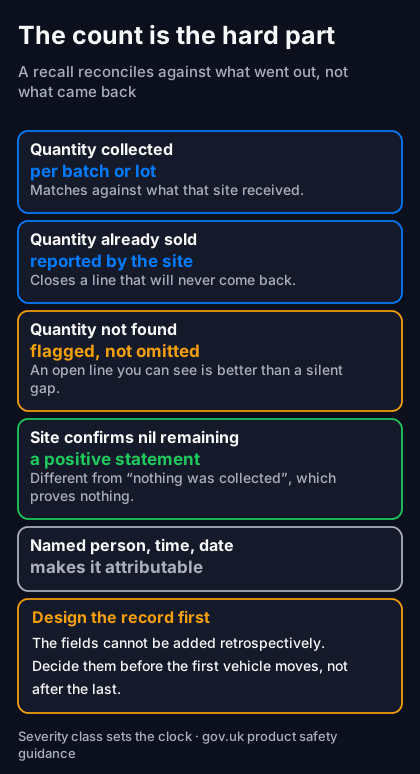
A recall is not a fast collection. It is a reconciliation against what was distributed, with a deadline set by a regulator and a record that has to survive being read afterwards. The transport is the easy part; the count is the hard part, and the count is built from what the driver captures at each site. This sets out what a carrier needs to know before the first vehicle moves, why the paperwork has to be designed in advance, and what happens to the goods once they are back.
What makes a recall different from an ordinary collection?
A recall is the removal from the market of a product already supplied, for a reason the supplier is obliged to act on. What distinguishes it operationally is a deadline set by someone other than you, and a requirement to prove completeness. An ordinary collection succeeds when the goods arrive. A recall succeeds when you can demonstrate that every affected unit has been accounted for — recovered, quarantined, destroyed or formally written off — and that the record stands up to a regulator reading it afterwards.
The difference is measurable in one number: an ordinary collection is judged on a delivery date, and a recall is judged on the percentage of distributed units accounted for. Regulators ask for the second, and nobody can produce it from a signature. That changes what the transport has to deliver. Speed matters, but traceability matters more: a fast collection with a vague record is worse than a slower one with a complete chain of custody, because the first cannot be evidenced and the second can.
What are the three recall classes, and why do they change the logistics?
Recalls are graded by the severity of the risk, and the grade drives the clock. The language varies by sector but the structure is consistent: a top-class recall is a health risk requiring immediate action, the middle class is a risk of temporary or reversible harm, and the lowest is a defect unlikely to cause harm.
| Severity | What it means | What it does to transport |
|---|---|---|
| Highest | Risk of serious harm or death | Immediate, out-of-hours, multi-vehicle; cost is not the constraint |
| Middle | Temporary or reversible harm | Days rather than hours; planned routes across many sites |
| Lowest | Defect unlikely to cause harm | Can run with ordinary scheduled collections |
Most of the cost difference between a well-run recall and a badly run one sits in the first row. A recall that could have been planned over three days and is instead executed in eight hours costs several times as much, and the usual reason is that nobody established the class early.
What does a carrier actually need to know?
More than a normal booking, and it has to arrive at once rather than site by site. The information that decides the vehicle, the route and the paperwork is the same information you need for your own record.
- How many sites, with full addresses and a contact who knows the collection is coming.
- What is being collected at each, described well enough to identify it against stock that is not affected.
- Whether the goods are hazardous or temperature-controlled, because that decides vehicle and driver qualification.
- Where it is all going — one quarantine location, several, or a treatment facility.
- What evidence you need back, because that has to be designed before the first collection rather than reconstructed after the last.
The fifth is the one that is usually left until it is too late. A photograph of a signature proves a handover; it does not prove quantities, batch numbers or that the site had nothing else left.
Why is the count harder than the collection?
Because a recall is reconciled against what was distributed, not against what was collected. The arithmetic runs the other way from an ordinary job: you start from a quantity that left your control and you have to close the gap.
Sites hold stock they have forgotten about, stock that moved internally, stock already sold and stock that was never received. Each of those is a different line in the reconciliation, and none is a transport problem — but transport is where the data is captured. A collection record that says "collected: 14 cases" is far less useful than one that says "14 collected, 2 reported sold, 1 not found, site confirms nil remaining".
That is why the paperwork design matters more than the vehicle choice. Our proof of delivery article covers what a signature does and does not establish; a recall needs the version of that record that works in reverse.
What should the collection record capture?
More than a signature, and the fields have to be decided before the first vehicle moves because they cannot be added retrospectively.
| Field | Why the reconciliation needs it |
|---|---|
| Quantity collected, per batch or lot | Matches against what was distributed to that site |
| Quantity the site reports as already sold or used | Closes a line that will never be collected |
| Quantity not found | An open line, flagged rather than silently missing |
| Site confirmation of nil remaining | Turns an absence of stock into a positive statement |
| Named person, time and date | Makes the statement attributable |
The fourth row does the most work and costs the least. "Nothing was collected" and "the site confirms it holds none" look similar on a worksheet and are completely different in a reconciliation.
What happens to the goods after collection?
Quarantine first, decision second, and the two should not be collapsed. Goods recovered in a recall are segregated from saleable stock on arrival, physically and in the system, and only then assessed for return to the supplier, rework, or disposal.
Where disposal is the answer, a second regime starts. Recalled goods become waste at the point that decision is made, and the duty of care applies from then on: the right transfer document, a registered carrier, and an authorised destination. Pharmaceutical and chemical waste will frequently be hazardous, which means a consignment note rather than a transfer note and a longer retention period.
Treating a recall as finished when the goods are back in a warehouse is how businesses end up with a second compliance problem behind the first one.
How many vehicles does a recall need?
More than the volume suggests, because the constraint is sites rather than cubic metres. A recall of a small item across 40 stockists is a 40-stop problem even if everything recovered would fit in one van, and a single vehicle doing 40 drops over several days is the slowest possible way to close a reconciliation.
The arithmetic that matters is sites divided by the hours available, against what one vehicle can realistically visit in a lawful driving day — see our drivers' hours article for that ceiling. Where the answer exceeds one day, the choice is more vehicles or a longer window, and the severity class usually decides which is available.
Geography then modifies it. Forty sites clustered in two cities is a different job from forty spread across the country, and the second needs either more vehicles or an acceptance that the last site is reached days after the first. Neither is wrong; what is wrong is discovering it after the notice has gone out.
Who has to be told, and when?
That depends on the sector and the severity, and it is not the carrier's call. Different regulators oversee different product categories, and the gov.uk product safety guidance for businesses sets out the general obligations on producers and distributors.
What matters operationally is that notification and collection run in parallel rather than in sequence. The common failure is a business that notifies first, waits for responses, and only then arranges transport — by which time affected stock has moved, been sold or been mixed. Booking collection capacity at the same time as issuing the notice costs little and removes the worst outcome.
What slows a recall down most?
Not transport capacity. Three things, in roughly this order, and all of them are decided before a vehicle is booked.
| Cause of delay | Why it bites |
|---|---|
| Site contacts who do not know a collection is coming | Driver arrives, nobody has authority to release stock |
| A description that does not distinguish affected from unaffected stock | The site cannot segregate, so nothing moves |
| No decision on destination | Goods collected with nowhere agreed to put them |
Each is solved by a single email sent before the first vehicle, and each costs a wasted journey if it is not. The first is the most common by a wide margin: a notice issued to a head office does not reach the stockroom, and the driver is the one who discovers it.
What can a courier do, and what needs a specialist?
We do the collection: dedicated vehicles to multiple sites, to a deadline, with a record designed before the first drop. Where goods are hazardous our drivers hold ADR for classes 2, 3, 4, 5, 6, 8 and 9, and where they are temperature-controlled we hold and evidence the range for the whole movement including waiting time.
What we are not is an accredited pharmaceutical operation. T&C Logistics is not an MHRA-licensed wholesale dealer and holds no GDP certification; work genuinely requiring those runs through GDP-certified partner carriers under their own licence, and we will name the partner for your job. We also hold no Home Office controlled drug licences. The full list, with the register that proves each credential, is on our licences page.
For the sector-specific case our pharmaceutical courier and medical logistics pages set out the handling, and the pharmaceutical recall page covers that scenario in detail.
Questions
- What makes a product recall different from a normal collection?
- The need to prove completeness. An ordinary collection succeeds when the goods arrive; a recall succeeds when you can demonstrate every affected unit has been accounted for — recovered, quarantined, destroyed or formally written off — in a record that stands up to a regulator reading it later. A fast collection with a vague record is worse than a slower one with a complete chain of custody.
- What information does a carrier need to run a recall collection?
- Five things, all at once rather than site by site: how many sites with addresses and a contact expecting the collection; what is being collected at each, described well enough to distinguish it from unaffected stock; whether the goods are hazardous or temperature-controlled; where everything is going; and what evidence you need back. The last is usually left too late and has to be designed before the first collection.
- Why is counting harder than collecting in a recall?
- Because a recall reconciles against what was distributed rather than what was collected. Sites hold stock they have forgotten, stock that moved internally, stock already sold and stock never received. Each is a separate line in the reconciliation. A record saying 'collected: 14 cases' is far less useful than '14 collected, 2 reported sold, 1 not found, site confirms nil remaining', and that detail is captured at the kerb or not at all.
- What happens to recalled goods after they are collected?
- They are quarantined on arrival — segregated from saleable stock physically and in the system — and only then assessed for return to supplier, rework or disposal. Where disposal is the answer a second regime starts: the goods become waste, the duty of care applies, and pharmaceutical or chemical waste will frequently be hazardous, needing a consignment note rather than a transfer note.
- Should I notify the regulator before arranging collection?
- Run them in parallel, not in sequence. The common failure is notifying first, waiting for responses and only then arranging transport, by which time affected stock has moved, been sold or been mixed with unaffected stock. Booking collection capacity at the same time as issuing the notice costs little and removes the worst outcome. Which regulator and when depends on the product category and the severity.
- Can you handle a pharmaceutical recall?
- We can do the collection — dedicated vehicles to multiple sites, to a deadline, with a record designed before the first drop, and temperature control held and evidenced for the whole movement including waiting time. What we are not is an accredited pharmaceutical operation: T&C Logistics is not an MHRA-licensed wholesale dealer, holds no GDP certification and no Home Office controlled drug licences. Work needing those runs through GDP-certified partner carriers.
- Can you collect recalled hazardous goods?
- Yes, within the classes our drivers are licensed for. Our ADR licences cover classes 2, 3, 4, 5, 6, 8 and 9; we do not carry class 1 explosives or class 7 radioactive material. Where recalled goods are being collected for disposal rather than return, the waste duty of care applies from the point that decision is made, which usually means a hazardous waste consignment note rather than an ordinary transfer note.
Explore more
More from the blog
- Demurrage, detention and waiting time: three clocks…
- Do you actually need a bonded warehouse, or just a…
- Drivers' hours: the number that decides your delive…
- EMCS: how a duty-suspended excise movement actually…
- EORI Number Explained: GB, XI, and Who Actually Nee…
- GVMS and the Goods Movement Reference Explained