
Do you actually need a bonded warehouse, or just a deferment account?
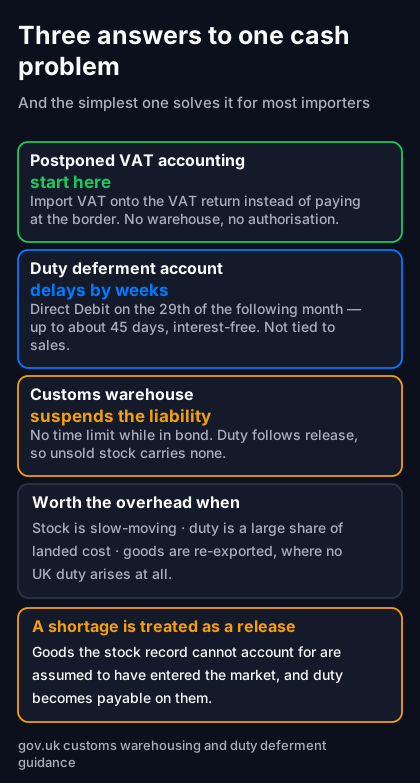
A bonded warehouse suspends duty until goods are released, which sounds like free money and is actually a trade: you take on an authorisation, a stock-record system and an audit exposure in exchange for duty that follows sales instead of arrivals. For a lot of importers a duty deferment account does enough at a fraction of the overhead, and for some the real problem is import VAT and needs neither. This sets out the decision rather than the definition.
What is a bonded warehouse?
A bonded warehouse is an HMRC-authorised site where imported goods are stored under customs control with duty and import VAT suspended. The charges are not waived — they fall due when the goods are released into the UK market, and not before.
The word "bonded" covers two different authorisations that people use interchangeably and should not. A customs warehouse suspends customs duty and import VAT. An excise warehouse suspends excise duty on alcohol, tobacco and energy products, under a separate approval and tracked through a different system. A single site can hold both, but they are distinct permissions covering distinct taxes.
What problem does it actually solve?
Cash tied up in duty on stock you have not sold. An importer paying duty at the border funds the tax on every unit the day it arrives, and recovers it only as the goods sell — which on slow-moving or seasonal stock can be months of working capital sitting in HMRC's account rather than the business's.
Bonded storage changes the timing so that duty follows sales. You pay on the stock you release, when you release it, and unsold stock carries no funded duty at all. There is no time limit while the goods stay in bond, which is the part that distinguishes it from every other deferral mechanism.
How does it compare with a duty deferment account?
They solve the same problem to very different depths, and the deferment account is the one most importers should look at first because it is far simpler.
| Duty deferment account | Customs warehouse | |
|---|---|---|
| What it does | Delays payment | Suspends liability |
| How long | Collected by Direct Debit on the 29th of the following month | No limit while the goods remain in bond |
| Effective credit | Up to about 45 days, interest-free | Until you release the stock |
| Linked to sales? | No — the clock runs on the calendar | Yes — duty follows release |
| Where the goods sit | Anywhere | In an authorised, controlled site |
| Admin | An account and a guarantee | Authorisation, stock records, audits |
A business importing regularly and selling steadily gets most of the benefit from a deferment account with a fraction of the overhead. Bonded storage earns its complexity where stock sits for months, or where some of it is never going to be sold in the UK at all.
When is bonded storage clearly the right answer?
Three cases, and the third is the strongest financial argument by a distance.
- Slow-moving or seasonal stock, where duty on unsold units would be funded for months.
- High-duty goods, where the tax is a large fraction of the landed cost and the cash effect is material rather than marginal.
- Re-export. Goods that enter a customs warehouse and leave again without entering free circulation never attract UK customs duty or import VAT at all.
That third case is why a business buying centrally and distributing across several markets uses bonded storage almost by default. The UK leg is a transit, not a sale, and paying UK duty on goods destined for Dublin or Rotterdam is paying a tax that was never owed.
When is it the wrong answer?
When the stock turns quickly and sells domestically, because then you are buying an authorisation, a stock-record system and an audit exposure to accelerate cash you would have paid within the month anyway.
It is also the wrong answer when the real problem is import VAT rather than duty. Postponed VAT accounting lets an importer account for import VAT on the VAT return instead of paying it at the border, which removes most of the cash impact for a VAT-registered business without any warehouse at all — see our postponed VAT accounting article. A surprising number of businesses investigating bonded storage are describing a VAT problem.
What does operating one actually involve?
An authorisation from HMRC, which is granted to a business and a site rather than bought off a shelf, and a continuing obligation that outlives any individual consignment.
| Requirement | What it means |
|---|---|
| Authorisation | Applied for per site; HMRC's decision point on customs warehousing is 60 calendar days |
| Guarantee | May be required to cover the suspended duty and VAT |
| Stock records | Every receipt, movement and release, reconcilable on demand |
| Type | Public, storing other people's goods, or private, storing your own |
Most businesses never operate one. They use a third party's public warehouse as a depositor, which gets the duty treatment without the authorisation, and that is the ordinary route. Our customs special procedures article covers how warehousing sits alongside inward processing and temporary admission.
Does bonded storage help with excise goods specifically?
It is close to essential for them, and for a different reason than for ordinary imports. Excise duty on alcohol and tobacco is frequently larger than the customs duty and sometimes larger than the value of the goods, so the cash effect of paying it on arrival is not a marginal improvement but the difference between a viable stockholding and an impossible one.
The approval is separate. An excise warehouse approval suspends excise duty; a customs warehouse authorisation suspends customs duty and import VAT. Imported wine needs both to sit fully in suspension, which is why excise sites commonly hold two permissions and why "bonded" means something slightly different depending on who is saying it.
How do goods get in and out?
On declarations at both ends, and the two have to correspond. Entry to the warehouse is a customs declaration using the appropriate procedure code, and removal is another — to free circulation with duty paid, to re-export, or to another procedure.
For excise goods the movement side runs on a different system again. A duty-suspended movement to or from an excise warehouse is opened on EMCS by the warehousekeeper and travels against an Administrative Reference Code; our EMCS article sets out how that works and who may open one.
The practical trap at the warehouse door is timing rather than paperwork. A release has a window, and a vehicle that arrives outside it waits or returns empty.
What does HMRC want to see before authorising one?
Evidence that you can account for every item while it is under customs control, which is a records question rather than a buildings one. The physical security of a site matters; the ability to reconcile it matters more, because that is what an audit actually tests.
- A stock record showing every receipt, every movement and every removal, reconcilable to a physical count on demand.
- A clear reason for wanting the authorisation, since it is granted for an economic need rather than as a general permission.
- Financial standing and a compliance history, in the same way every other customs authorisation is assessed.
- A guarantee where HMRC requires one, covering the duty and VAT being suspended.
The decision point on customs warehousing is 60 calendar days from a complete application, the longest of the storage and processing procedures, which is worth planning around rather than discovering.
What happens if the stock record does not reconcile?
The missing goods are treated as having been released to free circulation, and the duty and VAT become payable on them. That is the whole enforcement mechanism and it is why the records matter more than the fence.
It also explains an asymmetry people find counter-intuitive. A shortage is expensive because unaccounted goods are assumed to have entered the market. A surplus is not a windfall; it is evidence the record is wrong, which raises the same question about everything else in the building. Either way the exposure attaches to the authorisation holder rather than to the depositor whose goods they were.
For a depositor using a third party's public warehouse, this is the practical argument for asking how their stock system works before signing. You are relying on somebody else's reconciliation to protect goods you own.
What is our part in this?
The movement, not the storage. T&C Logistics holds no HMRC customs-warehouse authorisation and no excise-warehouse approval, we neither own nor rent bonded storage anywhere in the UK, and we are neither an authorised warehousekeeper nor a registered consignor.
What we do is the legs outside suspension: the duty-paid delivery out of a bonded warehouse, the sample run, the urgent replacement case. Where a consignment genuinely has to move in suspension, the warehousekeeper arranges that under their own approval and we handle what sits either side of it.
One thing worth knowing before you book a collection from a bonded site: the release and the clearance are separate events, and the second usually lags the first. A vehicle sent against a clearance notification rather than against an actual release instruction will arrive to find the goods still under control and nobody able to hand them over. Asking which of the two your contact is quoting takes a sentence and removes most of the wasted journeys in this corner of the work.
Waiting time is charged and we say so before the driver sets off rather than after, because a release window and a waiting charge meet at a bonded facility more often than anywhere else — see demurrage and waiting time. Everything we hold, with the register that proves it, is on our licences page, and the bonded warehouse glossary entry covers the short definition.
Questions
- What is the difference between a customs warehouse and an excise warehouse?
- The tax each suspends. A customs warehouse suspends customs duty and import VAT on goods from outside the UK. An excise warehouse suspends excise duty on alcohol, tobacco and energy products, under a separate HMRC approval and tracked through a different system. A single site can hold both authorisations, but they are distinct permissions covering distinct taxes, and 'bonded' is used loosely for either.
- Is a duty deferment account cheaper than bonded storage?
- Almost always, and simpler. A deferment account delays payment of customs duty, import VAT and excise for a whole month, collected by Direct Debit on the 29th of the following month — up to about 45 days of interest-free credit. It needs an account and a guarantee, not an authorisation, a site and stock records. The limitation is that the clock runs on the calendar rather than on your sales.
- When is bonded storage genuinely worth it?
- Three cases. Slow-moving or seasonal stock, where duty on unsold units would be funded for months. High-duty goods, where the tax is a large share of landed cost. And re-export, which is the strongest case by a distance: goods that enter a customs warehouse and leave again without entering free circulation never attract UK customs duty or import VAT at all.
- How long can goods stay in a bonded warehouse?
- There is no time limit while they remain in bond and under customs control. That is the main thing distinguishing bonded storage from every other deferral mechanism, which all run on a clock. Duty is paid on the stock you release, when you release it, so unsold inventory carries no funded duty for as long as it sits there.
- Do I need my own authorisation to use bonded storage?
- No, and most businesses do not have one. The ordinary route is to use a third party's public warehouse as a depositor, which gets the duty treatment without you holding the authorisation. A private warehouse is one where the keeper stores their own goods. Operating your own means an HMRC authorisation per site — the decision point on customs warehousing is 60 calendar days — plus stock records and possibly a guarantee.
- Could postponed VAT accounting solve my problem instead?
- Possibly, and it is worth checking first. Postponed VAT accounting lets a VAT-registered importer account for import VAT on the VAT return rather than paying it at the border, which removes most of the cash impact with no warehouse and no authorisation. A number of businesses investigating bonded storage are actually describing an import VAT problem, and the much simpler answer fixes it.
- Do you operate a bonded warehouse?
- No. T&C Logistics holds no HMRC customs-warehouse authorisation and no excise-warehouse approval, and we neither own nor rent bonded storage anywhere in the UK. We are also neither an authorised warehousekeeper nor a registered consignor. What we do is the movement: duty-paid deliveries out of a bonded facility, sample runs and urgent replacements, with the suspended legs arranged by the warehousekeeper under their own approval.
Explore more
More from the blog
- Proof of Delivery: What It Actually Proves, and Wha…
- Proof of Origin: The Four Ways to Prove Where Goods…
- Reverse logistics: why a return costs more than the…
- Road Charges on a UK Delivery: What They Are, and W…
- UN3480 vs UN3481: which number applies to your lith…
- What a Van Can Legally Carry: Gross Vehicle Weight,…