
EMCS: how a duty-suspended excise movement actually works
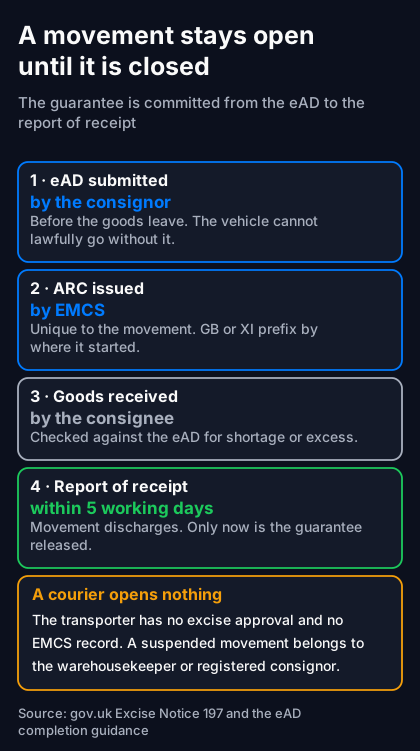
EMCS is where a duty-suspended excise movement lives: the electronic document raised before the goods leave, the reference that travels with them, and the receipt that closes it. A full load of spirits can carry more duty than the vehicle is worth, which is why none of it is optional. This sets out the four roles, what the ARC is for, the five working day clock on the report of receipt, and which legs of an excise job a courier can lawfully take — read from Excise Notice 197 rather than recalled.
What is EMCS?
EMCS is the Excise Movement and Control System, the electronic record HMRC uses to track excise goods moving under duty suspension. Excise goods means alcohol, tobacco and energy products — the categories that carry duty on top of customs duty and VAT — and duty suspension means that duty has not yet been paid because the goods have not yet been released for consumption.
It exists because of what duty suspension is worth. A full load of spirits can carry more duty than the vehicle is worth, so the state needs to know where it is at all times and who is answerable for it. EMCS is that answer: an electronic document raised before the goods move, a reference that travels with them, and a receipt confirmed at the other end. Nothing about it is optional and nothing about it is paper.
How is excise duty different from customs duty?
Excise duty is a domestic tax on particular goods regardless of where they came from. Customs duty is a border tax on goods arriving from outside the UK. A bottle of gin distilled in Scotland and sold in Scotland attracts excise duty and no customs duty at all; the same bottle imported from France attracts both, and the two are suspended by different systems under different approvals.
That is why a consignment can be customs-cleared and still not free to move: the import VAT and customs position can be settled while the excise duty remains suspended, and the goods stay inside EMCS until a report of receipt discharges them. Treating the two as one clearance is the mistake that strands pallets in sheds.
Who are the parties to a duty-suspended movement?
Four roles, each a separate HMRC approval, and a business may hold more than one. Confusing them is the commonest reason a movement is arranged with the wrong party.
| Role | What it permits |
|---|---|
| Authorised warehousekeeper | Hold excise goods in duty suspension in an approved warehouse, and dispatch them in suspension |
| Registered consignor | Dispatch goods in suspension from the point of import, without holding them |
| Registered consignee | Receive goods in suspension, but not store them in suspension — duty becomes payable on receipt |
| Transporter | Carry the goods. No excise approval, and no responsibility for the EMCS record |
The fourth row is where a courier sits, and it is the row with no approval attached. The transporter does not raise the electronic document, does not discharge it, and cannot cure a defect in it at the kerb.
What is an eAD, and when is it raised?
The electronic administrative document is the declaration that opens the movement, and the consignor submits it on EMCS before the goods leave. It is not paperwork that catches up with the vehicle; the vehicle cannot lawfully leave without it.
The eAD identifies the consignor, the consignee, the goods by excise product code and quantity, the place of dispatch and destination, the guarantee covering the duty at risk, and the expected journey time. Each of those fields does work later: the journey time sets the window inside which HMRC expects a receipt, and the guarantee is the money that sits exposed until one arrives.
What is an ARC, and where does it travel?
Once the eAD validates, EMCS generates an Administrative Reference Code — the ARC — unique to that movement. It is the single reference that HMRC, the warehouse and the consignee all check the load against, and the one thing that genuinely has to travel with the goods.
UK codes carry a prefix that says where the movement began: GB for a movement starting in Great Britain and XI for one starting in Northern Ireland. That distinction has mattered since the Northern Ireland arrangements took effect, and it is visible on the reference itself rather than buried in the record.
For a driver, the ARC is the functional equivalent of the CMR note on an international road movement: the number that proves the load is what it says it is. Unlike a CMR note it is not a contract and not a receipt — it is an index into a record held elsewhere.
How does a movement get discharged?
By a report of receipt, submitted on EMCS by the consignee, no later than five working days after the goods arrive. Until that message lands, the movement is open and the guarantee stays committed.
- The consignor raises the eAD and EMCS issues the ARC.
- The goods move, with the ARC available to anyone who stops the vehicle.
- The consignee receives the goods and checks them against the eAD.
- The consignee submits the report of receipt within five working days, noting any shortage or excess.
- The movement discharges and the guarantee is released.
Step five is the one people forget, in exactly the way they forget to discharge an NCTS transit movement. The vehicle has been unloaded, the goods are on the shelf, and the record says a duty-suspended consignment is still somewhere on the road.
What happens when EMCS is unavailable?
A fallback procedure exists, because a system outage cannot be allowed to stop trade. The consignor completes a fallback accompanying document carrying the same information the eAD would have carried, notifies HMRC, and moves the goods on that paper. Once EMCS is available again the electronic document is submitted retrospectively and the movement is brought back into the system.
The practical point for anyone booking transport is that fallback is the consignor's procedure, not the carrier's. A driver presented with a paper document instead of an ARC is not being handed a shortcut; they are being handed evidence that a declared process is running, and the one thing that must not happen is the load leaving without either.
Which legs of this can a courier actually do?
The ones outside suspension, and that is not a limitation so much as a division of labour. We hold no customs-warehousekeeper authorisation, no excise-warehouse approval and no WOWGR registration, and we are neither an authorised warehousekeeper nor a registered consignor.
| Movement | Who arranges it |
|---|---|
| Warehouse to warehouse, in suspension | The warehousekeeper, under their own approval and EMCS record |
| Import point to warehouse, in suspension | A registered consignor |
| Duty-paid delivery out of a bonded warehouse | Us, as the transporter |
| Samples, urgent replacements, duty-paid stock between sites | Us |
In practice this splits the work cleanly. The great majority of urgent excise work is duty-paid or already cleared: a case of spirits to a trade show, a replacement pallet to a wholesaler, a sample run to a laboratory. Those are ordinary same-day jobs with an unusual commodity, and our alcohol courier work is exactly that.
Who provides the guarantee, and when is it released?
The movement guarantee is provided by the consignor — the authorised warehousekeeper or registered consignor — and it covers the excise duty at risk while the goods are in suspension. It is their money, not the carrier's and not the consignee's, which is why they care about the report of receipt more than anyone else in the chain.
It is released when the movement discharges, and not before. That makes the five working day clock a cashflow question rather than a compliance abstraction: every day a report of receipt is late is a day a guarantee stays committed against a consignment that has already been unloaded. A business running many movements has a material sum tied up in the gap between arrival and acknowledgement, and the gap is entirely administrative.
What does the driver actually need to have?
Less than the paperwork suggests, and one thing absolutely. The ARC must be available to anyone who stops the vehicle — in practice printed, or accessible on a device — because it is the reference that proves a declared duty-suspended movement exists. Without it the load is indistinguishable from untaxed goods in transit, which is a different conversation entirely.
- The ARC for the movement, legible and to hand.
- Where the journey is international by road, the CMR note as well — the two documents do different jobs and neither substitutes.
- Delivery details matching the destination on the eAD, because a diverted load is a change to the movement rather than a change to the drop.
A driver cannot fix a missing ARC and should not be asked to try. The movement is the consignor's record; the vehicle simply has to be carrying goods that the record already accounts for.
What should you confirm before booking a vehicle?
Three questions, asked in this order, because the first one changes the answer to the other two.
- Is this consignment duty-paid or duty-suspended? If suspended, the movement belongs to the warehousekeeper or registered consignor and the transport arrangement follows their EMCS record rather than a separate booking.
- Is there an ARC, and will it be available to the driver? A suspended movement without one is not a movement that should start.
- Who submits the report of receipt, and do they know the five working day clock has started? This is the step that leaves guarantees committed weeks after the vehicle was unloaded.
Where the answer to the first is duty-paid, none of the rest applies and the job is priced like any other urgent delivery. Our bonded warehouse glossary entry covers the storage side, and the full list of what we hold and do not hold is on our licences page.
Questions
- What does EMCS stand for?
- The Excise Movement and Control System. It is the electronic record HMRC uses to track excise goods — alcohol, tobacco and energy products — moving under duty suspension, which means duty has not yet been paid because the goods have not been released for consumption. The consignor opens a movement with an electronic administrative document, EMCS issues a reference for it, and the consignee closes it with a report of receipt.
- What is an ARC on an excise movement?
- The Administrative Reference Code, generated by EMCS once the consignor's electronic administrative document validates. It is unique to that movement and is the reference HMRC, the warehouse and the consignee all check the load against. UK codes begin GB where the movement started in Great Britain and XI where it started in Northern Ireland, so the prefix tells you the origin without opening the record.
- How long does the consignee have to submit a report of receipt?
- No later than five working days after receiving the goods. Until the report of receipt lands on EMCS the movement stays open and the guarantee covering the duty at risk stays committed. This is the step most often missed, in the same way transit movements are left undischarged: the vehicle has been unloaded and the stock is on the shelf, while the record still shows a duty-suspended consignment somewhere on the road.
- Can any courier carry duty-suspended excise goods?
- The transporter itself needs no excise approval, but the movement does — it has to be opened on EMCS by an authorised warehousekeeper or a registered consignor, under their approval and against their guarantee. So the question is never whether the carrier is approved but whether the movement is. A suspended consignment without a valid ARC is not a job that should leave the premises, whoever is driving.
- Do you hold WOWGR or an excise warehouse approval?
- No. T&C Logistics holds no customs-warehousekeeper authorisation, no excise-warehouse approval and no WOWGR registration, and we are neither an authorised warehousekeeper nor a registered consignor. Where goods genuinely have to move in suspension, the warehousekeeper arranges that movement under their own approval and EMCS record. We handle the legs outside it: duty-paid deliveries, sample runs and urgent replacements.
- What happens if EMCS is down?
- A fallback procedure applies. The consignor completes a fallback accompanying document carrying the information the electronic document would have carried, notifies HMRC, and the goods move on that paper; the electronic document is submitted once the system is available again. Fallback is the consignor's procedure rather than the carrier's, and the thing that must not happen is a suspended load leaving with neither an ARC nor a fallback document.
- Is an ARC the same as a CMR note?
- No, though both travel with the goods. A CMR note is a contract of carriage and a receipt, and it is prima facie evidence of the condition the goods were in when the carrier took them. An ARC is neither: it is an index into a record held by HMRC, proving a declared duty-suspended movement exists. An international road movement of duty-suspended goods needs both, for different purposes.
Explore more
More from the blog
- Import VAT and Postponed VAT Accounting: How It Is…
- Incoterms 2020 Explained: All Eleven Rules and Who…
- ISPM 15: when your pallet needs a stamp, and when i…
- NCTS Explained: UK Transit Declarations, Guarantees…
- Sending Goods Abroad for Repair, and Bringing Them…
- Pallet Sizes and How Many Fit in Each Vehicle: UK G…