
Waste transfer notes and the duty of care: which document, and for how long
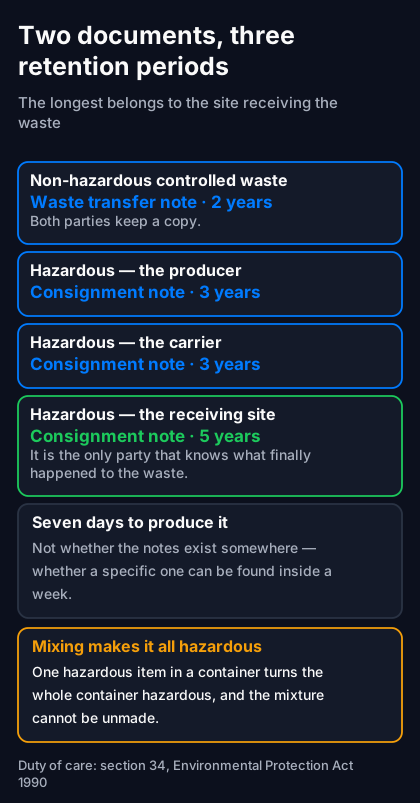
The waste duty of care does not end when the vehicle leaves. It is a statutory obligation to describe waste accurately, hand it only to someone authorised to take it, and keep a record you can produce within seven days of being asked. Two documents cover it, with three different retention periods, and the longest belongs to the site receiving the waste rather than to the producer. This sets out which document applies, what has to be on it, how to check a carrier is genuinely registered, and the failures that surface months later.
What is the waste duty of care?
The waste duty of care is a legal obligation under section 34 of the Environmental Protection Act 1990 to keep waste safe, hand it only to someone authorised to take it, describe it accurately, and keep a record of the transfer. It is not a code of good practice that applies if you opt in. It is a statutory duty, and it does not end when the vehicle drives away.
The code of practice states its own scope plainly: it applies to you if you produce, carry, keep, dispose of, treat, import or have control of waste in England or Wales. That list is deliberately wide. A business clearing an office is a waste producer even if waste is nothing to do with its trade, and the duty attaches to it in the same terms as to a waste company.
What is a waste transfer note?
A waste transfer note is the written record of a transfer of non-hazardous controlled waste from one party to another. It is the evidence that the duty of care was discharged on that occasion, and it is the document an enforcement officer asks for first because it is the one that either exists or does not.
It has to describe the waste well enough to identify it, which is the part most often done badly. "General waste" describes nothing; a description naming the material, its form and its classification code describes something a receiving site can act on. The note must also record the quantity, the containers, both parties and their addresses, the place and date of transfer, and the authorisation under which the carrier is operating.
Which document applies, and for how long must it be kept?
Two documents, two regimes, and three different retention periods. The periods are not interchangeable and the longest one does not belong to the party most people assume.
| Waste | Document | Who keeps it | How long |
|---|---|---|---|
| Non-hazardous controlled waste | Waste transfer note | Both parties | At least 2 years |
| Hazardous waste | Consignment note | Producer | At least 3 years |
| Hazardous waste | Consignment note | Carrier | At least 3 years |
| Hazardous waste | Consignment note | The site receiving it | At least 5 years |
Whichever document applies, it has to be produced on demand to an officer of the regulator or a waste collection authority within seven days. That is the practical test of a filing system: not whether the notes exist somewhere, but whether a specific one can be found inside a week.
Why does the receiving site keep its copy longest?
Because it is the only party that knows what actually happened to the waste. The producer knows what left, the carrier knows what moved, and the site knows whether it was recovered, treated or landfilled — which is the fact a regulator is usually trying to establish years later.
The five-year period at the receiving site against three at the producer and carrier is therefore not an arbitrary extra margin. It matches the point in the chain where the evidence of final disposal sits. For a producer the practical consequence is useful: if your own copy is missing beyond its retention period, the site that accepted the waste may still hold a record, and that is worth asking for before concluding the trail is gone.
What makes waste hazardous?
Classification, not intuition. Waste is hazardous where it displays one or more hazardous properties under the Hazardous Waste Regulations 2005, and the classification is made against the List of Waste rather than by judging how dangerous something looks.
The results are frequently counterintuitive for an ordinary business. Fluorescent tubes, most display screens, lead-acid and many lithium batteries, oils, solvents, some paints and a great deal of laboratory consumable waste classify as hazardous. A skip of office furniture does not. The same physical item can also fall either side of the line depending on what it contains, which is why the classification code matters more than the description in plain English.
What is the EWC code, and why does it decide everything downstream?
The code is the List of Waste classification, still universally called the EWC code after the European Waste Catalogue it came from. It is a six-digit code, and an entry marked with an asterisk is hazardous.
It decides three things at once: which document the transfer needs, which sites may lawfully accept the waste, and what the receiving site may do with it. Getting it wrong is therefore not a clerical error with a clerical consequence — a mis-coded load can be refused at the gate, or accepted at a site not permitted to take it, which creates a problem for the producer rather than for the driver.
How do you check a carrier is actually registered?
On the public register, in about a minute, and the duty of care requires you to satisfy yourself rather than to take a number on trust. The Environment Agency publishes a searchable register of waste carriers, brokers and dealers, and anyone registered appears on it.
- Ask for the registration number before the job, not after it.
- Search the register by number or by business name.
- Check the name on the register matches the business you are contracting with, not a trading name or a subcontractor.
- Check the tier. Upper tier is required for carrying waste as a business in its own right; lower tier covers a narrower set of cases.
- Keep a note of the check alongside the transfer note.
Ours is CBDU654368, and it is on that register under T&C Logistics Ltd. Every credential we hold is listed with its number and its register on our licences page, along with what we do not hold.
What goes wrong most often?
Not fly-tipping. The ordinary failures are documentary, and they surface months later when someone asks for a note that was never completed properly.
| Failure | What it causes |
|---|---|
| Waste described as "general waste" or "office clearance" | The receiving site cannot treat it correctly; the description fails the duty of care |
| No classification code, or a guessed one | Wrong document, or a load refused at the gate |
| Carrier registration not checked | The producer's duty is unmet even where the carrier was in fact registered |
| Hazardous and non-hazardous mixed in one container | The whole container becomes hazardous |
| Notes filed but not retrievable | Fails the seven-day production requirement |
The last row in that table is the one that catches otherwise careful businesses. Everything was done correctly at the time and nobody can find the paper.
Who is liable if the waste is fly-tipped after you hand it over?
Possibly you, and that is the whole point of the duty of care. The duty does not transfer with the waste; it applies to each holder in turn, and a producer who handed waste to someone unauthorised has breached their own duty regardless of what the other party then did with it.
The defence is documentary and it has to exist beforehand. A producer who checked the carrier on the public register, described the waste accurately, recorded the transfer and kept the note has discharged their duty, and the subsequent fly-tipping is the carrier's offence alone. A producer who took a laminated card at face value and has a note reading "general waste" has not, and the enforcement interest in them is real rather than theoretical — fly-tipped waste is routinely traced back through whatever paperwork it contains.
This is why "we paid someone to take it away" is not an answer. Payment is not authorisation, and a cheap quote for a job nobody else would do that cheaply is the commonest shape of the problem.
What does a business clearing an office actually need?
Four things, none of which takes long, and all of which are far harder to assemble after the event than before it.
- A classification of what is going. Separate the hazardous items — screens, batteries, fluorescent tubes, anything with oil or solvent in it — from the furniture and general waste, because they need different documents and different sites.
- A check of the carrier on the public register, recorded with the date you did it.
- The right document for each stream: a transfer note for the non-hazardous waste, a consignment note for the hazardous.
- A filing arrangement that can produce a specific note within seven days, which in practice means filed by date and carrier rather than in a drawer.
A single clearance frequently generates both document types, and treating it as one job with one note is the error that makes the rest unfixable.
What does this mean for an IT or equipment clearance?
That two separate regimes apply at once, and meeting one does not meet the other. Electrical equipment falls under the WEEE regulations as well as the duty of care, and items such as screens and batteries will usually classify as hazardous, so the transfer needs a consignment note rather than a transfer note.
Data is a third regime again, and it is not a waste question at all. A hard drive is subject to the duty of care because it is waste and to data protection law because of what is on it, and a waste document proves nothing about erasure. That is why our chain of custody work records both, and why the IT equipment collection and WEEE collection pages set out what travels with the load. The duty of care glossary entry covers the definition in short form.
Questions
- How long do I have to keep a waste transfer note?
- At least two years, and both parties to the transfer must keep it — the producer and the carrier each hold a copy. Hazardous waste works differently: the producer and the carrier each keep the consignment note for at least three years, while the site that receives the waste keeps its copy for at least five. Whichever applies, the note has to be produced to an officer of the regulator or a waste collection authority within seven days of being asked.
- What is the difference between a waste transfer note and a consignment note?
- The waste they cover. A waste transfer note records a transfer of non-hazardous controlled waste under the duty of care. A consignment note is required where the waste is hazardous under the Hazardous Waste Regulations 2005, carries more information, and has longer retention periods. Classification against the List of Waste decides which one applies, so the code is settled before the document is chosen rather than after.
- What is an EWC code?
- The List of Waste classification code, still universally called the EWC code after the European Waste Catalogue. It is six digits, and an entry marked with an asterisk is hazardous. It decides three things at once: which transfer document is needed, which sites may lawfully accept the waste, and what they may do with it. A mis-coded load can be refused at the gate or accepted at a site not permitted to take it.
- Do I have to check my waste carrier is registered?
- Yes. The duty of care requires you to satisfy yourself that waste is handed only to an authorised person, and taking a number on trust is not the same as checking it. The Environment Agency publishes a searchable public register of waste carriers, brokers and dealers. Check the registered name matches the business you are contracting with rather than a trading name, note the tier, and keep a record of the check with the transfer note.
- Is the waste duty of care only for waste companies?
- No. The code of practice applies to anyone who produces, carries, keeps, disposes of, treats, imports or has control of waste in England or Wales. A business clearing an office is a waste producer even though waste is nothing to do with its trade, and the duty attaches on the same terms as it does to a waste company. The obligation follows the waste, not the industry.
- Does a waste document prove my data was destroyed?
- No, and this is a common and expensive confusion. A waste transfer note or consignment note records that waste changed hands lawfully and says nothing whatever about data erasure. A hard drive is subject to the duty of care because it is waste and to data protection law because of what is on it, and the two produce different evidence. Erasure or destruction needs its own record, held alongside the waste document rather than instead of it.
- What happens if hazardous and non-hazardous waste are mixed?
- The whole container becomes hazardous. Mixing is the quickest way to turn a routine non-hazardous collection requiring a transfer note into a hazardous consignment requiring a consignment note, longer retention and a site permitted to accept it. It also removes the option of correcting the classification later, because the mixture cannot be unmade. Segregation at the point of production is cheaper than any remedy afterwards.
Explore more
More from the blog
- Aerospace Courier UK — AOG & Parts Logistics Guide…
- Aerospace AOG Support: Emergency Parts Delivery Acr…
- Top 10 UK Cities for Logistics Companies (2026)
- Heathrow Cargo: The Complete Guide for Freight Ship…
- UK Pharmaceutical Cold Chain Logistics: 2026 Compli…
- Van Size Guide: Which Courier Vehicle Do You Need?