
Construction site deliveries: what the site demands, and what it does not
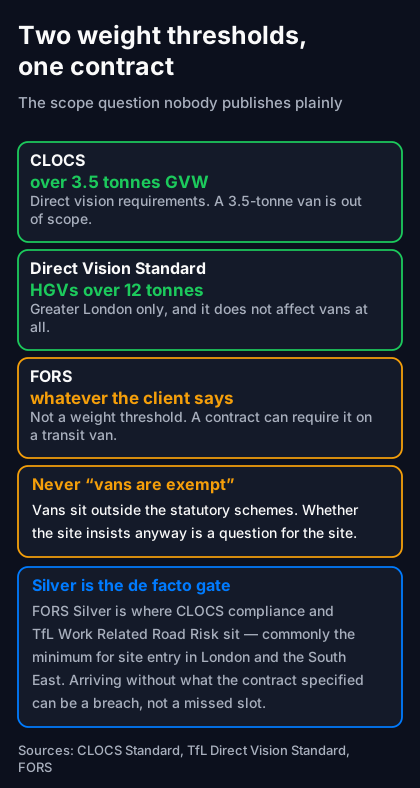
On a construction delivery the site sets the terms, not the carrier, and the most useful thing a sender can establish is whether their delivery is in scope of the big schemes at all. CLOCS applies to vehicles over 3.5 tonnes; the Direct Vision Standard applies to HGVs over 12 tonnes and does not affect vans. Almost everything written about this is written for HGV operators, which leaves buyers assuming a standard that often does not apply to them.
Why is a construction delivery different?
Because the site, not the carrier, sets the terms. A construction site is a regulated workplace with a traffic management plan, an induction regime and an access window, and a vehicle that does not satisfy all three is turned around at the gate regardless of what is on it.
That inverts the usual booking question. For an ordinary delivery you ask what the goods need; for a site delivery you ask what the site demands, and the goods are almost incidental. The commonest and most expensive mistake is booking transport before establishing the site's requirements, because the requirements decide the vehicle.
Does your delivery actually need FORS?
Probably not, if it is going on a van. This is the single most useful thing a sender can establish, and almost everything published about it is written by and for HGV operators, which leaves buyers assuming a standard that does not apply to them.
| Scheme | Applies to | Your 3.5t van |
|---|---|---|
| CLOCS direct vision requirements | Vehicles over 3.5 tonnes GVW | Out of scope |
| Direct Vision Standard | HGVs over 12 tonnes, Greater London | Out of scope — DVS does not affect vans at all |
| FORS accreditation | Set by the client or site, not by law | Depends entirely on the site's own rules |
The third row is the one that still bites. CLOCS and DVS are scope questions with weight thresholds; FORS is a contractual requirement a client can impose on anything, including a transit van. So the answer is never "vans are exempt" — it is "vans are outside the statutory schemes, and whether the site insists anyway is a question for the site".
What are the FORS levels, and which one do sites ask for?
Three, and the middle one is where the demands concentrate. Bronze is the entry level and meets the Safer Lorry Scheme. Silver is where CLOCS compliance and Transport for London's Work Related Road Risk requirements sit, which is why it has become the de facto gate. Gold is the top tier.
In London and the South East, FORS Silver is commonly the minimum for site entry, and in the rest of the country it varies by main contractor. A vehicle arriving without the accreditation the contract specified can be refused, and that refusal can be treated as a breach of contract rather than a missed slot.
What else does a site require beyond accreditation?
More than most senders expect, and all of it is knowable in advance.
- A booked delivery slot. Sites run tight traffic management and an unbooked vehicle is not simply late — it has nowhere to go.
- Driver induction, which can run to an hour on first visit and is not transferable between sites.
- PPE to the site's specification: hard hat, hi-vis, safety boots, gloves and eye protection as a minimum, with some sites specifying standards beyond that.
- A banksman or escort for reversing and manoeuvring, which the site provides and which has to be available when you arrive.
- Offload method agreed: who lifts, with what, and whether the driver is permitted to be in the lifting zone at all.
Induction and the slot together are why construction waiting time runs longer than almost any other sector — see our waiting time article for how that is charged and why it is charged separately.
Who offloads, and why does it matter so much?
Settle it before booking, because the answer decides the vehicle. A site with a telehandler or crane unloads for you and needs only a flat deck. A site without one needs a vehicle that can offload itself — a tail lift, or a Moffett-style mounted forklift — and that is a different and more expensive vehicle class.
The failure mode is predictable and common: goods arrive on a flatbed at a site with nothing to lift them, and the load goes back. Nobody is at fault and everybody pays. A single question at booking removes it entirely.
Many sites also bar the driver from the lifting zone, which means the driver cannot help even where they would be willing. That is a safety rule rather than an attitude, and arguing with it at the gate does not work.
What goes wrong most often?
| Failure | What it costs |
|---|---|
| No slot booked | Vehicle turned away; redelivery charged |
| Accreditation not checked against the contract | Refusal at the gate, potentially a contract breach |
| Offload method not agreed | Load returns; a second journey on the right vehicle |
| Driver has no induction booked | An hour lost at best, refusal at worst |
| Site contact unreachable | Driver waits at a gate with no authority to admit them |
Every row is settled by information the sender already has. None of them is a transport problem until the vehicle is at the gate, at which point all of them are.
Can a delivery run outside site working hours?
Only with the local authority's agreement, and that is a planning question rather than a transport one. Construction noise is controlled under the Control of Pollution Act 1974: section 60 lets a local authority impose requirements on how and when work is carried out, and section 61 lets a contractor apply for prior consent to an agreed method and timetable.
In practice that produces site hours that typically run from the early morning to early evening on weekdays with a shorter Saturday and no Sunday working, tightened further on residential schemes. Deliveries sit inside those hours because the vehicle, the offload and the banksman are all part of the noise picture.
So an out-of-hours delivery is not a question of paying more for a driver. It is a question of whether the site holds a consent that covers it, and the answer comes from the site manager rather than from the carrier. Where it is permitted it is usually because the consent specifically provides for it — a crane lift or a road closure, booked weeks ahead.
Who takes the packaging away?
Whoever is registered to, and on a construction site that question has a legal answer rather than a courtesy one. Anyone who transports waste produced by someone else must be a registered waste carrier with the Environment Agency, and the movement needs a waste transfer note describing the waste and naming both parties.
This catches more deliveries than people expect. Pallets, crating, shrink wrap, offcuts and a failed part going back to the supplier are all waste the moment the site decides to dispose of them, and a driver who takes them away as a favour has carried waste without authorisation.
T&C Logistics is registered with the Environment Agency as a waste carrier, broker and dealer, which is on the public register against company number 16838210. So a return leg carrying packaging or a rejected item is something we can do properly rather than informally — but it is booked as part of the job, because the transfer note has to exist before the waste moves.
What about hazardous materials on site?
They follow their own rules and the site's rules at the same time. Adhesives, solvents, fuels, gas cylinders and resin hardeners are common on construction projects and most of them classify under ADR, which decides the driver qualification and the vehicle marking independently of anything the site requires.
Our drivers hold ADR licences for classes 2, 3, 4, 5, 6, 8 and 9, which covers the great majority of construction chemistry. We do not carry class 1 explosives or class 7 radioactive material. Where a load sits under the limited-quantity or 1,000-point thresholds, it travels as an ordinary van job with the right paperwork rather than as a placarded movement.
What can we actually do on construction work?
Van-sized, time-critical movement to and from sites: a replacement part, a sample, a test certificate, chemistry, tools, a document that has to be signed today. Our vehicles are at or under 3.5 tonnes, which puts them outside CLOCS direct-vision requirements and outside DVS entirely.
What we are not is an accredited construction haulier. T&C Logistics holds no FORS accreditation at any level, and no Operator's Licence — HGV work requiring one is carried out by partner carriers operating their own vehicles under their own licence and their own accreditation. If your main contractor specifies FORS Silver on the vehicle, that is work for a FORS-accredited operator and we will say so rather than send a van and hope.
Everything we hold, with the public register that proves it, is on our licences page, including the list of what we do not hold. The construction page covers the sector work and our same-day courier page how a job is scoped.
What should you establish before booking anyone?
Five answers, in this order, and all of them come from the site rather than from the carrier.
- Does the contract specify FORS, and at what level?
- What is the delivery slot, and who books it?
- Is driver induction required, and how long does it take?
- Who offloads, with what equipment, and may the driver assist?
- Who is the site contact on the day, and will they answer a phone?
A carrier given those five can quote accurately and arrive once. A carrier given an address quotes on a guess, and the difference shows up as a wasted journey rather than as a cheaper price.
Questions
- Does a van need FORS to deliver to a construction site?
- Not as a matter of law. CLOCS direct-vision requirements apply to vehicles over 3.5 tonnes gross weight, and the Direct Vision Standard applies only to HGVs over 12 tonnes and explicitly does not affect vans. FORS, however, is a contractual requirement a client or main contractor can impose on anything, including a transit van. So the answer is never 'vans are exempt' — it is that vans sit outside the statutory schemes and the site may still insist.
- What is the difference between FORS Bronze, Silver and Gold?
- Bronze is the entry level and meets the Safer Lorry Scheme. Silver is where CLOCS compliance and Transport for London's Work Related Road Risk requirements sit, which is why it has become the de facto gate for site entry. Gold is the top tier. In London and the South East, FORS Silver is commonly the minimum a site will accept, and elsewhere it varies by main contractor.
- What happens if a vehicle arrives without the required accreditation?
- It is refused entry. That is not a missed slot to be rebooked casually: where the contract specified an accreditation, arriving without it can be treated as a breach of contract rather than a delivery failure. The vehicle, the driver and the load all go back, the goods are not on site, and somebody pays for a second journey on a compliant vehicle.
- Who is responsible for offloading on a construction site?
- It depends on the site, and the answer decides which vehicle you need. A site with a telehandler or crane offloads for you and a flat deck is enough. A site without one needs a vehicle that offloads itself — a tail lift or a mounted forklift — which is a different and dearer class. Many sites also bar the driver from the lifting zone, so the driver cannot assist even if willing.
- Why does construction waiting time run so long?
- Induction and slot management. Driver induction can take an hour on a first visit and is not transferable between sites, and sites run tight traffic management so a vehicle that misses its slot has nowhere to go until another opens. Both are knowable before booking, which is why telling a carrier about them changes the quote rather than surprising you with a waiting charge afterwards.
- Can you deliver hazardous materials to a site?
- Within the ADR classes our drivers are licensed for: 2, 3, 4, 5, 6, 8 and 9, which covers most construction chemistry — adhesives, solvents, fuels, gas cylinders and resin hardeners. We do not carry class 1 explosives or class 7 radioactive material. Where a load sits under the limited-quantity or 1,000-point thresholds it travels as an ordinary van job with the right paperwork rather than as a placarded movement.
- Do you hold FORS accreditation?
- No. T&C Logistics holds no FORS accreditation at any level, and no Operator's Licence. HGV work requiring one is carried out by partner carriers operating their own vehicles under their own licence and accreditation. If your main contractor specifies FORS Silver on the vehicle, that is work for a FORS-accredited operator and we will tell you so rather than send a van and hope it is admitted.