
Clinical trial logistics: who owns the obligation, and who decides
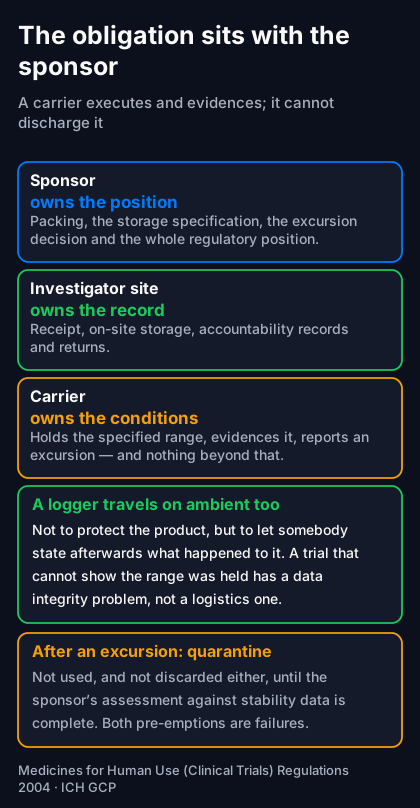
Clinical trial transport is governed twice: by the Medicines for Human Use (Clinical Trials) Regulations 2004 and ICH Good Clinical Practice, and by the trial protocol, which can be stricter than either. The obligations sit with the sponsor rather than the carrier, a temperature logger travels even on ambient shipments, and nobody but the sponsor decides what happens to a product after an excursion. This sets out who owns what, and what to settle before the first shipment.
What makes clinical trial transport different?
The product is unapproved and the record is evidence. An Investigational Medicinal Product is the pharmaceutical form of an active ingredient or a placebo being tested, or used as a reference, in a trial — and unlike licensed medicine it has no established safety record to fall back on if something goes wrong in transit.
So the transport is governed twice over: by the Medicines for Human Use (Clinical Trials) Regulations 2004 and ICH Good Clinical Practice, and by the individual trial protocol, which can be stricter than either. A courier arrangement that satisfies the regulations and ignores the protocol is still non-compliant.
Whose obligation is it?
The sponsor's, and that is the most commonly misplaced responsibility in the whole chain. The sponsor ensures the IMP is packed properly and that storage requirements are met during transport. A carrier executes; it does not own the obligation and cannot discharge it on the sponsor's behalf.
| Party | Owns |
|---|---|
| Sponsor | Packing, storage specification, the decision on any excursion, and the whole regulatory position |
| Investigator site | Receipt, on-site storage, accountability records, returns |
| Carrier | Holding the specified conditions in transit and evidencing that it did |
Reading that table the right way round changes how a courier is briefed. The question to a carrier is never "are you compliant" in the abstract — it is "can you hold this range for this duration and produce the record afterwards".
Why does a temperature logger travel even on ambient shipments?
Because the absence of an excursion has to be demonstrable, not assumed. A logger goes in the container regardless of the transport conditions, which surprises people who associate monitoring only with cold chain.
The reasoning is evidential rather than thermal. An ambient product still has a specified range, a vehicle in summer traffic can exceed it, and a trial that cannot show the range was held has a data integrity problem rather than a logistics one. The logger is not there to protect the product; it is there to let somebody state afterwards what happened to it.
That is also why a logger reading is worth nothing without the times at both ends. A record that shows 4°C for six hours proves nothing if nobody can say when the box was sealed and when it was opened.
What happens when there is an excursion?
It gets reported and assessed, and the decision belongs to the sponsor. Excursions encountered in transit or in on-site storage are recorded on a temperature excursion response form and referred for assessment against the product's stability data.
The critical operational point is what does not happen: the product is not used, and it is not discarded either, until that assessment is complete. It is quarantined. A site that uses an excursed product because it looked fine, or destroys one because it assumed it was ruined, has pre-empted a decision that was not theirs and in both directions.
The record that goes with the referral has 5 parts, and an assessment cannot start without all of them.
- The full logger trace, not a summary or a maximum reading.
- Seal and open times, so the trace can be bounded to the movement.
- Duration and magnitude of the departure from the specified range.
- What was happening — in transit, waiting at a site, in a vehicle overnight.
- The consignment identity, reconciled to the accountability log.
A carrier's part is narrow and absolute: report the excursion promptly, hand over the complete record, and do not offer an opinion about whether the product is still good.
What does a site-to-site transfer require?
More than a delivery, because the product moves between two parties who both have accountability obligations. Validated temperature control for the duration, chain-of-custody documentation, and a signed proof of delivery at both ends — collection as well as delivery.
- Confirm the receiving site is authorised to hold that IMP for that trial.
- Reconcile the quantity leaving against the sending site's accountability log.
- Seal, with the logger started and the start time recorded.
- Signed POD at collection, naming the person releasing the product.
- Signed POD at delivery, with the logger stopped and the record handed over.
The opposite direction matters too. A trial generates a sample flow from site to central laboratory running alongside the product flow, travelling as UN 3373 Biological Substance Category B on its own timetable — see biological samples courier for how that leg is scoped. Treating the two as one transport plan is what stops a site booking two vehicles for the same corridor on the same morning.
Step one is the one that strands shipments. A product cannot simply be moved to a site that needs it; that site has to be set up to receive it, and sorting that out while a vehicle is in motion is how consignments end up sitting in a car park.
How is this different from ordinary pharmaceutical delivery?
Licensed medicine moves under established distribution rules towards a known patient population. An IMP moves towards a protocol, under a blind, with accountability for every unit.
| Licensed medicine | Investigational product | |
|---|---|---|
| Product status | Approved, known stability | Unapproved, stability data may be limited |
| Unit accounting | By batch | By unit, reconciled at every stage |
| Blinding | Not applicable | Packaging may not reveal the arm; labels are controlled |
| Returns | Commercial process | Returned and reconciled, often destroyed under witness |
| Monitoring | Cold chain where required | Logger regardless of conditions |
The returns row is the one that catches operations teams. Unused IMP is not stock to be written off — it is trial data, and it comes back to be counted.
What does blinding mean for the carrier?
That the packaging is part of the science, and must arrive exactly as it left. In a blinded trial neither the participant nor the investigator knows which arm a unit belongs to, and the packaging and labelling are designed so that nothing reveals it — identical presentation for active product and placebo, with the code held elsewhere.
Three practical consequences follow for anyone moving the consignment. A carrier never opens an IMP container, even to check a logger, because the logger is positioned so it can be read without breaking the seal. Damaged outer packaging is reported rather than repacked, since a substituted carton can break the presentation. And a label is never corrected in transit, however obviously wrong it looks, because labels are controlled documents under the protocol.
None of that is unusual handling. It is simply the difference between a parcel, where the goal is that the contents survive, and a trial shipment, where the goal is that the contents survive and that nobody can later argue the blind was compromised.
What happens to unused product at the end?
It is counted, not written off. Unused and partially used IMP returns from the site to be reconciled against what was dispensed, because the count is trial data: a discrepancy between product supplied, product dispensed and product returned is a finding at audit regardless of what the clinical results say.
Destruction follows reconciliation rather than replacing it, and is commonly witnessed and certificated. Pharmaceutical waste then moves under the ordinary duty of care — the carrier must be a registered waste carrier and the movement needs a waste transfer note — so the paper trail runs continuously from manufacture to incinerator.
The operational point for a transport plan is that a trial generates return legs from the first shipment to the last, and they are as time-bound as the outbound ones. A site closing out a study has a date by which its accountability has to be clean, and product still sitting in a cupboard because nobody booked a collection is the commonest reason it is not.
What should you ask a carrier before a trial starts?
Six things, settled at set-up rather than on the first shipment, because the first shipment is usually the one with a deadline.
- Which temperature ranges can you hold, and for how long, with what equipment?
- What record do I get, and in what format — and does it carry seal and open times?
- How quickly is an excursion reported, and to whom?
- Can you produce signed PODs at both collection and delivery?
- What happens out of hours, and at weekends?
- Where does GDP-certified handling sit, and who holds that certification?
The last question is the one sponsors most often leave unasked and most often need answered.
What is our part, and what is not?
We move consignments and evidence the conditions. Our temperature-controlled work holds and records the specified range for the whole movement including waiting time, with signed proof of delivery, and our medical logistics and pharmaceutical courier pages set out the handling.
What we are not is an accredited pharmaceutical operation. T&C Logistics is not an MHRA-licensed wholesale dealer and holds no GDP certification, and we hold no Home Office controlled drug licences. Where a trial requires GDP-certified handling, that work runs through GDP-certified partner carriers under their own licence and we will name the partner for your study.
We also do not make product decisions. If a logger shows an excursion we report it with the full record and the sponsor decides — that boundary is not modesty, it is the correct allocation of a responsibility that is not ours. The clinical trial courier page covers the service and the licences page lists every credential with the register that proves it.
Questions
- What is an IMP?
- An Investigational Medicinal Product: the pharmaceutical form of an active ingredient or a placebo being tested, or used as a reference, in a clinical trial. Unlike licensed medicine it has no established safety record to fall back on if something goes wrong in transit, which is why its movement is governed by the Medicines for Human Use (Clinical Trials) Regulations 2004 and ICH Good Clinical Practice as well as by the individual trial protocol.
- Whose responsibility is IMP transport — the sponsor's or the carrier's?
- The sponsor's. The sponsor ensures the product is packed properly and that storage requirements are met during transport; a carrier executes and evidences, but does not own the obligation and cannot discharge it on the sponsor's behalf. That changes how a courier should be briefed: the question is not 'are you compliant' in the abstract but 'can you hold this range for this duration and produce the record'.
- Why does a temperature logger travel on ambient shipments too?
- Because the absence of an excursion has to be demonstrable rather than assumed. An ambient product still has a specified range, a vehicle in summer traffic can exceed it, and a trial that cannot show the range was held has a data integrity problem rather than a logistics one. The logger exists so somebody can state afterwards what actually happened to the product.
- What happens if there is a temperature excursion in transit?
- It is reported and assessed against the product's stability data, on a temperature excursion response form, and the decision belongs to the sponsor. The important thing is what does not happen: the product is neither used nor destroyed until that assessment is complete — it is quarantined. A site that uses an excursed product because it looked fine has pre-empted a decision that was not theirs, and so has one that destroys it.
- What does a site-to-site IMP transfer need?
- Validated temperature control for the duration, chain-of-custody documentation, and a signed proof of delivery at both collection and delivery rather than only at the end. Before any of that, confirmation that the receiving site is authorised to hold that product for that trial — this is the step that strands shipments, because a product cannot simply be moved to a site that needs it.
- How is clinical trial logistics different from pharmaceutical delivery?
- Licensed medicine moves under established distribution rules towards a known patient population; an investigational product moves towards a protocol, often under a blind, with accountability for every unit rather than by batch. Returns differ most: unused IMP is not stock to write off, it is trial data, and it comes back to be reconciled and frequently destroyed under witness.
- Do you hold GDP certification for clinical trial work?
- No. T&C Logistics is not an MHRA-licensed wholesale dealer, holds no GDP certification and holds no Home Office controlled drug licences. Where a trial requires GDP-certified handling, that work runs through GDP-certified partner carriers under their own licence and we will name the partner for your study. What we do is move consignments, hold the specified range for the whole movement including waiting time, and evidence it.
Explore more
More from the blog
- Road Charges on a UK Delivery: What They Are, and W…
- UN3480 vs UN3481: which number applies to your lith…
- What a Van Can Legally Carry: Gross Vehicle Weight,…
- Waste transfer notes and the duty of care: which do…
- Great Britain to Northern Ireland: what the rules a…
- UK Same-Day Courier: The Complete 2026 Guide for Bu…