
Hospital deliveries: why the postcode is not the destination
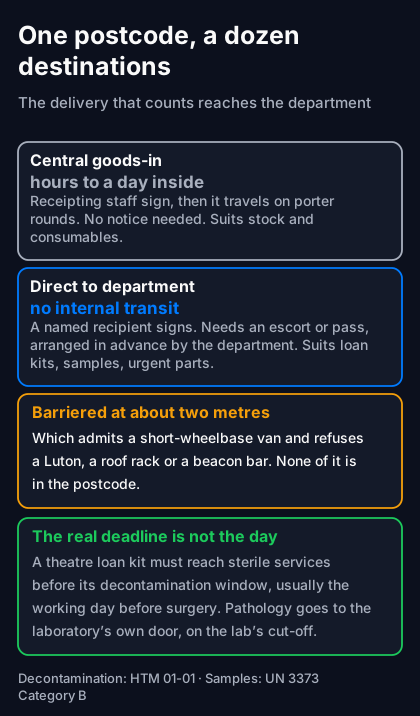
A hospital has one postcode and a dozen destinations. The delivery that counts as successful is the one that reaches the department that ordered it, not the one signed for at a loading bay a quarter of a mile away — and between those two points sit height barriers, booked slots, separate entrances for pathology and pharmacy, and internal porter rounds that run to their own timetable. This is what to establish before the vehicle leaves.
Why is delivering to a hospital different?
Because the address is not the destination. A hospital is a campus with one postcode, several entrances, a goods-in department that may be a quarter of a mile from the ward that ordered the item, and a security regime that will not let a driver wander.
A commercial delivery ends when someone at reception signs. A hospital delivery ends when the item reaches the department that needs it, and the gap between those two events is where most failures live. A box signed for at goods-in first thing can reach theatres the following afternoon through no one's fault, because internal distribution runs on its own rounds.
So the operative question for a time-critical hospital consignment is not "when will it arrive" but "who receives it, and where".
Goods-in or direct to department?
Two routes, and the choice is made before the vehicle leaves, not at the barrier.
| Central goods-in | Direct to department | |
|---|---|---|
| Who signs | Receipting staff | Named recipient in the department |
| Internal transit | Hours to a day, on porter rounds | None |
| Access needed | Loading bay only | Pre-arranged escort or pass |
| Suits | Stock, consumables, bulk | Loan kits, samples, urgent parts |
| Arranged by | Default; no notice required | The requesting department, in advance |
Most routine supply flows through goods-in, and for consumables ordered through NHS Supply Chain that is correct. Direct delivery is the exception, has to be set up by the department that wants it, and cannot be conjured by a driver at the gate.
What stops a vehicle at the gate?
Height, almost always. Hospital loading bays and multi-storey car parks are commonly barriered at around two metres, which admits a car-derived or short-wheelbase van and refuses a Luton or any vehicle with a roof rack or beacon bar.
- Height barriers on the bay or car park approach.
- Permit systems — some trusts require a booked delivery slot and will turn away an unbooked vehicle at peak.
- Restricted hours for the bay, typically outside clinical peaks.
- Separate entrances for pathology, pharmacy, mortuary and general supplies, often on different sides of the site.
- Emergency lockdown, which overrides everything and has no appeal.
None of this is discoverable from the postcode. It is why a hospital job is scoped by phone with the receiving department rather than typed into a booking form, and why the vehicle is chosen after that call, not before it. Our small van page sets out the dimensions that clear a two-metre barrier.
What is a theatre loan kit, and why is it urgent?
A loan kit is a set of surgical instruments and implants supplied by a manufacturer for one specific operation, returned afterwards. It is the single most time-critical item in hospital logistics, because a missing kit cancels a listed procedure.
The reason it cannot simply arrive on the morning is decontamination. HTM 01-01, the Department of Health technical memorandum on decontamination of surgical instruments, governs the process, and a kit must reach the sterile services department with enough time to be inspected, decontaminated and sterilised before the list. Trusts commonly require delivery the working day before surgery for exactly this reason.
Return matters as much. The kit belongs to the manufacturer, is needed at another hospital, and a late return is a charge. A loan-kit movement is therefore two jobs, and the second one is the one people forget to book.
How do pathology samples differ?
They go to a different place, under different rules, and they are the one hospital flow with a transport regulation of its own.
Diagnostic samples travel as UN 3373 Biological Substance Category B, which requires triple packaging and a diamond-shaped UN3373 mark, and they are delivered to the laboratory's own reception rather than to central goods-in — frequently a separate door with its own hours. Many labs operate a cut-off after which a sample is held until the next run, which is the real deadline on a pathology job rather than the end of the working day.
Our biological samples guide covers the packaging requirement in full, and medical logistics how a sample run is scoped.
What about medicines and controlled drugs?
This is a licensing question before it is a transport question, and the honest answer is a boundary rather than a capability.
| Category | What the law requires | T&C |
|---|---|---|
| General goods, devices, consumables | No special authorisation | Direct |
| Pathology samples (UN3373) | Triple packaging, correct marking | Direct |
| Loan kits, instruments | Delivery before the decontamination window | Direct |
| Licensed medicines (wholesale) | MHRA WDA(H), GDP conditions | Partner-authorised only |
| Controlled drugs | Home Office licence | Partner-authorised only |
We are not an MHRA-licensed wholesale dealer and we do not hold a Home Office controlled-drug licence. Those movements are coordinated with partner carriers who hold the relevant authorisations, and we say so rather than taking the job and working it out afterwards.
Can a hospital take a delivery out of hours?
Usually yes, but not to the same place, and the difference is who is awake. A hospital runs continuously while its goods-in department does not, so an out-of-hours consignment goes to whichever function is staffed — the emergency department, switchboard, the pathology laboratory, or a 24-hour pharmacy if one operates on site.
That matters because those departments are receiving your item in addition to their actual job. An out-of-hours drop is accepted on the understanding that it is genuinely urgent, and routine stock arriving late at night to a staffed clinical area is a reasonable thing to be refused.
The operational requirement is a named recipient who knows the delivery is coming and will come to the door. Out of hours there is nobody to ring round on the driver's behalf, and a consignment that arrives unannounced at a locked bay with an unreachable contact goes back on the vehicle. Our same-day courier page covers how an overnight job is scoped and confirmed before the vehicle leaves.
How does a private hospital differ from an NHS trust?
Mostly by simplicity. A private hospital is typically a single building with one goods entrance, its own procurement, and a receptionist who knows who ordered what — which removes most of the campus problem in one step.
| NHS acute trust | Private hospital | |
|---|---|---|
| Site | Campus, several buildings, multiple entrances | Usually one building, one entrance |
| Receiving | Central goods-in, then internal rounds | Often direct to the department |
| Access control | Permits, booked slots, escorts | Reception sign-in |
| Procurement | Trust systems and national frameworks | The hospital's own |
| Loan kits | Through sterile services | Through theatres or an outsourced provider |
The clinical requirements do not change. A loan kit still needs its decontamination window and a sample still travels as UN 3373; what changes is that there are fewer places for the consignment to go astray between the gate and the person waiting for it.
What about medical gas cylinders?
They are dangerous goods before they are hospital supplies. Oxygen, nitrous oxide, medical air and the Entonox mixture are compressed gases under ADR class 2, which sets the driver qualification, the vehicle marking and the securing method independently of anything the hospital requires.
Two rules do most of the work in practice. Cylinders travel secured and upright, in a load space with ventilation, and never loose in a sealed car boot. And an oxidising gas such as oxygen is kept away from anything flammable on the same vehicle, which is a segregation question rather than a tidiness one.
Our drivers hold ADR licences covering class 2, so a cylinder movement to or from a hospital is work we can take directly. What it is not is a job to combine casually with other freight: the segregation rules decide what else may share the deck, and on a van the answer is frequently nothing.
What proof of delivery does a hospital need?
More than a scribble on a handheld, and the requirement is usually the receiving department's rather than the carrier's.
A named signature with a printed name and department, a timestamp, and for anything temperature-controlled the logger data covering the whole journey. For a loan kit the sterile services department will record receipt against the procedure; for a sample the laboratory logs it against the request. A proof of delivery that says only "received" at a loading bay does not evidence that the item reached the person who needed it.
Photograph the handover point where the department allows it. On a campus with four possible receiving points, a photograph settles in seconds an argument that would otherwise take a day of internal enquiries.
How should a hospital job be booked?
With five pieces of information that a standard courier booking does not ask for, gathered before the vehicle is allocated.
- The receiving department and a named contact, not the hospital name.
- Which entrance, and whether a permit or booked slot is required.
- The real deadline — the lab cut-off, the decontamination window, the theatre list — rather than a time of day.
- Height and access limits at that entrance.
- Whether a return leg exists, which for loan kits it almost always does.
That is the whole difference between a hospital delivery that works and one that technically arrived. We scope it by phone with the department for the same reason. Our healthcare logistics page covers the sector capability, and same-day courier the dedicated vehicle a time-critical job runs on.
Questions
- Why is delivering to a hospital harder than a normal business address?
- Because the address is a campus, not a destination. One postcode covers several entrances, a central goods-in department that may be a quarter of a mile from the ward that ordered the item, and a security regime that will not let a driver walk around. A box signed for at goods-in first thing can reach theatres the following afternoon on internal porter rounds, so the operative question is who receives it and where, not when it arrives.
- What is the difference between goods-in and direct-to-department delivery?
- Goods-in is the default: receipting staff sign, no notice is needed, and the item then travels internally on porter rounds, which can take hours to a day. Direct-to-department puts it in the hands of a named recipient with no internal transit, but needs a pre-arranged escort or pass set up in advance by the requesting department. Stock and consumables suit goods-in; loan kits, samples and urgent parts need direct delivery.
- What vehicle fits a hospital loading bay?
- Usually one under about two metres. Hospital bays and multi-storey car parks are commonly barriered at that height, which admits a car-derived or short-wheelbase van and refuses a Luton or anything with a roof rack or beacon bar. None of this is discoverable from the postcode, which is why the entrance and its height limit are established with the receiving department before the vehicle is allocated.
- Why must a theatre loan kit arrive the day before surgery?
- Because it has to be decontaminated first. A loan kit is a set of surgical instruments and implants supplied by a manufacturer for one specific operation, and HTM 01-01 governs decontamination of surgical instruments in acute care. The kit must reach sterile services with enough time to be inspected, decontaminated and sterilised before the list, so trusts commonly require delivery the working day before. A missing kit cancels the procedure.
- Where do pathology samples go in a hospital?
- To the laboratory's own reception, not to central goods-in — frequently a separate door with its own hours. Diagnostic samples travel as UN 3373 Biological Substance Category B, requiring triple packaging and the diamond-shaped UN3373 mark. Most labs operate a cut-off time after which a sample is held until the next run, and that cut-off, rather than the end of the working day, is the real deadline on a pathology job.
- Can you deliver medicines or controlled drugs to a hospital?
- Not directly. Wholesale movements of licensed medicines require an MHRA wholesale dealer's authorisation under GDP conditions, and controlled drugs require a Home Office licence. T&C Logistics holds neither, so those movements are coordinated with partner carriers who hold the relevant authorisations. General goods, devices, consumables, UN3373 pathology samples and surgical loan kits we carry directly.
- What proof of delivery does a hospital require?
- More than a signature at a bay. A named signature with printed name and department, a timestamp, and for temperature-controlled items the logger data covering the whole journey. Sterile services record a loan kit against the procedure and the laboratory logs a sample against the request. On a campus with four possible receiving points, a photograph of the handover settles in seconds a question that would otherwise take a day of internal enquiries.
Explore more
More from the blog
- EMCS: how a duty-suspended excise movement actually…
- EORI Number Explained: GB, XI, and Who Actually Nee…
- Groupage: cheaper space, and whose risk you take on
- GVMS and the Goods Movement Reference Explained
- Import VAT and Postponed VAT Accounting: How It Is…
- Incoterms 2020 Explained: All Eleven Rules and Who…