
Groupage: cheaper space, and whose risk you take on
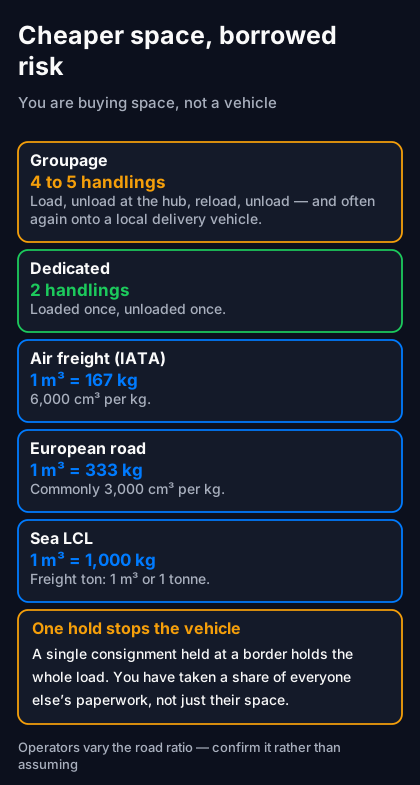
Groupage buys space rather than a vehicle, and the saving is real: for one to six pallets of robust goods on a flexible timescale it is the cheapest sensible option. What it costs is control. Your departure depends on the load filling, your goods are handled four or five times rather than twice, and another customer's customs hold is now your delay. This sets out when that trade is worth making and when it is the wrong instrument entirely.
What is groupage?
Groupage is the consolidation of several customers' consignments into one vehicle or container, so that each pays for the space it occupies rather than for the whole vehicle. It is the freight equivalent of a shared taxi, and its economics follow from that: cheaper per consignment, slower, and dependent on other people's goods.
The term is used most in international road and sea freight, where it is interchangeable with LCL — less than container load — and with part-load or LTL in domestic haulage. Different words, one idea: you are buying space, not a vehicle.
What do you actually pay for?
Whichever is greater of the weight or the volume, which is where most groupage quotes surprise people. A consignment that is light and bulky is charged on the space it denies other freight, not on what it weighs.
The conversion is a volumetric or chargeable weight, and the ratio differs by mode: road, sea and air each use their own. A pallet of pillows and a pallet of brake discs occupy the same floor space and will be priced far closer together than their weights suggest, because the vehicle runs out of deck before it runs out of payload.
| Mode | Standard conversion | 1 m³ is charged as |
|---|---|---|
| Air freight (IATA) | 6,000 cm³ per kg | 167 kg |
| European road freight | commonly 3,000 cm³ per kg | 333 kg |
| Sea LCL | freight ton: 1 m³ or 1 tonne | 1,000 kg |
Individual operators vary their road ratio, so confirm it rather than assuming, but the ordering holds everywhere: air punishes volume hardest and sea least. That is worth modelling before you assume groupage is cheaper. For dense, heavy freight it usually is. For light, bulky freight the saving narrows, and sometimes disappears.
What does consolidation cost you in time?
Two delays that a dedicated vehicle does not have, and they compound.
| Delay | Why it exists |
|---|---|
| Waiting for the load to fill | A vehicle leaves when it is economic, not when your goods are ready |
| Hub handling | Consolidation and deconsolidation each add a day in many networks |
| Another customer's problem | A customs hold or a damaged pallet elsewhere on the vehicle delays yours |
The third row is the one buyers underestimate. On a dedicated vehicle your consignment's risks are your own; on a groupage load you have taken on a share of everyone else's, including their paperwork. A single consignment held at a border holds the vehicle.
How many times are the goods handled?
Four at least, against two on a direct run. Loaded at origin, unloaded at the consolidation hub, reloaded onto the trunk, unloaded at deconsolidation, and frequently handled again onto a local delivery vehicle.
Each handling is an opportunity for damage, and it is the reason groupage packaging has to be better than dedicated packaging for identical goods. A pallet that survives being loaded once and unloaded once is not necessarily a pallet that survives four or five transfers, forklift tines from unfamiliar operators, and being stacked under somebody else's freight.
Our cross-docking article covers the handling arithmetic in more detail; groupage sits at the heavier end of it.
When is groupage the right answer?
When the consignment is too big for a parcel network, too small to fill a vehicle, and not urgent. That is a real and common shape, and for it groupage is straightforwardly the cheapest sensible option.
- One to six pallets, where a dedicated vehicle would run mostly empty.
- Robust, well-packaged goods that tolerate multiple handlings.
- A flexible delivery window measured in days rather than hours.
- Standard goods with no special handling, temperature or security requirement.
- Dense freight, where you pay on weight rather than on volume.
Miss any one of those and the calculation starts to move. Miss two and it has usually moved.
When is it the wrong instrument?
When the thing you need is control, and consolidation is the sale of control in exchange for price.
| Requirement | Why groupage struggles |
|---|---|
| A fixed deadline | Departure depends on the load filling, not on your date |
| Temperature control | Every transfer is an exposure, and the chain is evidenced in pieces |
| High value or security | Your goods sit unattended with others at hubs |
| Fragile or awkward | Four or five handlings instead of two |
| Hazardous goods | Segregation rules restrict what may share a vehicle |
| A single urgent item | Nothing to consolidate; you get the delays without the saving |
The hazardous row is a hard constraint rather than a preference. ADR segregation rules limit which classes may travel together, so a consolidator may simply refuse the load or hold it for a compatible vehicle.
How long does groupage take?
Longer than a dedicated run by a margin that depends on the leg, and the honest way to compare is door to door rather than on the trunk time, which is the number quoted.
| Movement | Dedicated | Groupage |
|---|---|---|
| Within the UK | Same day or next day | Two to four working days |
| UK to near Europe | One to two days | Three to seven working days |
| Deep-sea LCL | Not comparable | Port transit plus a week or more at each end |
The spread inside each row is the point. A dedicated vehicle's transit time is arithmetic — distance, driver hours, a border. A groupage transit time is a forecast, because it includes a departure that waits on other people's bookings and a hub that processes freight in the order it arrives.
That is why a groupage quote that promises a precise delivery date should be read carefully. Most reputable operators quote a range, and the ones that quote a date are usually quoting the trunk and leaving the hubs out of it. For how driver hours constrain even the dedicated figure, see our drivers' hours article.
What paperwork does a groupage consignment need?
Its own full set, which is the detail that most often delays a load. Consolidation shares a vehicle; it does not share documents. Each consignment on the deck needs its own commercial invoice, packing list and customs declaration, and the completeness of yours does not protect you from the incompleteness of somebody else's.
On an international movement the operative document for the vehicle is a CMR note, but the customs position is per consignment. A commercial invoice missing a commodity code or a value holds that consignment, and because the goods are physically on the same vehicle as everyone else's, it frequently holds the vehicle too.
Marking matters more than on a dedicated run for the same reason. Every carton needs the consignment reference visible on at least two faces, because the pallet will be broken down and rebuilt by people who have never seen your goods before and are working from labels alone.
How should groupage freight be packaged?
To survive five handlings rather than two, by people and equipment you will never meet. This is the single cheapest thing a sender controls, and the most frequently skimped.
- Palletise wherever possible. Loose cartons are handled individually, stacked by judgement, and lost by ones.
- No overhang. Anything past the pallet edge takes the first forklift strike and prevents the pallet being stacked.
- Stack-tested or corner-protected, because somebody else's freight is going on top and nobody will ask you first.
- Shrink-wrapped to the pallet base, not just around the load — a load that separates from its pallet is a damage claim in waiting.
- Weight and handling marks on the outside, in English, on more than one face.
For international movements on wooden pallets, add the treatment requirement: a pallet entering most non-EU destinations must meet ISPM 15 and carry the stamp, and an untreated pallet is refused at the border with the goods still on it.
Who is liable when it goes wrong?
The carrier, within the same limits as any other movement, and the consolidator is the carrier for this purpose. On an international road leg that is CMR at 8.33 SDR per kilogram; domestically it is the carrier's own conditions.
What changes is the evidence. Damage discovered on a dedicated run happened between two known points. Damage discovered after four handlings at two hubs happened somewhere, and establishing where is materially harder — which is why photographing a groupage consignment before it is collected is worth the two minutes it takes.
Who pays for the carriage itself is a separate question, settled by the Incoterms rule rather than by the transport arrangement.
Do we offer groupage?
No, and that is a deliberate boundary rather than a gap. T&C Logistics runs dedicated point-to-point vehicles: your goods travel alone, the vehicle leaves when they are ready, and it is handled twice. We operate no warehouse and no consolidation hub.
So for one to six pallets on a flexible timescale, a groupage operator or a pallet network is genuinely the better buy and we will say so. What we are for is the other case: when the deadline is fixed, the goods are fragile, valuable, temperature-controlled or hazardous, or there is simply nothing to consolidate with.
Our groupage glossary entry covers the definition, groupage against a full load the economics, and the same-day courier page how a dedicated job is scoped.
Questions
- What is groupage in logistics?
- The consolidation of several customers' consignments into one vehicle or container, so each pays for the space it occupies rather than for the whole vehicle. It is interchangeable with LCL — less than container load — in sea freight, and with part-load or LTL in domestic haulage. Different words for one idea: you are buying space, not a vehicle, and the economics follow from that.
- How is groupage priced?
- On whichever is greater of the weight or the volume, converted to a chargeable or volumetric weight whose ratio differs by mode. A light, bulky consignment is charged on the space it denies other freight rather than on what it weighs, so a pallet of pillows and a pallet of brake discs price far closer than their weights suggest. For dense freight groupage is usually cheaper; for light bulky freight the saving narrows.
- How many times are groupage goods handled?
- At least four, against two on a direct run: loaded at origin, unloaded at the consolidation hub, reloaded onto the trunk, unloaded at deconsolidation, and often again onto a local delivery vehicle. Each handling is an opportunity for damage, which is why packaging for groupage has to be better than packaging for a dedicated run carrying identical goods.
- When should I not use groupage?
- When you need control rather than price. A fixed deadline struggles because departure depends on the load filling. Temperature control suffers because every transfer is an exposure. High-value goods sit unattended at hubs. Fragile goods take four or five handlings. Hazardous goods face ADR segregation rules that restrict what may share a vehicle. And a single urgent item has nothing to consolidate with, so you get the delays without the saving.
- Can another customer's problem delay my groupage shipment?
- Yes, and this is what buyers most underestimate. On a dedicated vehicle your consignment's risks are your own. On a groupage load you have taken a share of everyone else's, including their paperwork: a single consignment held at a border holds the whole vehicle, and a damaged pallet elsewhere on the deck can delay an unloading sequence that includes yours.
- Who is liable if groupage freight is damaged?
- The carrier, within the same limits as any other movement — on an international road leg that is CMR at 8.33 SDR per kilogram, and domestically the carrier's own conditions. What changes is the evidence: damage on a dedicated run happened between two known points, while damage found after four handlings at two hubs happened somewhere. Photographing a groupage consignment before collection is worth the two minutes.
- Do you offer groupage?
- No, and deliberately. T&C Logistics runs dedicated point-to-point vehicles — your goods travel alone, the vehicle leaves when they are ready, and the load is handled twice — and we operate no warehouse or consolidation hub. For one to six pallets on a flexible timescale a groupage operator or a pallet network is the better buy and we will say so. We are for fixed deadlines, fragile, valuable, temperature-controlled or hazardous goods.
Explore more
More from the blog
- EMCS: how a duty-suspended excise movement actually…
- EORI Number Explained: GB, XI, and Who Actually Nee…
- GVMS and the Goods Movement Reference Explained
- Hospital deliveries: why the postcode is not the de…
- Import VAT and Postponed VAT Accounting: How It Is…
- Incoterms 2020 Explained: All Eleven Rules and Who…