
Cross-docking: what it saves, and what it costs you
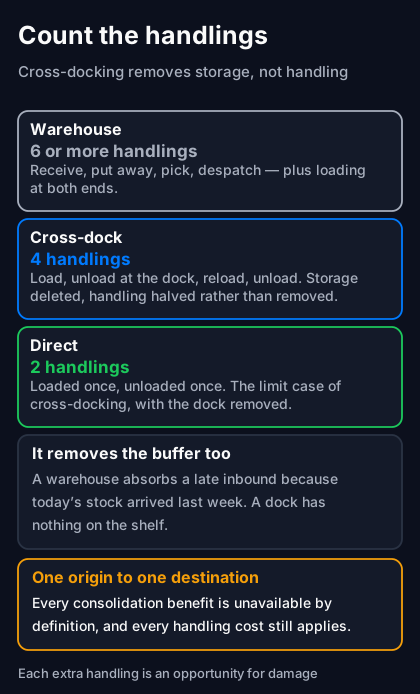
Cross-docking deletes the two most expensive steps in a warehouse — put-away and picking — by moving goods from an inbound vehicle to an outbound one without storing them. What it deletes along with them is the buffer, which converts a storage problem into a synchronisation problem. And for a single consignment going from one place to one other, every consolidation benefit is unavailable while every handling cost still applies.
What is cross-docking?
Cross-docking is moving goods from an inbound vehicle to an outbound one with little or no storage in between. The goods touch the facility; they do not live in it. A conventional warehouse receives, puts away, picks and despatches; a cross-dock receives and despatches, and deletes the two steps in the middle.
Those two deleted steps are most of the cost of a warehouse. Put-away and picking are the labour-intensive operations, and the space that stock occupies while it waits is the expensive asset. Cross-docking is an attempt to get the consolidation benefit of a hub without paying for either.
What are the two kinds?
They differ in when the allocation decision is made, which is a bigger difference than it sounds.
| Pre-distribution | Post-distribution | |
|---|---|---|
| Allocation decided | Before the goods arrive | At the dock, on arrival |
| Who sorts | The supplier, into customer-ready units | The cross-dock operator |
| Dock work | Move pallets across; no handling of contents | Break down, re-sort, rebuild |
| Needs | Demand known in advance | Flexibility, and more labour |
Pre-distribution is faster and cheaper and requires you to have committed to the allocation earlier. Post-distribution costs more at the dock and lets you decide later. Most real operations do some of both, and the ratio is a working-capital decision rather than a logistics one.
What does it actually save?
Storage and handling, in that order. Goods that never enter stock do not consume racking, do not need putting away, do not need picking, and do not age. For high-turnover and time-sensitive goods those savings are real and repeatable.
What it does not save is transport. The same vehicles still run; they just meet at a building instead of at a customer. Cross-docking is a consolidation technique, and its benefit comes from filling outbound vehicles better than direct shipping would. Where the outbound vehicles would have been full anyway, the dock adds a handling step and saves nothing.
What does it cost you?
The buffer. A warehouse absorbs a late inbound delivery because the stock for today's outbound is already on the shelf from last week. A cross-dock has nothing on the shelf, so a late inbound becomes a late outbound within the hour.
That makes cross-docking a synchronisation problem rather than a storage one, and it is the same trade just-in-time production makes — see our line stop article. Removing inventory does not remove the risk inventory was absorbing; it converts it into a timing risk and moves it upstream.
The second cost is damage. Goods handled twice at a dock are goods with two more opportunities to be dropped, and consignments that survive a point-to-point run are not always the same consignments that survive a break-bulk and rebuild.
When is a direct run better than a cross-dock?
When there is nothing to consolidate. A dedicated point-to-point vehicle is the limit case of cross-docking: dwell time of zero, no dock, and no second handling. For a single consignment going from one place to one other place, every consolidation benefit is unavailable by definition and every consolidation cost still applies.
| Shape of the job | Better served by |
|---|---|
| Many suppliers to many stores, high turnover | Cross-dock |
| One origin to one destination | Direct, dedicated |
| Full outbound loads either way | Direct — the dock adds handling for nothing |
| Time-critical, single consignment | Direct — dwell is the thing you are buying out of |
| Fragile or awkward goods | Direct — each handling is a risk |
The last row is the one that decides most of our work. A consignment that is loaded once and unloaded once has been handled twice; the same consignment through a dock has been handled four times, and for anything fragile that is the whole argument.
How is it different from a pallet network?
A pallet network is a shared cross-docking operation run as an industry rather than by one company, and the difference is whose goods meet at the hub. Where a private cross-dock handles one business’s freight, a network hub handles freight belonging to dozens of independent member hauliers on the same night. In a network, many independent hauliers trunk into a central hub overnight, pallets are re-sorted by destination, and each haulier takes back the pallets for its own area.
A network hub handles pallets in the hundreds per night across dozens of member hauliers, and that volume is exactly what makes the economics work. It gives national coverage at a cost no single operator could reach, and it imposes the structure that comes with it: fixed trunking times, a sort window, and a pallet that is handled at the hub whatever its contents. Our pallet delivery work and the pallet network glossary entry cover how that economy works and where it stops being the right answer.
What makes a site a good cross-dock?
Doors, not floor. A warehouse is measured by the space inside it; a cross-dock is measured by how many vehicles can be loading and unloading at once, because throughput is the product and storage is the thing being avoided.
| Matters | Why |
|---|---|
| Number of dock doors | Throughput is bounded by simultaneous vehicle positions |
| Yard space for marshalling | Vehicles waiting outside are vehicles not being unloaded |
| Inbound arrival discipline | A dock with no buffer cannot absorb a late trunk |
| Floor area | Less than you would think — it is staging, not storage |
This is also why cross-docking is hard to retrofit into a building designed for storage. Racking and long put-away runs are the opposite of what a dock needs, and a warehouse operating as a cross-dock usually performs like a slow warehouse rather than a fast dock.
Does cross-docking change the customs position?
It can, and the question is whether the goods enter free circulation at the dock. Goods moving under a customs procedure — in transit, or into a customs warehouse — keep their status only if the facility holds the relevant HMRC authorisation, and an ordinary cross-dock is not.
So a consignment that is cross-docked after clearance is a logistics question, and one cross-docked before clearance is a customs question with a logistics component. The special procedures article covers which facilities may hold goods under suspension, and bonded storage covers when that is worth arranging.
Where does cross-docking quietly fail?
At the measurement. A dock that is working looks identical to a dock that is accumulating, right up until the staging area is full, because the thing going wrong is dwell time and nobody is watching it.
Three symptoms, in the order they appear:
- Dwell creeping up. Goods that were crossing in hours start crossing in a day, which is storage by another name and without the racking to do it properly.
- Staging area growing. Floor quietly reallocated from marshalling to holding, which reduces throughput and makes the dwell worse.
- Re-handling. Pallets moved to get at other pallets, which is pure cost and a direct consequence of the first two.
The remedy is to measure dwell rather than volume. A dock reporting pallets per night looks healthy while failing; a dock reporting hours between arrival and departure cannot hide it.
Does cross-docking suit every kind of goods?
No, and the exclusions follow from what the technique does rather than from any rule. Anything whose handling cost is high relative to its value is a poor candidate, because cross-docking adds handling even as it removes storage.
| Suits a dock | Does not |
|---|---|
| Fast-moving, uniform, palletised | Fragile or high-value single items |
| Pre-sorted by the supplier | Temperature-controlled, where each transfer breaks the chain |
| Predictable inbound timing | Hazardous goods needing segregation at the dock |
| Destination known before arrival | Anything whose condition must be evidenced end to end |
Temperature-controlled goods are the clearest case. Every transfer is an exposure, and a chain evidenced from collection to delivery on one vehicle is a stronger record than one interrupted at a dock, whatever the dock’s own controls.
What do we do, and what do we not?
We run direct. T&C Logistics operates no warehouse and no cross-dock facility: our work is dedicated point-to-point movement, which is cross-docking with the dock removed rather than a version of it.
That is a limitation on some jobs and the point of the service on others. Where a consignment needs consolidating with other people's freight, a pallet network or a cross-dock operator is the right answer and we will say so. Where it needs to be loaded once, driven, and unloaded once — because it is time-critical, fragile, hazardous or simply singular — the dock is a cost with no benefit attached.
It is worth being explicit about the trade, because it runs both ways. Direct running costs more per consignment than a network does — you are paying for a whole vehicle rather than a share of one — and buys back dwell, handling count and control of the timing. For a cheap, robust, non-urgent pallet that is a bad trade and a network is plainly better. For a consignment where a day of dwell or two extra handlings is the actual risk, it is the only trade that addresses it.
Our same-day courier page covers how a direct job is scoped, and the cross-docking glossary entry covers the definition. What we hold and what we do not is on the licences page.
Questions
- What is cross-docking?
- Moving goods from an inbound vehicle to an outbound one with little or no storage in between. A conventional warehouse receives, puts away, picks and despatches; a cross-dock receives and despatches and deletes the two steps in the middle. Those two are the labour-intensive ones, and the space stock occupies while waiting is the expensive asset, so the technique is an attempt to get hub consolidation without paying for either.
- What is the difference between pre-distribution and post-distribution cross-docking?
- When the allocation decision is made. In pre-distribution the supplier sorts into customer-ready units before the goods arrive, so the dock only moves pallets across — faster and cheaper, but you commit to the allocation earlier. In post-distribution the operator breaks down and re-sorts at the dock, which costs more in labour and lets you decide later. Most real operations run a mix.
- Does cross-docking reduce transport costs?
- Not directly. The same vehicles still run; they meet at a building instead of at a customer. The saving is in storage and handling — goods that never enter stock consume no racking and need no put-away or picking. The transport benefit is indirect, from filling outbound vehicles better than direct shipping would. Where outbound loads would have been full anyway, the dock adds a handling step and saves nothing.
- What is the main risk of cross-docking?
- Losing the buffer. A warehouse absorbs a late inbound because today's outbound stock arrived last week; a cross-dock has nothing on the shelf, so a late inbound becomes a late outbound within the hour. It converts a storage problem into a synchronisation one. The second risk is damage: goods handled twice at a dock have two more opportunities to be dropped than goods loaded and unloaded once.
- When is a direct delivery better than cross-docking?
- When there is nothing to consolidate. For one origin to one destination, every consolidation benefit is unavailable by definition while every handling cost still applies. The same holds where outbound loads would be full either way, where the consignment is time-critical and dwell is exactly what you are buying out of, and where the goods are fragile — each extra handling is a risk with no offsetting gain.
- Is a pallet network the same as cross-docking?
- It is cross-docking operated as a shared industry. Many independent hauliers trunk into a central hub overnight, pallets are re-sorted by destination, and each haulier takes back the pallets for its own area. That gives national coverage at a cost no single operator could reach, and imposes the structure that comes with it: fixed trunking times, a sort window, and a pallet handled at the hub whatever it contains.
- Do you operate a cross-dock facility?
- No. T&C Logistics runs no warehouse and no cross-dock: our work is dedicated point-to-point movement, which is cross-docking with the dock removed rather than a version of it. Where a consignment needs consolidating with other people's freight, a pallet network or a cross-dock operator is the right answer and we will say so. Where it needs loading once and unloading once, the dock is a cost with no benefit.
Explore more
More from the blog
- Heathrow Cargo: The Complete Guide for Freight Ship…
- UK Pharmaceutical Cold Chain Logistics: 2026 Compli…
- Van Size Guide: Which Courier Vehicle Do You Need?
- Heathrow Cargo: Complete Shipper's Guide to UK's La…
- The nine ADR dangerous goods classes, and what they…
- Waybills compared: air, sea and road, and what each…