
Digital waste tracking: the dates, the paper that continues, and the collector phase
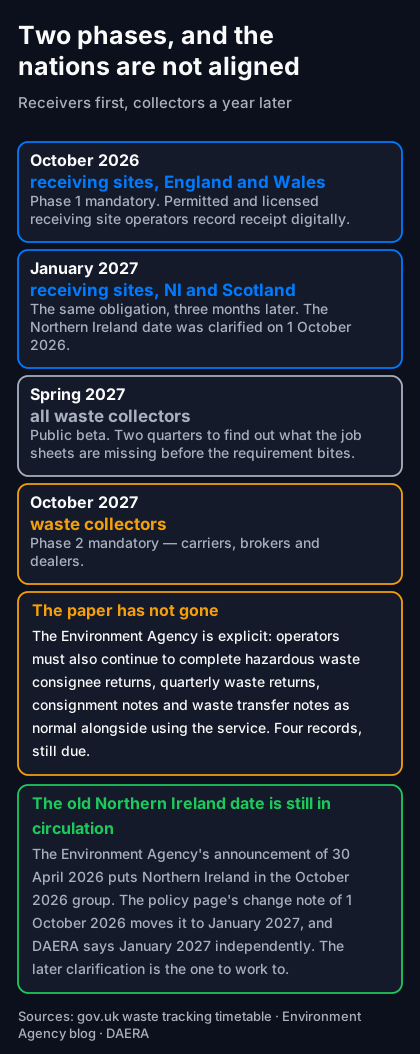
Digital waste tracking became mandatory for receiving site operators in England and Wales in October 2026, and reaches waste collectors in October 2027. It does not yet replace the paper: the Environment Agency is explicit that consignment notes, transfer notes, consignee returns and quarterly returns all continue alongside it. This sets out the dates, including the Northern Ireland date that changed, and what a business should do before the collector phase.
What is the digital waste tracking service?
Digital waste tracking is a single government service that records waste movements electronically instead of on paper. DAERA's description is the plainest: it will replace the existing, non-digital, systems used to report waste data.
The reason it exists is enforcement rather than tidiness. Paper waste documents sit in different filing cabinets at each end of a movement, so a load that leaves a producer and never arrives anywhere lawful leaves no trace until somebody goes looking. A shared record shows both ends of the same movement.
What it does not do is change the underlying duties. The waste duty of care still applies to each holder in turn, and the service is a reporting mechanism for it rather than a replacement — our waste duty of care entry covers the duty itself.
When does it become mandatory?
In two phases, receivers first and collectors a year later, and the nations are not aligned. These are the dates from gov.uk's own timetable.
| Stage | Who | When |
|---|---|---|
| Public beta | All permitted and licensed receiving site operators | Spring 2026 |
| Phase 1 mandatory | Receiving site operators in England and Wales | October 2026 |
| Phase 1 mandatory | Receiving site operators in Northern Ireland and Scotland | January 2027 |
| Private beta | An invited group of waste collectors | Autumn 2026 |
| Public beta | All waste collectors | Spring 2027 |
| Phase 2 mandatory | Waste collectors | October 2027 |
The sequencing is deliberate and worth understanding rather than just noting. Receiving sites are permitted operators with a fixed address and an existing reporting relationship, so they are the easier population to onboard; waste collectors are far more numerous and mobile, which is why they come second.
Why do the Northern Ireland dates differ from what you may have read?
Because they changed, and the earlier version is still in circulation. The Environment Agency's announcement of 30 April 2026 puts Northern Ireland in the October 2026 group alongside England and Wales.
The policy page was then updated on 1 October 2026 with a change note clarifying that the service will now become mandatory in Northern Ireland from January 2027, and DAERA states January 2027 independently. The later and more specific statement is the one to work to.
This is the ordinary condition of devolved environmental regulation rather than an anomaly, and it is the reason a business operating across the Irish Sea cannot read one page and stop. Waste, like customs, runs on more than one timetable at once.
Does it replace the waste transfer note?
Eventually, and not yet — which is the single most consequential thing on this page. The service is the destination; the paper is still the requirement.
So a transfer note is still a transfer note today, with everything our waste transfer note article sets out about describing the waste accurately, checking the carrier on the public register and being able to produce a specific note on request. Nothing about that has been switched off.
The same holds for hazardous movements. A consignment note is a different document with a different retention period, and the arrival of a digital service does not merge the two.
| What the service changes | What it leaves alone |
|---|---|
| Receiving sites record receipt digitally | The duty of care on each holder of the waste |
| Both ends of a movement sit in one record | The requirement to describe the waste accurately |
| A movement either reconciles or does not | Checking the carrier's registration before handover |
| Administration moves to before collection | Transfer notes and consignment notes, for now |
| Phase 2 brings collectors in from 2027 | Separate WEEE and hazardous waste obligations |
What must a business still do during the transition?
Both, in parallel, and the Environment Agency says so in terms. Its words are worth quoting exactly, because paraphrase has been losing the second half of them: "Initially we will not be moving away from current reporting methods. This means operators must also continue to complete hazardous waste consignee returns, quarterly waste returns, consignment notes and waste transfer notes as normal alongside using the Digital Waste Tracking to record receipt of waste movements."
Four categories of paper record, then, still due while the digital record is also being made. The duplication is the cost of a transition rather than an oversight, and a business that reads "digital waste tracking is live" as "the paperwork has gone" has acquired a compliance gap rather than saved any work.
Read against the table above, that also tells a collector what its own position is: nothing changes for a carrier in phase 1 except that the sites it delivers to are now recording receipt digitally.
When does it reach waste carriers?
October 2027, with a private beta from autumn 2026 and a public beta from spring 2027. Gov.uk's phrasing is that the service becomes mandatory for waste collectors from October 2027, the category covering carriers, brokers and dealers.
That is a year's notice from the point receivers went live, and the betas are the useful part of it. A carrier that joins a public beta in spring 2027 has two quarters to find out what its own job sheets are missing before the requirement bites; one that waits for October 2027 finds out on live movements.
The practical preparation has nothing to do with software. It is whether the data a movement needs — who holds which registrations, what the waste actually is, where it is going — exists in a usable form at the point of collection rather than being reconstructed afterwards.
What will a carrier have to do?
On the published design, three things, and all three happen before the vehicle moves rather than after. These are the shape set out in the policy documents rather than the text of phase 2 legislation, so treat them as the direction of travel.
- A record exists before the waste is removed, with a unique identifier generated for the movement.
- All parties are registered on the service before anything moves — with householders and non-UK operators outside that requirement.
- The identifier is passed to the other parties, so that the movement reconciles at both ends rather than at one.
The first item is the operational change. A paper transfer note can be completed at the kerb, signed and filed; a record that must exist and carry an identifier before removal has to be raised in advance, which pushes the administration from the end of the job to the start of it.
What does it mean for a one-off office or IT clearance?
More than for a routine collection, because a clearance is exactly the job where nobody has done the paperwork before. A single office strip-out generates several waste streams, each with its own document, and the digital record will reconcile against what the receiving site says it got.
That reconciliation is the new risk. A clearance recorded loosely at the producer's end and precisely at the site's end produces a mismatch that did not previously exist, because nothing used to compare the two. Our IT disposal documents note covers which documents a clearance needs.
For electrical equipment the separate WEEE obligations run alongside rather than instead, which is why an IT clearance is usually two compliance exercises wearing one invoice.
Does it change the duty of care?
No, and conflating the two is the commonest misreading. The duty of care is a statutory obligation on each holder of waste; digital waste tracking is a way of recording that waste moved. A better record of a transfer does not make an unlawful transfer lawful.
What it does change is how quickly a bad transfer becomes visible. Under paper, a producer who handed waste to an unregistered carrier might never learn of it; under a shared record, the movement either reconciles at a permitted receiving site or it does not.
So the checks that mattered before matter more rather than less: the carrier's registration, an accurate description of the waste, and a site legally able to accept it. See WEEE collection and chain of custody for how that evidence is built on the kind of work we do.
What should a business do before October 2027?
Treat it as a data exercise rather than an IT project, because that is what it is. Three things are worth doing while there is no deadline attached to them.
- Check who you are using. Carrier registrations, site permits, and the date you last verified each — the same checks the duty of care already requires, recorded rather than remembered.
- Fix the waste descriptions. "General waste" has never been an adequate description and will reconcile badly against a receiving site's own classification.
- Decide who raises the record. Producer, carrier or broker — somebody has to, before the vehicle leaves, and the time to settle that is not on the morning of a clearance.
None of that requires the service itself. All of it is what the service will expose, which is the useful way to read any mandatory reporting change: the reporting is new, the underlying facts are not.
Where do we stand in this?
We are a carrier, and in phase 1 our position is unchanged: the sites we deliver to record receipt digitally, and the paper documents for the movements we make are still due as normal. We are not a waste broker and we are not a disposal site, so we are neither arranging the destination nor accepting the waste at it.
Where we expect to be in phase 2 is a collector with records to raise before movements rather than after them, and the preparation for that is the job sheet rather than a system. Our IT equipment collection page sets out the work and waste transfer note the document that still governs it.
What we do not do is advise on waste classification or hold anybody's duty of care for them. The description of the waste is the producer's, the destination is the producer's or the broker's choice, and our part is to move it between the two with the documents correct for the movement — see also our hazardous versus standard comparison where the streams differ.
Questions
- What is the digital waste tracking service?
- A single government service that records waste movements electronically rather than on paper. DAERA's description is the plainest: it will replace the existing, non-digital, systems used to report waste data. The purpose is enforcement — paper documents sit in separate filing cabinets at each end of a movement, so a load that never arrives anywhere lawful leaves no trace, whereas a shared record shows both ends of the same movement.
- When does digital waste tracking become mandatory?
- In two phases. Phase 1 covers receiving site operators: mandatory from October 2026 in England and Wales, and from January 2027 in Northern Ireland and Scotland. Phase 2 covers waste collectors — carriers, brokers and dealers — and is mandatory from October 2027, with a private beta from autumn 2026 and a public beta for all collectors from spring 2027.
- Has the Northern Ireland date changed?
- Yes, and the earlier version is still in circulation. The Environment Agency's announcement of 30 April 2026 puts Northern Ireland in the October 2026 group with England and Wales. The gov.uk policy page was updated on 1 October 2026 with a change note clarifying that the service will now become mandatory in Northern Ireland from January 2027, and DAERA states January 2027 independently. The later clarification is the one to work to.
- Does digital waste tracking replace the waste transfer note?
- Eventually, but not yet, and this is the most consequential point. The Environment Agency states that operators must also continue to complete hazardous waste consignee returns, quarterly waste returns, consignment notes and waste transfer notes as normal alongside using the service to record receipt of waste movements. Reading “digital waste tracking is live” as “the paperwork has gone” creates a compliance gap rather than saving work.
- What will waste carriers have to do under digital waste tracking?
- On the published design: a record must exist with a unique identifier generated before the waste is removed; all parties must be registered on the service before anything moves, with householders and non-UK operators outside that requirement; and the identifier must be passed to the other parties so the movement reconciles at both ends. The first is the real operational change, because it moves the administration from the end of the job to the start.
- Does digital waste tracking change the waste duty of care?
- No. The duty of care is a statutory obligation on each holder of waste in turn; digital waste tracking is a way of recording that waste moved, and a better record of a transfer does not make an unlawful transfer lawful. What changes is visibility: under paper a producer might never learn they used an unregistered carrier, whereas under a shared record the movement either reconciles at a permitted site or it does not.
- What should a business do before the collector phase in October 2027?
- Treat it as a data exercise rather than an IT project. Record which carrier registrations and site permits you have checked and when, rather than remembering it; fix the waste descriptions, because “general waste” will reconcile badly against a receiving site's own classification; and decide who raises the record before the vehicle leaves — producer, carrier or broker. None of that needs the service itself.
Explore more
More from the blog
- Commodity Codes Explained: How to Classify UK Impor…
- Proof of Delivery: What It Actually Proves, and Wha…
- ATA Carnet: how it works, what it costs, and when n…
- Top 10 UK Cities for Logistics Companies (2026)
- UK Pharmaceutical Transport: GDP Compliance Guide […
- Aerospace AOG Support: Emergency Parts Delivery Acr…