
ATA Carnet: how it works, what it costs, and when not to bother
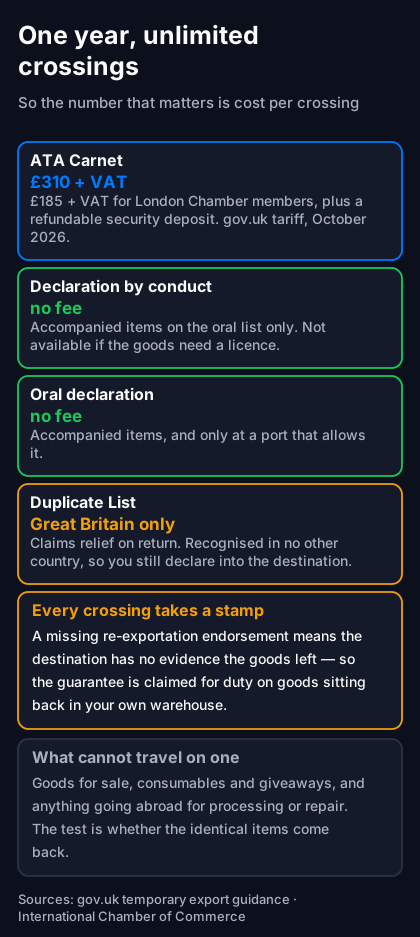
An ATA Carnet is a customs document that lets goods enter a country temporarily without paying import duty or tax — a passport for goods, valid one year, accepted in around 80 countries. It costs £310 plus VAT on gov.uk's published tariff plus a refundable security deposit, and it is worth that against several crossings rather than one. This sets out what it covers, what happens at each border, and the three cheaper alternatives for a single trip.
What is an ATA Carnet?
An ATA Carnet is an international customs document that lets goods enter a country temporarily without paying import duty or tax, and it is usually described as a passport for goods. You present and have it endorsed at each border instead of filing import and export declarations.
The document carries its own guarantee. That is what makes it work: the issuing body in your country stands behind the duties and taxes that would be owed if the goods did not leave again, so foreign customs will release them against the carnet rather than against a cash deposit at their own border.
It is accepted in approximately 80 countries and customs territories, and in each one the carnet is issued at national level by that country's guaranteeing association.
What does a carnet cost and how long does it last?
One year, and the fee is published rather than quoted. These are the gov.uk figures as at October 2026.
| Item | Amount |
|---|---|
| Standard carnet fee | £310 plus VAT |
| London Chamber of Commerce and Industry members | £185 plus VAT |
| Security deposit | Required in addition, scaled to the value of the goods |
| Validity | 1 year, unlimited journeys within it |
The one-year validity is the part that changes the economics. A carnet is expensive against a single trip and cheap against a touring exhibition schedule, because the same document covers as many journeys as you can fit into the twelve months. Work out the cost per crossing, not the cost per carnet.
The security deposit is returned once the carnet is properly discharged, which is a cash-flow question rather than a cost, but it is a real one on high-value equipment.
What can travel on a carnet, and what cannot?
Three broad categories go, and the exclusions are defined by what happens to the goods rather than by what they are.
| Travels on a carnet | Does not |
|---|---|
| Commercial samples | Goods for sale |
| Professional equipment — cameras, instruments, tools, test rigs | Consumables and giveaways |
| Goods for exhibitions, trade fairs and events | Goods going for processing or repair |
The test is whether the identical items come back. A carnet covers temporary admission, so anything consumed, given away, sold or altered abroad has left the scheme, and customs will treat the shortfall as an import when the carnet is reconciled.
The International Chamber of Commerce lists which goods each country admits, and the lists differ. A carnet accepted for broadcast equipment in one territory may not cover the same kit in another, so the check is per country and per category, before you travel rather than at the border.
How does the document actually work at a border?
By being stamped, every time, in both directions. A carnet is a booklet of paired vouchers and counterfoils, and each crossing consumes one pair.
- Exportation from the home country, stamped on the way out.
- Importation into the destination, stamped on arrival.
- Re-exportation from that destination, stamped on the way out again.
- Re-importation home, which closes the loop.
- Transit vouchers, used where the goods cross a country without stopping.
A missing stamp is the classic and expensive failure. If the re-exportation voucher is not endorsed, the destination's customs authority has no evidence the goods left, and will claim against the guarantee — so the deposit is drawn on for duty and tax on goods that are physically sitting back in your own warehouse. Recovering that means proving the exit after the fact, which is slow.
Can somebody else carry goods on your carnet?
Yes, and this is the part most buyers do not realise. Gov.uk states plainly that someone else can use an ATA Carnet on your behalf, which means the carnet holder does not have to be the person at the wheel.
In practice that makes a carnet workable for unaccompanied freight. The carnet travels with the goods, the driver presents it, and the stamps go in the booklet exactly as they would if you were there. What the driver needs is the booklet itself, the itemised list, and clear instructions about which voucher is being used at which crossing.
What a carrier cannot do is fix a carnet that is wrong. If the item list does not match what is in the vehicle, the crossing stops, and no amount of goodwill at the barrier resolves a discrepancy between a customs document and a load.
What are the alternatives to a carnet?
Three, and for a single short trip one of them is usually cheaper.
| Method | When it works | Limit |
|---|---|---|
| Declaration by conduct | Accompanied items on the oral and by conduct list | No fee, but goods needing a licence are excluded |
| Oral declaration | Accompanied items, at a port that allows it | Must check the port as well as the list |
| Duplicate List | Taking goods out of Great Britain and claiming relief on return | Not recognised in any other country |
| Full customs declaration | Anything | Declaration at both ends, every trip |
The Duplicate List trap is worth stating twice: it solves the British half of the problem and none of the other half. You still have to declare the goods into the destination country by some other means and pay whatever is owed there.
Note also that a licence requirement rules out both of the simple routes. If your goods need an export licence you cannot use declaration by conduct or an oral declaration, which frequently pushes a shipment back to a carnet or a full declaration.
Who issues a carnet, and how long does it take?
A chamber of commerce, acting as the national guaranteeing association, and the application is made by whoever owns the goods rather than by whoever drives them.
The work sits in the item list. A carnet is only as good as its schedule of goods, and that schedule has to describe every item individually — description, serial number where one exists, quantity, weight and value — because customs at each border will check the physical load against it. A list reading "one case of tools" will not survive an inspection that finds eleven tools.
- Build the item list with serial numbers, values and weights.
- Name every country the goods will enter, including transit countries.
- Apply through a chamber, with the security against the total value.
- Check the destination accepts your category, which varies by country.
- Brief whoever travels on which voucher is used where.
Add a country later and the carnet has to be amended, which is slower than including it at the outset. The cheap insurance is listing every country the goods might plausibly enter when you apply, not the ones you are certain about.
What happens if the goods do not come back?
The duty and tax become payable in the country where the goods stayed, and the guarantee is what pays it. That is the mechanism working as designed rather than a penalty — temporary admission relief was granted on the basis that the goods would leave, and they did not.
Three situations produce it, and only one is deliberate. Goods genuinely sold abroad have changed from temporary to permanent import and should be regularised properly at the time. Goods lost, stolen or destroyed still attract the liability unless the destination's customs authority accepts evidence of the loss. And goods that simply came home without the re-exportation voucher being stamped are the common case, where the duty is claimed on goods that are physically back in Britain.
The last one is recoverable but slow, and it is avoided entirely by treating the stamping as the job rather than as an administrative afterthought. A driver who is told which voucher to present at which crossing does not miss one; a driver handed an unexplained booklet frequently does.
Which route should you choose?
Count the crossings and check the licence position first; the answer usually falls out of those two facts.
- One trip, accompanied, no licence, goods on the list — declaration by conduct or oral declaration.
- One trip, unaccompanied or licensable — full declaration, or a carnet if the destination makes relief awkward.
- Several trips in a year, or several countries — a carnet, almost always.
- Goods that will be sold, consumed or altered — none of the above; this is a normal import.
A touring exhibition stand, a demonstration rig doing a European circuit and a film crew's kit all sit squarely in case three, which is why those are the users the scheme was built around. Where the movement is into the EU, the carnet replaces the import declaration but not the carrier's own paperwork — a CMR note still travels with the vehicle.
What is our part?
We carry goods travelling under a carnet; we do not issue one and we are not a customs agent. The carnet is applied for by the goods' owner through a chamber of commerce, and our part begins when the booklet and the goods are both ready.
What that looks like operationally is a dedicated vehicle, the booklet carried with the consignment, and the driver presenting it for endorsement at each crossing. Our customs page sets out where we coordinate with a broker and where we do not, the carnet glossary entry covers the definition, and exhibition and events logistics the work that most often needs one.
Where goods are moving permanently rather than temporarily, the paperwork is different and so is the article: see commercial invoices and customs special procedures, which covers temporary admission as a customs procedure in its own right.
Questions
- What is an ATA Carnet?
- An international customs document that lets goods enter a country temporarily without paying import duty or tax — commonly called a passport for goods. You present it for endorsement at each border instead of filing import and export declarations. It carries its own guarantee, so foreign customs release the goods against the carnet rather than against a cash deposit at their border. Around 80 countries and customs territories accept it.
- How much does an ATA Carnet cost in the UK?
- Gov.uk publishes the fee as £310 plus VAT, or £185 plus VAT for members of the London Chamber of Commerce and Industry, as at October 2026. A security deposit is required on top, scaled to the value of the goods, and it is returned once the carnet is properly discharged. The carnet lasts one year and covers unlimited journeys within it, so the figure that matters is cost per crossing rather than cost per carnet.
- How long is an ATA Carnet valid?
- One year, with unlimited journeys inside that period. That validity is what decides whether a carnet is worth buying: it is expensive against a single trip and cheap against a touring schedule, because the same document covers as many crossings as fit into the twelve months. A carnet cannot be extended, so a programme running past the year needs a fresh one.
- What goods cannot travel on an ATA Carnet?
- Anything that will not come back in the same state. Goods for sale, consumables and giveaways, and goods going abroad for processing or repair are all outside the scheme, because a carnet covers temporary admission only. The test is whether the identical items return; anything consumed, sold or altered abroad shows as a shortfall when the carnet is reconciled and is treated as an import.
- What happens if a carnet is not stamped on the way out?
- The guarantee is claimed against. Without an endorsed re-exportation voucher the destination's customs authority has no evidence the goods left, so it pursues duty and tax on goods that are physically back in your own warehouse, and the security deposit is drawn on. Recovering it means proving the exit after the fact, which is slow. Every crossing consumes a paired voucher and counterfoil, in both directions.
- Can a courier carry goods on my ATA Carnet?
- Yes. Gov.uk states that someone else can use an ATA Carnet on your behalf, so the holder does not have to be the person at the wheel. The booklet travels with the goods and the driver presents it for endorsement at each crossing. What a carrier cannot do is fix a carnet that is wrong — if the item list does not match what is in the vehicle, the crossing stops.
- What are the alternatives to an ATA Carnet?
- Three. Declaration by conduct and oral declaration are free but work only for accompanied items on the oral and by conduct list, and neither is available if the goods need a licence. A Duplicate List lets you claim relief returning to Great Britain but is not recognised in any other country, so you still have to declare into the destination separately. Otherwise, a full customs declaration at both ends of every trip.
Explore more
More from the blog
- Construction site deliveries: what the site demands…
- Sending Large and Heavy Items by Courier: When a Pa…
- Cross-docking: what it saves, and what it costs you
- Customs Procedure Codes: What DE 1/10 and DE 1/11 A…
- Customs special procedures: inward processing, ware…
- Demurrage, detention and waiting time: three clocks…