
Moving wine and spirits: the duty question decides everything else
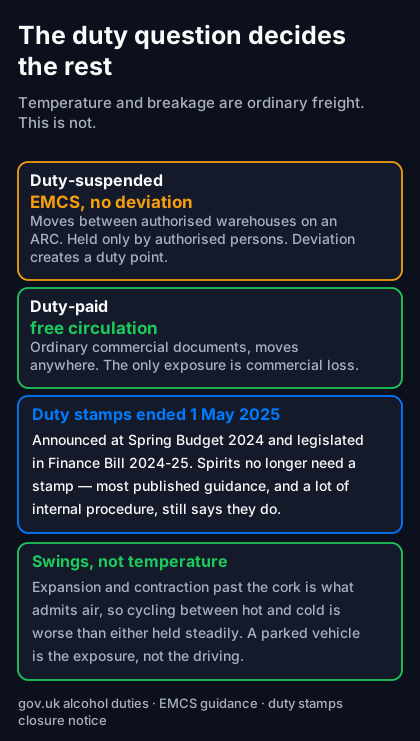
Moving wine and spirits is ordinary careful freight with one thing bolted on: excise duty, and whether it has been paid yet. A duty-suspended consignment travels on EMCS to a named authorised destination and cannot be diverted; a duty-paid one is simply valuable, fragile and temperature-sensitive. One widely repeated rule no longer applies — the Alcohol Duty Stamps Scheme ended on 1 May 2025.
What makes alcohol different to move?
Duty, and specifically the question of whether it has been paid yet. Alcohol carries excise duty in addition to any customs duty and VAT, and the entire structure of a wine or spirits movement follows from whether that duty has already been paid on the goods in the vehicle.
Everything else about the job — temperature, breakage, security — is ordinary careful freight handling. The excise position is the part that has no equivalent in general haulage, and it is where the expensive mistakes live.
Duty-paid or duty-suspended?
Two regimes, and a consignment is in one or the other at every moment of its journey.
| Duty-suspended | Duty-paid | |
|---|---|---|
| Duty status | Not yet paid; liability travels with the goods | Paid; the goods are in free circulation |
| Moves between | Authorised warehouses and registered traders | Anywhere |
| Paperwork | EMCS, with an ARC accompanying the movement | Ordinary commercial documents |
| Who may hold it | Authorised persons only | Anyone |
| Risk if it goes wrong | Duty becomes payable immediately | Commercial loss only |
The practical consequence is that a duty-suspended movement cannot simply be diverted. Goods released from an excise warehouse under suspension are travelling to a specific authorised destination on a specific document, and a driver who leaves them somewhere convenient has created a duty point.
Our EMCS article covers the mechanics of the suspended movement, including what an ARC is and what happens when a report of receipt is not filed.
Do spirits still need a duty stamp?
No. The Alcohol Duty Stamps Scheme ended on 1 May 2025, and this is the single most out-of-date fact in published guidance on moving spirits.
The government announced the end of the scheme at Spring Budget 2024 following an HMRC review, legislated for it in Finance Bill 2024-25, and confirmed the closure date as 1 May 2025. The scheme's requirements applied until that date and not after it.
This matters operationally because a lot of trade guidance, template procedures and supplier checklists still require a stamp and still describe checks for one. If a procedure in your business says to verify duty stamps on incoming spirits, that procedure is now more than a year out of date, and the useful thing to check instead is the duty status and the EMCS documentation.
Where does a courier sit in all this?
As the carrier, and almost never as the holder of the duty liability — which is the distinction worth being precise about when scoping a job.
Authorisation to hold goods in duty suspension sits with warehousekeepers and registered consignors and consignees, not with the vehicle. A carrier moving a suspended consignment is executing a movement that someone else has set up on HMRC's system, under documentation someone else is responsible for.
So the question to a carrier is not "are you approved for alcohol". It is whether they will carry the consignment to the authorised destination without deviation, hold the paperwork with the goods, and deliver against the right receipt. That is a discipline question, and it is answerable.
Duty-paid movements are simpler still: wine and spirits in free circulation are valuable, fragile, temperature-sensitive goods and nothing more exotic than that.
What temperature does wine need?
Stable more than cold, and the distinction changes what you should specify. Wine is damaged less by a particular temperature than by swings between temperatures, which drive expansion and contraction past the cork and let air in.
- Avoid heat — a sealed vehicle in summer traffic reaches temperatures that cook wine within hours.
- Avoid freezing, which can push corks and crack bottles.
- Avoid cycling between the two, which is worse than either held steadily.
- Keep bottles horizontal where the closure is cork, so it stays wet.
- Mind the standing time — a vehicle parked in the sun is the exposure, not the driving.
For a short domestic run in spring or autumn an insulated load space and sensible scheduling handles it, and a temperature logger in the load is how you evidence that afterwards. For fine wine, summer movements or anything held overnight, controlled temperature is a real requirement rather than an upsell, and the temperature-controlled page sets out how that is scoped.
How should wine and spirits be packed?
For the drop, not for the shelf. Glass in a vehicle fails in a specific way: not from a single impact but from bottles working against one another over a journey.
| Failure | What prevents it |
|---|---|
| Bottle-on-bottle contact | Dividers or moulded inserts in every carton |
| Carton collapse under stacking | Rated cases, and nothing heavy on top |
| Movement within the pallet | Shrink wrap to the pallet base, not just around the load |
| Corner damage in handling | No overhang past the pallet edge |
| Leakage spreading | Absorbent layer, so one broken bottle does not become twelve claims |
The last row is the one wholesalers learn the expensive way. A single breakage inside a shrink-wrapped pallet soaks the cartons below it, and the claim is not for one bottle but for everything the wine reached. Under duty suspension the same breakage also has to be accounted for to HMRC, so the absorbent layer is protecting a tax position as well as the stock.
What does a duty-suspended delivery need at the receiving end?
An authorised destination, a person who can receipt it, and a report of receipt filed afterwards — and the movement is not closed until that last step happens.
Under EMCS the consignee reports receipt of the goods, and until they do, the movement remains open and the consignor's guarantee remains exposed. A delivery that physically arrived and was never reported is, on the system, a consignment that has gone missing. This is why trade deliveries into bonded premises are not doorstep drops: the receipt is a regulatory act, not a signature for convenience.
- Confirm the destination is the one on the movement before the vehicle leaves.
- Confirm who is authorised to receipt it, and when they are on site.
- Keep the documentation with the goods for the whole journey.
- Record any shortage or breakage at delivery, because losses have a duty consequence.
- Check the report of receipt was filed, rather than assuming.
Breakage is the one with a tail. A case destroyed in transit under suspension is not simply a commercial loss; the duty position has to be settled too, and the evidence for that is the delivery note and the photographs taken at the time rather than a recollection a fortnight later.
Does any of this change for a small parcel of wine?
Yes, and in the sender's favour, because duty-paid wine going to a private address is ordinary fragile freight with one condition attached.
| Movement | What applies |
|---|---|
| Duty-paid, trade to trade | Commercial documents; packaging and temperature are the risks |
| Duty-paid, to a consumer | Same, plus an age check at the door |
| Duty-suspended, warehouse to warehouse | EMCS, authorised destination, no deviation |
| Imported, duty not yet accounted for | Customs and excise both, before release |
The age check is not optional and it is not a formality. Alcohol delivered to a residential address needs an adult recipient, and a delivery left in a porch or with a neighbour is a failed delivery however convenient it looked at the time.
For the trade-to-trade case the binding constraint is usually nothing regulatory at all — it is that someone has to be there to take it, and bars and restaurants are staffed at hours that suit them rather than the delivery round.
What goes wrong most often?
Four things, and three of them are settled before the vehicle moves.
- The duty status is not stated at booking, so the carrier does not know whether deviation is permissible.
- The delivery address is not the authorised destination on the EMCS movement.
- Nobody is authorised to sign at the receiving end, and alcohol is not a doorstep-drop commodity.
- Packaging was specified for retail display rather than for being handled four times.
The third is worth planning around specifically. Alcohol deliveries frequently need an adult signature and a named recipient, and a trade delivery to a bar or restaurant that arrives before anyone is on shift is a wasted journey rather than a late one. Confirm the hours someone is actually there, not the opening hours.
What do we carry?
Duty-paid wine and spirits on dedicated vehicles, and duty-suspended consignments as the carrier on a movement set up by an authorised consignor. We hold no excise warehouse approval and we are not a registered consignor or consignee — those authorisations belong to the warehouse and the trader, not to the vehicle.
What a dedicated vehicle gives this particular cargo is the thing the goods most need: the consignment travels alone, is handled twice rather than five times, and does not sit in a consolidation hub overnight. For glass that is a materially lower breakage risk, and for a suspended movement it removes the deviation question entirely.
See alcohol delivery for the service, EMCS for the duty-suspended mechanics, and bonded warehousing for where the goods sit between movements.
Questions
- Do spirits still need a duty stamp in the UK?
- No. The Alcohol Duty Stamps Scheme ended on 1 May 2025. The government announced it at Spring Budget 2024 following an HMRC review and legislated in Finance Bill 2024-25; the scheme's requirements applied until that date and not after it. This is the most out-of-date fact in published guidance on moving spirits — a lot of trade material and internal procedures still describe checking for stamps.
- What is the difference between duty-paid and duty-suspended alcohol?
- Whether the excise duty has been paid. Duty-suspended goods move between authorised warehouses and registered traders under EMCS with an ARC accompanying the movement, may only be held by authorised persons, and create an immediate duty liability if the movement goes wrong. Duty-paid goods are in free circulation, move anywhere on ordinary commercial documents, and the only exposure is commercial loss.
- Can a duty-suspended consignment be diverted en route?
- No. Goods released from an excise warehouse under suspension are travelling to a specific authorised destination on a specific EMCS movement, and a driver who leaves them somewhere more convenient has created a duty point. That is why the duty status has to be stated at booking: the carrier needs to know whether any deviation at all is permissible before the vehicle moves.
- What temperature should wine travel at?
- Stable rather than cold. Wine is damaged less by a particular temperature than by swings between temperatures, which drive expansion and contraction past the cork and admit air. Avoid heat, avoid freezing, and above all avoid cycling between them. Keep cork-closed bottles horizontal so the closure stays wet, and watch standing time — a vehicle parked in the sun is the exposure, not the driving.
- How should wine be packed for transport?
- For the drop, not the shelf. Glass fails from bottles working against one another over a journey rather than from a single impact, so every carton needs dividers or moulded inserts, cases need to be rated for stacking, and shrink wrap must go to the pallet base rather than just around the load. Include an absorbent layer: one breakage inside a wrapped pallet soaks the cartons below and turns one bottle into a dozen claims.
- Does a courier need special approval to carry alcohol?
- Not to carry it. Authorisation to hold goods in duty suspension sits with warehousekeepers and registered consignors and consignees, not with the vehicle — a carrier is executing a movement someone else set up on HMRC's system. So the question is not whether the carrier is approved, but whether they will deliver to the authorised destination without deviation, keep the paperwork with the goods, and obtain the right receipt.
- What do you carry, and what do you not?
- Duty-paid wine and spirits on dedicated vehicles, and duty-suspended consignments as the carrier on a movement set up by an authorised consignor. We hold no excise warehouse approval and are not a registered consignor or consignee — those authorisations belong to the warehouse and the trader. A dedicated vehicle suits this cargo because the goods travel alone, are handled twice rather than five times, and do not sit in a hub overnight.
Explore more
More from the blog
- Customs special procedures: inward processing, ware…
- Demurrage, detention and waiting time: three clocks…
- Do you actually need a bonded warehouse, or just a…
- Tail lifts: what one will actually lift, and whethe…
- Drivers' hours: the number that decides your delive…
- EMCS: how a duty-suspended excise movement actually…