
AWRS: who needs approval to sell alcohol wholesale, and who must check
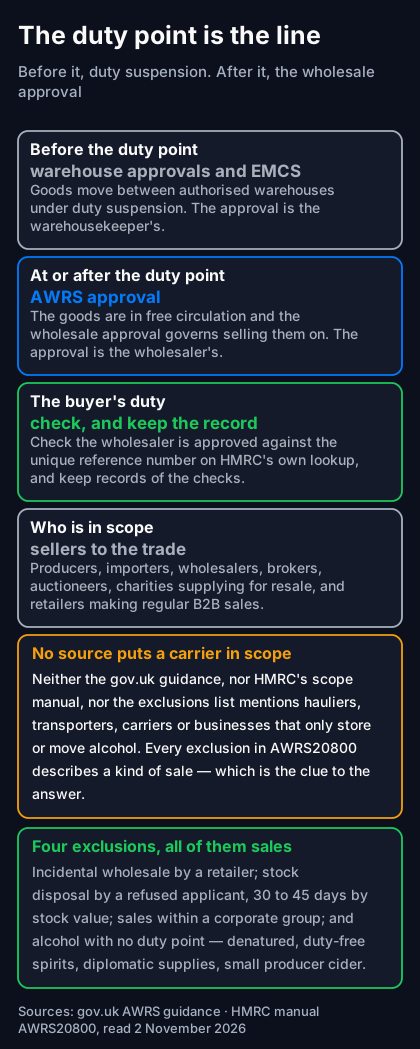
The Alcohol Wholesaler Registration Scheme is an HMRC approval a business must hold before selling alcohol wholesale at or after the duty point. It also places a duty on the buyer: check that the wholesaler is approved, and keep records of the check. Nothing in the scheme addresses hauliers or storage-only businesses — it turns on selling. This sets out who needs approval, who is excluded, and how to check one.
What is the Alcohol Wholesaler Registration Scheme?
The Alcohol Wholesaler Registration Scheme is an HMRC approval that a business must hold before it sells alcohol wholesale in the UK. HMRC introduced it in 2016 to make alcohol fraud harder by putting a registration between the duty point and the trade counter.
The scheme is defined by the transaction rather than the product. It requires wholesalers of alcohol, at or after the duty point, to be approved — so what matters is when and to whom the sale is made, not what is in the bottle.
It also creates a duty on the other side of the sale. A business buying alcohol for resale has to satisfy itself that its supplier is approved, which turns a registration scheme into a due diligence obligation running through the whole trade.
What does "at or after the duty point" mean?
It means the sale happens once excise duty has become due on the goods. Gov.uk puts the test as whether your sales are made at, or after, the point where excise duty is due.
That single phrase separates two worlds of alcohol logistics. Before the duty point, goods move between authorised warehouses under duty suspension, with its own controls and its own paperwork; after it, the goods are in free circulation and the wholesale approval is what governs selling them on.
Our EMCS and duty-suspended movements article covers the before; this one covers the after. Confusing the two is the commonest error in the area, because the same pallet of spirits can sit either side of the line depending on nothing visible from the outside.
Who has to be approved?
Anyone selling alcohol to another business for resale, and the list is broader than the word "wholesaler" suggests.
| In scope | Why |
|---|---|
| Breweries, wine, spirit and cider producers | Selling their own output to the trade |
| Importers | Selling imported stock on to businesses |
| General wholesalers and brokers | The obvious case |
| Retailers making regular business-to-business sales | Regular trade sales are wholesaling |
| Auctioneers | Selling alcohol to buyers who will resell |
| Charities supplying alcohol for resale | No exemption for the purpose |
The fourth row is the one that catches businesses by surprise. A shop that occasionally sells a case to a neighbouring restaurant is in different territory from one doing it regularly, and the dividing line is a judgement about the pattern of trade rather than a volume threshold.
Who is excluded?
Four categories, and all four are about the nature of the sale rather than the size of the business. HMRC's exclusions guidance sets them out.
- Incidental wholesale sales by a retailer, where they are incidental to authorised retail sales.
- Stock disposal by a refused applicant winding down, within a window of 30 to 45 days depending on the value of the stock.
- Intra-group sales — sales of alcohol between members of the same corporate group.
- No duty point, which covers denatured alcohol, duty-free spirits, diplomatic supplies and small producer cider.
Read the list for what it is not about. Nothing in it turns on storage, carriage or movement — every exclusion describes a kind of sale, which is the clue to the question most hauliers and warehouses actually want answered.
Does a carrier or haulier need AWRS approval?
Nothing in the scheme says so, and the honest answer is that it addresses sellers rather than movers. The scheme requires approval of wholesalers of alcohol at or after the duty point; neither the guidance, nor HMRC's scope manual, nor the exclusions list mentions hauliers, transporters, carriers or businesses that only store or move alcohol.
That is a statement about what the sources say, not a legal opinion, and the distinction matters for anybody relying on it. A business that moves alcohol and also sells it is selling it, and the approval question is answered by the selling half — which is why a haulier that starts buying and reselling pallets of beer has changed what it is, whatever the vehicles are doing.
Where a carrier genuinely needs to care is upstream of its own position. The goods in the vehicle may be the subject of an offence by somebody else, and the paperwork travelling with them is where that shows — a consignment of duty-paid alcohol with no identifiable approved seller behind it is a problem for everyone who handles it, whatever the scheme formally requires of each party.
What must a buyer do?
Check, and keep the evidence of checking. Gov.uk requires purchasers acquiring alcohol from UK wholesalers to check that the wholesaler is approved by HMRC, and to keep records of these checks as evidence of their due diligence activities.
The second half is the part businesses skip. A check that happened but was not recorded is indistinguishable, later, from a check that never happened — the same structural problem as the pallet balance in our pallet exchange article, and with considerably more at stake.
Checking once is also not enough. An approval can be revoked, so a supplier that was approved when the account was opened is not necessarily approved on the invoice in front of you, and the check has to be repeated rather than filed away as done.
How do you check an approval?
Against the unique reference number, on HMRC's own lookup. The approval number should appear on the wholesaler's invoices, and gov.uk's checker confirms whether that number is currently registered.
- Find the reference on the invoice or the supplier's paperwork.
- Enter it in the HMRC checker rather than trusting the document.
- Record the result and the date, which is the evidence HMRC asks for.
- Repeat it periodically, because approval status can change.
Step two is the one worth insisting on. A number printed on an invoice evidences what the supplier typed, and the only thing that evidences an approval is the register.
What happens if the seller is not approved?
The buyer is exposed, not just the seller. Gov.uk states that a business will face penalties if it trades without approval, and directs readers to Excise Notice 2002 for the detail rather than listing amounts.
The exposure on the buying side is the reason the due diligence duty exists at all. Buying alcohol from an unapproved wholesaler puts the stock and the buyer's own position at risk, which is why a trade buyer with no record of having checked is in a weaker place than one with a dated screenshot.
This is also why the scheme works as an anti-fraud measure rather than a registration formality. It makes the whole chain interested in the approval status of the link above it, which no amount of enforcement at the duty point would achieve.
How does this sit with duty-suspended movements?
They are different regimes for different stages, and a consignment can pass through both. Under duty suspension the goods move between authorised warehouses on EMCS with their own controls; once duty is paid they are in free circulation and the wholesale approval governs the onward sale.
So the questions to ask about a pallet of spirits are sequential rather than alternative: has duty been paid, and if so, is the seller approved to sell it wholesale? Our moving wine and spirits article covers the fork, and bonded warehousing the place where duty sits suspended.
| Before the duty point | At or after the duty point | |
|---|---|---|
| Regime | Duty suspension | Free circulation |
| What governs the movement | Warehouse approvals and EMCS | Ordinary carriage |
| What governs the sale | Duty-suspended trade rules | AWRS approval |
| Approval held by | The warehousekeeper | The wholesaler |
| Buyer's check | The movement paperwork | The HMRC register |
The practical consequence for a buyer is that "it came from a bonded warehouse" answers the first question and says nothing about the second. A warehouse approval and a wholesaler approval are held by different parties for different activities, and a business can perfectly well hold one and not the other.
Nothing in the table above changes what a vehicle does. Both columns describe loads that get collected, carried and delivered the same way, which is precisely why the approval question cannot be answered by looking at the goods, the pallet or the paperwork in the cab — only by asking who is selling to whom, and at what point.
What is our part in this?
We move alcohol and we do not sell it, so we are not a wholesaler and we hold no AWRS approval — nor, on everything published about the scheme, does the scheme ask us to. We are not a customs or excise agent either, and nothing we issue evidences a duty position.
What we ask for is the paperwork that makes a movement traceable to an identified seller and buyer, because a consignment of duty-paid alcohol with vague documentation is a consignment nobody can place in the chain. Our alcohol delivery and alcohol courier pages set out the work, and sending wine and spirits the single-consignment version.
For the compliance that does sit with us on these loads, see who unloads and drivers' hours; for the duty-suspended alternative, EMCS.
Questions
- What is the Alcohol Wholesaler Registration Scheme?
- An HMRC approval a business must hold before it sells alcohol wholesale in the UK, introduced in 2016 to make alcohol fraud harder. It requires wholesalers of alcohol, at or after the duty point, to be approved — so what matters is when and to whom the sale is made rather than what is in the bottle. It also obliges buyers to satisfy themselves that their supplier is approved.
- What does “at or after the duty point” mean?
- That the sale happens once excise duty has become due on the goods. Gov.uk puts the test as whether your sales are made at, or after, the point where excise duty is due. Before that point, alcohol moves between authorised warehouses under duty suspension with its own controls; after it, the goods are in free circulation and the wholesale approval governs selling them on. The same pallet can sit either side of the line.
- Who has to be approved under AWRS?
- Anyone selling alcohol to another business for resale: breweries and wine, spirit and cider producers selling to the trade, importers, general wholesalers and brokers, auctioneers, charities supplying alcohol for resale, and retailers making regular business-to-business sales. That last category surprises people — occasional sales to a neighbouring restaurant are different from regular ones, and the line is a judgement about the pattern of trade.
- Who is excluded from AWRS?
- Four categories, all about the nature of the sale: wholesale sales by a retailer that are incidental to its authorised retail sales; stock disposal by a refused applicant winding down, within a window of 30 to 45 days depending on stock value; sales between members of the same corporate group; and alcohol with no duty point, such as denatured alcohol, duty-free spirits, diplomatic supplies and small producer cider.
- Does a haulier need AWRS approval to carry alcohol?
- Nothing in the scheme says so. It requires approval of wholesalers of alcohol at or after the duty point, and neither the gov.uk guidance, nor HMRC's scope manual, nor the exclusions list mentions hauliers, transporters, carriers or businesses that only store or move alcohol — every exclusion describes a kind of sale. A business that moves alcohol and also sells it is selling it, and the selling half answers the question.
- How do I check whether an alcohol wholesaler is approved?
- Against the unique reference number on HMRC's own lookup. The approval number should appear on the wholesaler's invoices; enter it into the gov.uk checker rather than trusting the document, record the result and the date, and repeat it periodically because approval can be revoked. A number printed on an invoice evidences what the supplier typed — only the register evidences an approval.
- What happens if I buy alcohol from an unapproved wholesaler?
- The buyer is exposed, not only the seller. Gov.uk states that a business will face penalties if it trades without approval and points to Excise Notice 2002 for the detail. Buying from an unapproved wholesaler puts the stock and the buyer's own position at risk, which is why a trade buyer with no record of having checked is in a weaker place than one with a dated result from the register.
Explore more
More from the blog
- Our Certifications & Compliance Framework
- New Business Boom: 500K+ Companies Registered Annua…
- UK Same-Day Courier: The Complete 2026 Guide for Bu…
- ULEZ Compliance for UK Courier Operators: 2026 Guide
- Emergency Freight Collection at Glasgow Airport — A…
- Same-Day vs Next-Day Delivery: A Data-Driven Decisi…