
Who owns the pallet: exchange, pooled and one-way compared
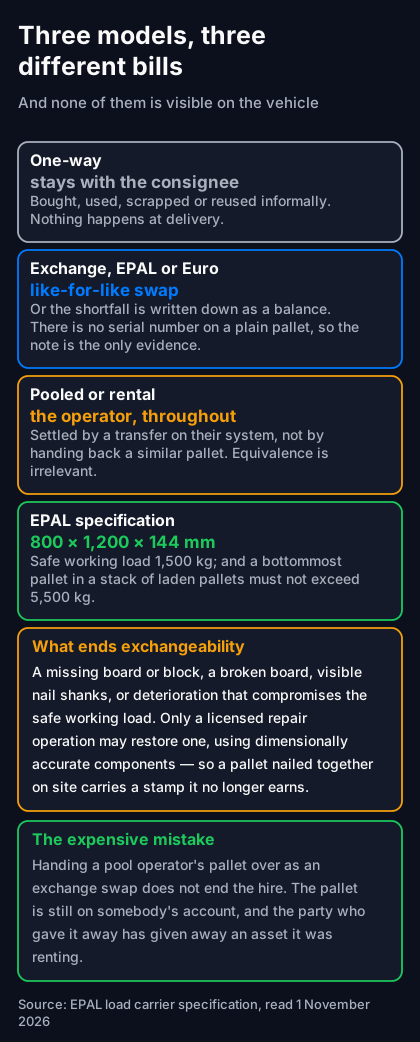
A pallet is one of three things: a one-way carrier that stays with the consignee, an exchange pallet swapped like for like at delivery, or a pooled pallet hired from an operator who never stops owning it. EPAL specifies the Euro pallet at 800 by 1,200 by 144 mm with a safe working load of 1,500 kg, and lists the defects that take one out of the exchange system. This sets out who owns what, and where the money leaks.
Who owns the pallet?
Whoever owned it before the delivery, which is almost never the carrier and frequently not the sender either. That sounds like a technicality until a consignment arrives on forty pallets and somebody has to account for them.
Three arrangements exist and they behave completely differently. A one-way pallet is bought, used and scrapped. An exchange pallet is swapped like for like at the delivery. A pooled pallet is hired from a pool operator who never stops owning it, and has to be returned or accounted for.
The reason this ends up in dispute is that none of it is visible on the vehicle. A blue pallet, a brown one and a plain one all carry the same load, and the only thing distinguishing a hired asset from a disposable one is a contract nobody read at the loading bay.
What are the three models?
One-way, exchange and pooled, with the cost falling in a different place in each.
| Model | Who owns it | What happens at delivery |
|---|---|---|
| One-way, often plain softwood | Passes to the consignee | Nothing — it stays, and is scrapped or reused informally |
| Exchange, typically EPAL or Euro | Whoever holds an equivalent pallet | A like-for-like swap, or a debt recorded |
| Pooled or rental | The pool operator, throughout | Transferred on the operator's system, then returned |
The middle row is the one that generates paperwork and the bottom row the one that generates charges. A pooled pallet that is not accounted for stays on somebody's hire, which means the meter runs after the goods have been unpacked and the pallet is behind a shed.
What is a Euro pallet, exactly?
A standardised load carrier with published dimensions and a published load rating. EPAL specifies it at 800 mm by 1,200 mm with a height of 144 mm, and a safe working load of 1,500 kg.
There is a second figure worth knowing, because it governs stacking rather than the individual pallet. When laden pallets are stacked on solid ground, the bottommost pallet must not exceed a load of 5,500 kg — which is the limit that decides how high a block of goods can be built in a warehouse or on a trailer, not the 1,500 kg figure people quote.
Our pallet sizes and vehicle capacity article covers how those footprints fit into vehicles. The standard exists precisely so that the pallet can be exchanged: a carrier can only hand back an equivalent if equivalence is defined.
What makes a pallet exchangeable, or not?
Condition, assessed against a published quality classification rather than by eye. EPAL lists the defects that take a pallet out of the exchange system, and they are specific.
- A missing board or block.
- A broken board.
- Visible nail shanks.
- General deterioration that compromises the safe working load.
That list is why exchange disputes happen at the tailgate rather than in an office. A driver is being asked to accept a pallet in exchange for one in good order, and the test is not whether the pallet looks usable but whether it meets the classification — a judgement made in two minutes with a load waiting behind it.
Who may repair a damaged pallet?
Only a licensed repair operation, and that constraint is what keeps the standard meaningful. EPAL states that pallets not fit for use in accordance with the quality classification should be repaired in accordance with its Technical Regulations, and that repairs must use dimensionally accurate components before the pallet re-enters circulation.
So a pallet nailed back together on site is not a repaired exchange pallet; it is a one-way pallet with a stamp on it. The distinction matters because the stamp is what the next exchange will be judged on, and a pallet carrying a mark it no longer earns is the kind of thing that gets a whole load rejected.
For a shipper the practical consequence is to stop treating damaged pallets as a maintenance question. A pallet that fails the classification has left the exchange pool, and the honest options are to have it properly repaired or to write it off, not to keep circulating it.
How does exchange actually work on a delivery?
Like for like, at the point of delivery, or as a recorded debt. The driver hands over loaded pallets and receives the same number of empty ones in equivalent condition, and the delivery note records what happened.
Where the consignee has no pallets to give, the shortfall is written down and becomes a balance between the parties. That is the moment the system either works or quietly fails: a note that says "no pallets available" creates a traceable debt, while a note that says nothing creates a loss that nobody can later attribute.
Our proof of delivery article covers what the delivery record does and does not evidence. Pallet balances are a case where the record is the only evidence — there is no serial number on a plain Euro pallet and no way to prove, a month later, how many left the vehicle.
What goes wrong with exchange?
Four failures, and three of them are recording failures rather than pallet failures.
| Failure | Consequence |
|---|---|
| No note of the exchange | An unprovable balance that becomes a write-off |
| Quality dispute at the tailgate | A delay, then an exchange refused or accepted under protest |
| A pooled pallet treated as an exchange one | Hire charges running on a pallet the operator still owns |
| Balances tracked by nobody | A standing loss discovered at a stock count |
The third row is the expensive one and the easiest to cause. Handing a pool operator's pallet over as an exchange swap does not end the hire — the pallet is still on somebody's account, and the party who gave it away has given away an asset it was renting.
How do pooled pallets differ?
The pallet never changes owner, so the transaction is a transfer on the operator's system rather than a swap at the kerb. Pooling works by hiring the load carrier out and keeping it: the operator maintains and replaces the fleet, and the user pays for the time and the movements.
CHEP is the best-known operator in the UK, and the model is the same across the pooled sector: the pallet is an asset on hire, and the obligation is to account for it rather than to replace it with a similar one. Unlike the exchange system, equivalence is irrelevant — you cannot settle a pooled pallet by handing back a different pallet in the same condition.
That is why pooled and exchange pallets should not be mixed in one flow without a system that knows which is which. The two settle in different currencies, and a warehouse treating them as interchangeable is accruing a liability in one of them.
What does this cost if nobody manages it?
Three kinds of leakage, and none appears as a line on a freight invoice. Hire charges continue on pooled pallets that were not transferred back. Exchange balances accumulate as an unrecorded loss that surfaces at a stock count. And rejected exchanges turn into a delivery that took longer than it was quoted for.
The last of those is the one that reaches us. Waiting time while an exchange is argued over is charged to whoever booked the vehicle, which means a pallet dispute between a shipper and its customer is paid for by the shipper through its carrier — see demurrage, detention and waiting time.
None of this is expensive to control. It needs a decision about which model applies, a line on the delivery note, and somebody who reconciles the balances — which is less work than any one of the three failures above.
What should you agree before booking?
Five points, and all of them before the vehicle is loaded rather than when it arrives.
- Which model applies — one-way, exchange or pooled.
- Whether exchange is expected, and whether the consignee has agreed to it.
- Who records the balance, and on what document.
- What happens if the consignee has no pallets to give back.
- For pooled pallets, who raises the transfer on the operator's system.
The second point is the one most often assumed. Exchange is a commercial arrangement between the sender and the receiver, not a service the carrier can impose on a delivery address — a driver cannot create an obligation at the tailgate that nobody agreed to beforehand.
What is our part in this?
Most of our work is dedicated vehicles, where the pallets are whatever the sender loaded and they travel to one address. That makes the ownership question simpler than it is on a shared network, but it does not make it disappear: a pooled pallet is still a hired asset on our vehicle, and a note still has to say what happened to it.
What we need before loading is which model applies and whether an exchange is expected at the far end, because an exchange that nobody arranged is a conversation at the kerb with a clock running. Our pallet delivery page sets out the service and kerbside delivery and who unloads the other half of what happens at the tailgate.
For how the pallet decides the vehicle and the price, see pallet sizes and vehicle capacity and chargeable weight; for when consolidation is worth it at all, groupage.
Questions
- Who owns the pallet after a delivery?
- It depends which of three models applies. A one-way pallet passes to the consignee and is scrapped or reused informally. An exchange pallet is swapped like for like at delivery, or the shortfall becomes a recorded balance. A pooled pallet is hired and the operator never stops owning it, so it has to be accounted for rather than replaced. None of this is visible on the vehicle, which is why it ends up in dispute.
- What are the dimensions of a Euro pallet?
- EPAL specifies 800 mm by 1,200 mm with a height of 144 mm, and a safe working load of 1,500 kg. A second figure governs stacking rather than the single pallet: where laden pallets are stacked on solid ground, the bottommost must not exceed a load of 5,500 kg. That second number is the one that decides how high a block can be built, and it is not the one usually quoted.
- What makes a pallet non-exchangeable?
- Condition, judged against EPAL's published quality classification rather than by eye. A missing board or block, a broken board, visible nail shanks, or general deterioration that compromises the safe working load all take a pallet out of the exchange system. That is why disputes happen at the tailgate: a driver has to make the judgement in two minutes with a load waiting behind.
- Can a damaged pallet be repaired and exchanged again?
- Only by a licensed repair operation. EPAL states that pallets not fit for use under the quality classification should be repaired in accordance with its Technical Regulations, using dimensionally accurate components, before re-entering circulation. A pallet nailed back together on site is not a repaired exchange pallet — it is a one-way pallet carrying a stamp it no longer earns, which can get a whole load rejected.
- How is a pooled pallet different from an exchange pallet?
- The pallet never changes owner. Pooling works by hiring the load carrier out and keeping it, so settlement is a transfer on the operator's system rather than a swap at the kerb, and equivalence is irrelevant — you cannot settle a pooled pallet by handing back a different one in the same condition. Handing a pool operator's pallet over as an exchange swap gives away an asset you were renting and leaves the hire running.
- What happens if the consignee has no pallets to exchange?
- The shortfall should be written down on the delivery note and becomes a balance between the parties. That is the moment the system works or quietly fails: a note recording “no pallets available” creates a traceable debt, while a note that says nothing creates a loss nobody can attribute later. There is no serial number on a plain Euro pallet, so the record is the only evidence that exists.
- Can a carrier insist on a pallet exchange at delivery?
- No. Exchange is a commercial arrangement between the sender and the receiver, not a service a carrier can impose on a delivery address, and a driver cannot create an obligation at the tailgate that nobody agreed beforehand. That is why whether an exchange is expected — and whether the consignee has agreed to it — belongs in the booking rather than in the conversation at the kerb.
Explore more
More from the blog
- The nine ADR dangerous goods classes, and what they…
- Waybills compared: air, sea and road, and what each…
- Bill of lading or CMR note: which one your shipment…
- Cabotage after Brexit: two jobs in, one job out
- Chargeable weight: why a light pallet can cost like…
- Clinical trial logistics: who owns the obligation,…