
Kerbside, tail lift or carried in: who unloads, and who is liable
Kerbside delivery means the vehicle gets the goods to the nearest point it can safely reach and no further. Under the Road Haulage Association's standard Conditions of Carriage the customer and consignee are responsible for unloading, the carrier need not provide equipment the vehicle does not carry, and where there is no safe access transit ends one clear day after notice. This sets out who unloads, what HSE's lifting figures actually say, and the four ways a load comes off a vehicle.
What does kerbside delivery actually mean?
Kerbside delivery means the vehicle brings the goods to the nearest point it can safely reach and no further. The driver gets the consignment off the vehicle; getting it across a driveway, through a door or up a staircase is somebody else's job.
The phrase exists because the alternatives are expensive, and the gap between them is where most delivery disputes start. A pallet of tiles left on a hardstanding is a completed delivery. The same pallet expected in a back garden is a different service with a different vehicle, a different crew and a different price.
Three levels are worth distinguishing before you book anything: kerbside, where the goods come off at the vehicle; threshold or doorstep, where they are moved to the first door; and room of choice, where they are carried to where they will be used. Our white glove delivery page covers the last of those, which usually also includes unpacking and taking the packaging away.
Who is responsible for unloading the vehicle?
By default the customer and the consignee, not the carrier. The Road Haulage Association Conditions of Carriage 2024 are the industry's standard terms, and Condition 4(1) says it plainly: unless otherwise agreed in writing, the customer is responsible for loading goods onto the vehicle and for the consignee unloading them off it.
Two consequences follow, and both surprise people. The carrier is not responsible for loss or damage arising from loading or unloading, or from overloading or unsafe loading of the vehicle. And where the carrier's own people do help, Condition 4(1) makes that assistance discretionary rather than contractual — the customer indemnifies the carrier against loss, damage, death or injury arising during the operation, whether or not the carrier was negligent.
This is the default rather than the law. It can be varied in writing, and a booking that says "driver to offload with tail lift" has varied it. What cannot happen is for the position to be assumed on the day.
What equipment and access must the customer provide?
Everything the vehicle does not carry, plus the ground to use it on. Condition 4(2) and 4(3) of the same terms split the obligation into equipment and site.
| Condition | What the customer must ensure |
|---|---|
| 4(2) Equipment | Cranes, fork lift trucks, slings, chains or other equipment used in loading or unloading are suitable, well maintained, and operated only by suitably trained personnel |
| 4(3) Access | Adequate access to the loading and unloading points, roadways of suitable material, and unloading onto good sound hardstanding with sufficient space to work safely |
| 4(6) Risk assessment | Any site risk assessments are made available to the carrier on request, and the responsibility for carrying them out is the customer's, not the carrier's |
Condition 4(4) closes the loop: where the carrier's personnel are instructed to serve an area that does not comply with 4(3), the carrier is not liable for loss or damage however caused — even if the driver advised against it. And Condition 4(6) lets the carrier refuse to enter any site it considers unsafe, at its sole discretion.
How much is one person allowed to lift?
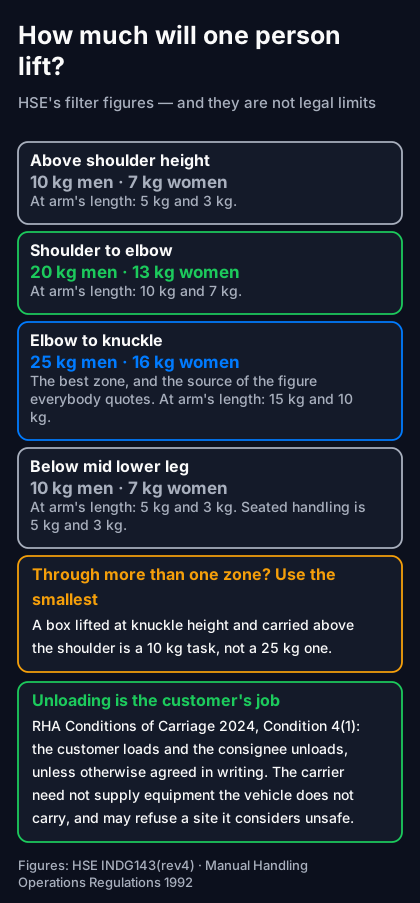
There is no legal maximum, and the figure everybody quotes is not what they think it is. The Manual Handling Operations Regulations 1992 set no specific weight limits; HSE publishes a lifting and lowering risk filter instead, and says in terms that the figures are not safe limits.
These are the HSE filter values, in kilograms, for a load that is easily grasped with both hands in reasonable conditions.
| Height of the hands | Men, close to body | Men, at arm's length | Women, close to body | Women, at arm's length |
|---|---|---|---|---|
| Above shoulder height | 10 kg | 5 kg | 7 kg | 3 kg |
| Shoulder to elbow | 20 kg | 10 kg | 13 kg | 7 kg |
| Elbow to knuckle | 25 kg | 15 kg | 16 kg | 10 kg |
| Knuckle to mid lower leg | 20 kg | 10 kg | 13 kg | 7 kg |
| Below mid lower leg | 10 kg | 5 kg | 7 kg | 3 kg |
Read the table the way HSE intends it: if the hands pass through more than one zone during the lift, the smallest figure applies. A 25 kg box lifted from the tail of a van at knuckle height and carried above shoulder height into a rack is a 10 kg task, not a 25 kg one. Handling while seated drops to 5 kg for men and 3 kg for women.
When does a lift need more than one person?
HSE lists six triggers for a fuller assessment, and three of them describe an ordinary delivery. A detailed assessment is needed where the hands must work outside the zones above, where the weight exceeds the filter figures, where the handling involves torso twisting, where it happens more often than one lift every two minutes, where a team is doing it, or where the operation is complex.
Pushing and pulling is treated separately and more generously, which is why a pallet truck changes the arithmetic so much. That work is likely to be low risk where the force is applied with the hands, the torso is upright and not twisted, the hands are between hip and shoulder height, and the distance moved without a pause is no more than about 20 m.
The practical reading for a delivery: a single heavy item is a two-person job long before a trailer-load of light ones is, and a flat run with a pallet truck beats a short carry with a kerb in it. Our two-man delivery entry covers how that is booked.
Which offload method suits which load?
Four, and the choice is usually made by the heaviest single item rather than by the total weight.
| Method | Suits | What it needs on site |
|---|---|---|
| Hand unload | Items inside the HSE filter figures | Nothing, if the access is level |
| Tail lift and pallet truck | Palletised goods up to the lift's rating | Hardstanding, level, space behind the vehicle |
| Lorry-mounted crane, widely called a Hiab after one maker | Single heavy items, over a wall or onto a slab | Ground that will take the outriggers, clear airspace |
| Truck-mounted forklift, widely called a Moffett | Pallets onto unmade ground, several drops | Room to dismount the machine, firm going |
A forklift at the destination is cheaper than any of the vehicle-mounted options and is the right answer wherever one exists. Lorry-mounted cranes and truck-mounted forklifts come with the vehicle that carries them, so where a load needs one we arrange it with a partner carrier rather than improvising on the day.
What does a tail lift not solve?
Weight, mostly. A tail lift moves a load the last metre vertically and solves nothing about whether the vehicle can carry it or the platform can hold it, which is why four separate limits apply and the lowest wins.
The plated safe working load is only the first. Capacity falls as the load sits further from the vehicle; the vehicle's own payload usually binds before the lift does; and a load that overhangs the platform cannot be lifted safely whatever it weighs. A Luton van carries roughly 1,200 kg in total, and the lift is part of the vehicle, so its weight has already come out of that figure before anything is loaded. Our tail lift article works through all four limits, and van payload and gross vehicle weight covers the one that catches most people.
Lifting equipment also has to be in examination. Under LOLER 1998 regulation 9, lifting equipment used to lift people needs a thorough examination every 6 months and other lifting equipment every 12 months, or according to an examination scheme. A lift the operator rides on is lifting a person.
What happens if the site cannot take the vehicle?
Transit ends anyway, and that is the clause worth knowing before the day. Under the RHA terms, where no safe and adequate access exists at the delivery address, or no safe and adequate unloading facilities exist there, transit is deemed to end one clear day after notice of the arrival of the consignment has been sent to the consignee or the customer.
In other words the carrier's liability as a carrier stops, and the goods are then held rather than carried. That matters because the limit of liability is already modest: Condition 12(1)(c) caps it at the lowest of the value of the goods, the cost of replacing or repairing them, or a sum calculated at the rate of £1,300 per tonne on the gross weight of the goods lost or damaged.
That cap can be raised, but only in advance. Condition 12 lets the customer give written notice at least 7 days before transit begins asking for the per-tonne limit to be increased, up to the value of the consignment, in return for an agreed increase in the carriage charge — and if no agreement is reached, the per-tonne limit continues to apply.
What should you tell the carrier when you book?
Six facts, and five of them are about the destination rather than the goods. A quote built only on mileage and weight is a quote built on a guess about access.
- The heaviest single item, in kilograms, not the total.
- Its dimensions, because overhang decides whether a tail lift is usable at all.
- The floor or level it is going to, and whether there is a lift.
- Access width and surface — gravel, grass and loose block paving are not hardstanding.
- What is already on site: a forklift, a loading dock, a pallet truck, or nothing.
- Who will be there to receive it, and whether they can unload.
Answer those and the service either costs what the mileage suggests or it does not, but the number holds. Leave them and the vehicle arrives with the wrong equipment, which is the one failure mode that cannot be fixed from the kerb. Our construction site deliveries article covers sites where the answer to most of these is "nothing yet".
What is our part in this?
We quote the access, not just the distance, and we say which of the four methods above the price assumes. Where a load needs a lorry-mounted crane or a truck-mounted forklift, that is arranged through a partner carrier whose vehicle carries one, and the booking says so.
Our own position on liability is set out in our terms rather than inherited from anybody's standard conditions: our goods-in-transit limit is £50,000, higher values need advance notification, and claims must be reported within 24 hours of delivery. The RHA figures above are quoted because they are the published industry default that most hauliers trade on, which makes them the right benchmark — not because they are ours.
For loads past what a tail lift and a pallet truck can handle, see when your load is too big for a van and our Luton van page; for what the delivery record has to show once the goods are off, proof of delivery.
Questions
- What does kerbside delivery include?
- The vehicle brings the goods to the nearest point it can safely reach and the driver gets them off the vehicle. It does not include moving them across a driveway, through a door, up stairs or into a room. Threshold delivery adds the first door; room of choice adds the carry to where the goods will be used, and usually unpacking and packaging removal. The three are different services with different vehicles, crews and prices.
- Who is legally responsible for unloading a delivery?
- Under the Road Haulage Association Conditions of Carriage 2024, Condition 4(1), the customer is responsible for loading the goods onto the vehicle and for the consignee unloading them off it, unless otherwise agreed in writing. The carrier is not responsible for loss or damage arising from loading or unloading, and any help the driver gives is discretionary. The default can be varied, but only in writing and in advance.
- Is 25 kg the legal limit for lifting at work?
- No. The Manual Handling Operations Regulations 1992 set no specific weight limits, and HSE states that its guideline figures are not safe limits. The 25 kg figure is one value in a filter: it applies to a man lifting close to the body between elbow and knuckle height. It falls to 10 kg above shoulder height and to 15 kg at arm's length, and the equivalent figures for women are 16 kg, 7 kg and 10 kg.
- What is the difference between a Hiab and a Moffett?
- A Hiab is a lorry-mounted crane and a Moffett is a truck-mounted forklift; both are manufacturer names used as generic trade terms. A crane lifts single heavy items, including over a wall or onto a slab, and needs ground that will take its outriggers plus clear airspace above. A truck-mounted forklift places pallets on unmade ground and suits several drops, but needs room to dismount the machine from the vehicle.
- What happens if the delivery address has no safe access?
- Transit ends regardless. Under the RHA conditions, where no safe and adequate access or unloading facilities exist at the address, transit is deemed to end one clear day after notice of the consignment's arrival has been sent to the consignee or the customer. The goods are then held rather than carried. The carrier may also refuse to enter any site it considers unsafe, and is not liable if instructed to serve non-compliant ground.
- How much is a carrier liable for if goods are damaged on a pallet?
- Under the RHA Conditions of Carriage the cap is the lowest of three figures: the value of the goods lost or damaged, the cost of replacing or repairing them, or a sum calculated at the rate of £1,300 per tonne on their gross weight. On light high-value goods the per-tonne figure is usually the binding one. It can be raised by written notice at least 7 days before transit begins, in return for an agreed increase in the carriage charge.
- What should I tell a courier about access before booking?
- Six things, five of them about the destination: the weight of the heaviest single item rather than the total, its dimensions, the floor or level it is going to and whether there is a lift, the access width and surface, what equipment is already on site, and who will be there to receive it. Gravel, grass and loose block paving are not hardstanding, and overhang decides whether a tail lift can be used at all.
Explore more
More from the blog
- Safety and security declarations: who files them, a…
- Road Charges on a UK Delivery: What They Are, and W…
- UN3480 vs UN3481: which number applies to your lith…
- What a Van Can Legally Carry: Gross Vehicle Weight,…
- Waste transfer notes and the duty of care: which do…
- When your load is too big for a van: abnormal loads…