
Safety and security declarations: who files them, and by when
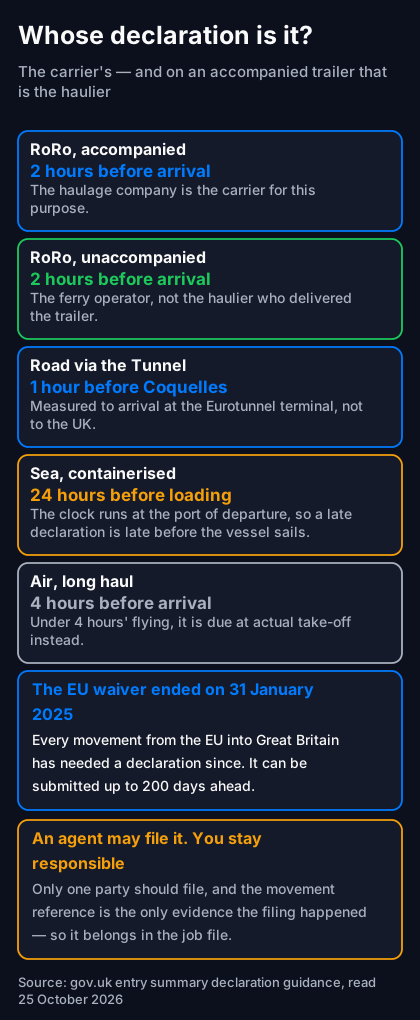
An entry summary declaration is a pre-arrival security filing, and on an accompanied road movement into Great Britain the legal duty to make it sits on the haulage company — not the importer, not the customs agent. The temporary waiver for EU goods ended on 31 January 2025. This sets out who files, the deadline for every mode, the six waived categories, and why containerised sea freight has the one deadline that runs before the vessel sails.
What is an entry summary declaration?
An entry summary declaration is a pre-arrival filing about the safety and security of a consignment, not about its duty or tax. It is lodged before the goods reach Great Britain so the movement can be risk-assessed while it is still on the other side of the water.
It goes to the Safety and Security GB service, which has no screen to type into. Gov.uk states that you need compatible software to submit an XML message, which is why most hauliers file through a service provider rather than directly, and HMRC issues a movement reference number once it accepts the declaration.
A declaration can be submitted up to 200 days ahead of arrival. The temporary waiver that excused goods of EU origin ended on 31 January 2025, so every movement from the EU into Great Britain has needed one since.
Great Britain and Northern Ireland use different systems for the same filing. Movements into Great Britain go to Safety and Security GB; movements into Northern Ireland go to ICS2, the EU's import control system, because Northern Ireland sits inside the EU's security perimeter for this purpose. A haulier running both needs access to both.
Who is legally responsible for filing it?
The carrier, and gov.uk says so in one sentence: the legal requirement to submit entry summary declarations, within the specified time limits, lies with the carrier. It then names who that is for each mode, which is the part worth reading twice.
| Mode | Who is the carrier for this purpose |
|---|---|
| RoRo, accompanied freight | The haulage company |
| RoRo, unaccompanied freight | The ferry operator |
| Road via the Channel Tunnel | The haulage company |
| Rail | The rail freight operator authorised to traction the train into Great Britain |
| Air | The airline that contracted and issued the air waybill |
| Sea, including short sea | The shipping company |
For an accompanied trailer coming off a ferry that is the haulier, not the importer and not the customs agent. It is the single most common misunderstanding on the subject: the party who knows least about the paperwork is the party the obligation lands on.
How long before arrival must it be submitted?
Between 24 hours before loading and the moment of take-off, depending entirely on the mode. These are the minimum timing requirements published by HMRC.
| Mode or shipping service | Minimum timing requirement |
|---|---|
| Maritime containerised cargo | 24 hours before loading at the port of departure |
| Maritime bulk or break bulk | 4 hours before arrival |
| Short sea journeys | 2 hours before arrival |
| RoRo, accompanied and unaccompanied | 2 hours before arrival |
| Road via the Channel Tunnel | 1 hour before arrival at the Eurotunnel terminal, Coquelles |
| Rail, journey under 2 hours | 1 hour before arrival |
| Rail, journey over 2 hours | 2 hours before arrival |
| Air, short haul under 4 hours | At the time of actual take-off |
| Air, long haul of 4 hours or more | 4 hours before arrival |
Containerised sea freight is the outlier and the one that catches exporters: the clock runs from loading at the far end, not from arrival here, so a declaration that is late is late before the vessel sails.
Short-haul air is the other oddity, because the deadline is an event rather than an interval. On a flight under 4 hours the declaration is due at the time of actual take-off, which on a European sector means the filing and the aircraft leave together and there is no margin to build in at all.
What happens if the declaration is late or missing?
Gov.uk publishes no penalty figure for this, and it is worth saying that plainly rather than inventing one. What the guidance does say is that the declaration must be complete and accurate and submitted within the legal time limits, and that HMRC and Border Force will work with carriers to help them become compliant.
The sharper consequence is operational, and it differs by mode. For deep-sea containerised cargo the system can return a Do not load message, which is an instruction to the carrier not to load the container at the port of departure — the cheapest possible failure, because the box never moves.
On accompanied RoRo there is no such brake. The trailer is already at the port with 2 hours on the clock, and a missing declaration becomes a problem at the point where the only options left are expensive ones.
Which goods do not need one?
A short list, and shorter than most people expect. Gov.uk waives six categories outright.
- Electrical energy.
- Goods entering by pipeline.
- Letters, postcards and printed material, including on electronic media.
- Goods in travellers' personal luggage.
- Goods declared to customs orally or by conduct, provided they are not moved under a transport contract — which is how empty trailers, containers and packaging are covered.
- Postal consignments moved under Universal Postal Union convention rules.
Qualifying Northern Ireland goods moving to Great Britain are also waived, in all but extremely limited circumstances. Our Windsor Framework article sets out what makes goods qualifying. The published list is explicitly not exhaustive, so a movement that looks exempt by analogy is not exempt.
How is it different from a customs declaration?
Different purpose, different filer, different deadline — and conflating them is how a load arrives with one of the two done. A customs declaration is about what the goods are and what is owed on them; an entry summary declaration is about whether the movement is a security risk.
| Entry summary declaration | Import declaration | |
|---|---|---|
| Question it answers | Is this movement a security risk? | What are the goods and what is owed? |
| Filed by | The carrier | The importer or their agent |
| Timing | Before arrival, by mode | Per the customs procedure used |
| Service | Safety and Security GB | Customs Declaration Service |
Neither one substitutes for the other, and neither substitutes for a transit movement under NCTS or for the commercial paperwork in our commercial invoice article.
Does the reference go into the goods movement reference?
Not necessarily, and the answer differs between Great Britain and Northern Ireland. For Great Britain you do not have to include entry summary declaration reference numbers in GVMS, although you can choose to; for Northern Ireland you should include them.
Choosing to include them changes your deadline rather than removing it. Where the references are in the movement reference, the declaration must be submitted by whichever comes first: the minimum timing requirement for the mode, or the moment check-in closes. On a short sea crossing, check-in frequently closes earlier than the 2-hour rule would, so the practical deadline moves forward rather than back.
Our GVMS and goods movement reference article covers how the movement reference itself is built.
Who files it when a forwarder or a subcontractor is involved?
The operator of the vehicle that actually crosses the border, whoever sold the job. In a subcontracted chain the question is not who took the booking, it is whose trailer is on the ferry.
A third party such as a customs agent can submit the declaration for you, and gov.uk is explicit that the carrier remains responsible for making sure it is submitted. Two things keep that arrangement out of trouble.
- A contract, and the carrier's knowledge. A third party should not file without both.
- One filing, not two. If the carrier and the agent both file for the same shipment, customs may use both declarations or accept only the carrier's — neither outcome is one you want to discover at a port.
- A reference back. The movement reference number is the only evidence the filing happened; a carrier who cannot produce it has no answer.
That third point is the one worth building into the process. A declaration that was filed and cannot be evidenced is indistinguishable, at a port, from one that was never filed — so the movement reference belongs in the job file alongside the CMR note, not in somebody's sent items.
What is our part in this?
On an accompanied road movement from the EU into Great Britain the haulage company is the responsible carrier, so where the vehicle is ours or a partner carrier's, the entry summary declaration is a carrier obligation rather than something to leave with the customer's broker. We are not a customs agent and we do not file import declarations.
What that means in practice is that we ask about the crossing at the quoting stage rather than at the port. Our European road freight page sets out the movements we run, the customs page sets out where we coordinate with a broker and where we do not, and cabotage rules covers what the vehicle may do once it is here.
Three questions decide whether a crossing is straightforward, and they are worth asking before the vehicle is loaded rather than after: which mode the goods arrive by, who is operating that vehicle, and whether anyone has the movement reference. Two of the three are ours to answer.
For a movement in the other direction the paperwork is the exporter's: see EORI numbers, export licences where the goods are controlled, and ATA Carnets where they are leaving only temporarily. Where the consignment is a customs declaration question rather than a security one, the import side is covered in import VAT and postponed VAT accounting.
Questions
- What is an entry summary declaration?
- A pre-arrival filing about the safety and security of a consignment rather than its duty or tax. It is lodged before goods reach Great Britain so the movement can be risk-assessed in advance, and it goes to the Safety and Security GB service. That service has no screen to type into, so compatible software is needed to submit an XML message. HMRC issues a movement reference number once the declaration is accepted.
- Who is legally responsible for the entry summary declaration?
- The carrier. Gov.uk states that the legal requirement to submit entry summary declarations within the specified time limits lies with the carrier, and names who that is per mode: the haulage company for accompanied RoRo and for road via the Channel Tunnel, the ferry operator for unaccompanied RoRo, the shipping company for sea, and the airline for air. A customs agent may file on the carrier's behalf, but the carrier stays responsible.
- How long before arrival must an ENS be submitted?
- It depends on the mode. Containerised sea cargo is 24 hours before loading at the port of departure; bulk or break bulk is 4 hours before arrival; short sea and RoRo, accompanied or not, are 2 hours before arrival; road via the Channel Tunnel is 1 hour before arrival at Coquelles; rail is 1 or 2 hours depending on journey length; short-haul air is at the time of take-off and long-haul air is 4 hours before arrival.
- Which goods are exempt from entry summary declarations?
- Six categories are waived: electrical energy, goods entering by pipeline, letters and printed material, goods in travellers' personal luggage, goods declared orally or by conduct and not moved under a transport contract, and postal consignments under Universal Postal Union rules. Empty trailers, containers and packaging fall under the fifth of those. Qualifying Northern Ireland goods moving to Great Britain are also waived in all but extremely limited circumstances, and the published list is not exhaustive.
- Is an entry summary declaration the same as a customs declaration?
- No. They answer different questions, are filed by different parties and have different deadlines. An entry summary declaration asks whether the movement is a security risk and is the carrier's duty; an import declaration says what the goods are and what is owed, and is the importer's. They go to different services, and neither substitutes for the other or for a transit movement. A load can easily arrive with one of the two done.
- Does the ENS reference have to go in the GVMS movement reference?
- For Great Britain, no — you can choose to include entry summary declaration reference numbers but you do not have to. For Northern Ireland you should include them. Including them changes the deadline: the declaration must then be in by whichever comes first, the minimum timing requirement for the mode or the point at which check-in closes. On short sea crossings check-in often closes earlier, so the practical deadline moves forward.
- What happens if no entry summary declaration is filed?
- Gov.uk publishes no penalty figure, and it is better to say that than to invent one. The guidance states the declaration must be complete, accurate and within the legal time limits, and that HMRC and Border Force will work with carriers to become compliant. Operationally, deep-sea containerised cargo can receive a Do not load message at the port of departure, while an accompanied trailer has no such brake and discovers the problem at the port.
Explore more
More from the blog
- Incoterms 2020 Explained: All Eleven Rules and Who…
- IPAFFS pre-notification: what the border needs befo…
- ISPM 15: when your pallet needs a stamp, and when i…
- Kerbside, tail lift or carried in: who unloads, and…
- Moving wine and spirits: the duty question decides…
- NCTS Explained: UK Transit Declarations, Guarantees…