
Do your goods need an export licence, and who has to hold it?
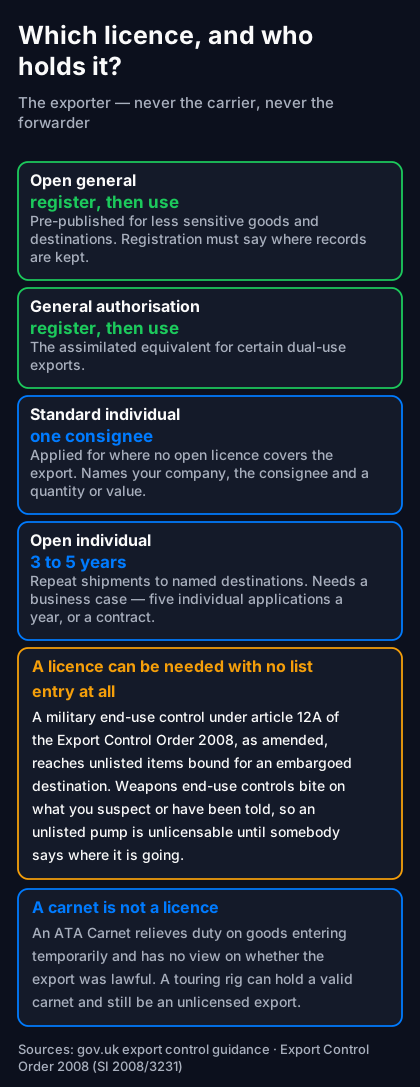
An export licence is a permission to send controlled goods out of the UK, and it belongs to the exporter rather than the carrier or the freight forwarder. Controlled military items sit in Schedule 2 to the Export Control Order 2008 and dual-use items in Schedule 3, but end-use controls can catch unlisted goods as well. This sets out the four kinds of licence, what an open licence requires before first use, and why an ATA Carnet is not a substitute.
What makes goods export-controlled?
Being on a list, or being destined for the wrong end use. The UK Strategic Export Control Lists are the starting point, and they are statutory rather than advisory — controlled military items sit in Schedule 2 to the Export Control Order 2008 and controlled dual-use items in Schedule 3.
Control attaches to the item and the destination together, which is why the same part can be free to one country and licensable to another. Software and technology are controlled in their own right alongside physical goods, and so are items that might be used for torture, and radioactive sources.
The practical test is not whether something feels military. It is whether the entry in the control list describes it, by specification rather than by purpose, and a civil component frequently matches a list entry written in terms of performance thresholds.
What counts as a dual-use item?
An item that can be used for both civil and military purposes. Gov.uk defines it that way and extends it to software and technology, to goods with non-explosive uses, and to items that help make nuclear weapons or other nuclear explosive devices.
That is a wider net than most exporters assume. Machine tools, test and measurement equipment, certain materials, encryption software, thermal imaging and some bearings are all routine commercial products that appear on the dual-use list once their performance passes a threshold. Our dual-use goods entry covers the classification side.
The distinction that matters commercially is between the Military List and the dual-use list rather than between military and civil companies. An aerospace supplier can hold both kinds of item in the same stores, and the two are licensed differently.
Which licence do you need?
One of four broad kinds, and the choice is driven by how often you export and whether you can name the consignee.
| Licence | What it is | Who or what it names |
|---|---|---|
| Open general export licence | A pre-published licence for less sensitive goods to less sensitive destinations, with fixed terms you must meet | Nobody — you register against it |
| General export authorisation | The assimilated equivalent for certain dual-use exports, also used by registration | Nobody — you register against it |
| Standard individual export licence | An individual licence applied for where no open licence covers the export | Your company, the consignee, and a set quantity or value |
| Open individual export licence | A tailored licence for repeat shipments of specific goods to named destinations | Your company and the destinations, not always the consignee |
Separate trade control licences cover arranging or promoting the supply of controlled goods between two other countries, which catches brokering done from the UK and by UK persons abroad even when the goods never come here. Licences are not transferable: an open individual licence belongs to the named exporter and cannot be lent to a sister company.
Do you have to register before using an open licence?
Yes, and before the first shipment rather than after it. An open general export licence is only usable by an exporter who has registered against that specific licence through the Export Control Joint Unit's online licensing service, and the registration has to state where the export records are kept and where the ECJU may inspect them.
Registration is not a formality with no consequences. Holders are subject to compliance audits, receive a pre-visit questionnaire to complete and return by a stated date, and must keep records of each export as required by article 29 of the Export Control Order 2008. Where an audit finds non-compliance, a warning letter sets out steps and a timescale; failing to take them can mean the licence is suspended or revoked until compliance is shown.
There is also a checker tool published by the ECJU that identifies whether an open licence exists for your goods and destination. Using it before registering is the cheap step, because an open licence you cannot comply with is worse than no open licence at all.
How long does an open individual licence last, and what must you show?
Usually 3 to 5 years, and you have to demonstrate a real need rather than a preference. Gov.uk asks for proof of business need — a record of at least 5 individual licence applications a year, or a contract, purchase order or tender award supporting frequent or large-volume delivery.
- Specific descriptions of the items, quantities and destinations.
- A complete end-user undertaking form, kept in original form for compliance audits.
- Evidence you checked the open licence list first, with a copy of the results.
- The sectors and ultimate end-user destination, plus an estimate of how often you will use the licence over the coming year.
Military exports from Northern Ireland to the EU are limited to 3 years rather than the usual range, and that limit does not apply to exports from Great Britain. A temporary open individual licence exists for demonstration and exhibition shipments, on the condition that the goods return to the UK within 12 months.
Can goods need a licence even when they are not on a list?
Yes, and this is the control that catches exporters who have checked the list and stopped there. End-use controls bite on the destination and the use rather than on the specification.
Two of them matter in ordinary trade. A military end-use control under article 12A of the Export Control Order 2008, as amended, can require a licence for unlisted items going to an embargoed destination or into military goods there. And weapons of mass destruction end-use controls prohibit export where you suspect, or have been told, that items might be used in a chemical, biological or nuclear weapons programme — extending to brokering, to transfers of software and technology for those purposes, and to providing technical assistance.
The reason this reads as a trap is that it turns on knowledge rather than classification. An unlisted pump is unlicensable until somebody tells you where it is going, at which point the duty changes.
Does a temporary export need a licence too?
Yes. Controlled items taken out of the UK temporarily for an exhibition, a repair or as samples still need an export licence, and this is where two different pieces of paper get confused with each other.
| Export licence | ATA Carnet | |
|---|---|---|
| What it permits | The export of controlled goods at all | Temporary entry without paying duty or tax |
| Issued by | The Export Control Joint Unit | A chamber of commerce |
| Turns on | What the goods are and where they are going | Whether the same goods come back |
| Substitutes for the other | No | No |
A carnet is a customs document and nothing more: it relieves duty, and it has no view at all on whether the goods were lawful to export. A touring demonstration rig can hold a perfectly valid carnet and still be an unlicensed export. Our ATA Carnet article covers the customs half, and customs special procedures the alternatives to it.
What happens if goods go without a licence?
It is a criminal offence, and the stated range is wide. Gov.uk says penalties can include revocation of the licence, seizure of the goods, and a fine and/or up to 10 years' imprisonment.
The commercial damage usually arrives before any of that. Seizure stops a consignment with no replacement in the system, which on an aerospace or defence programme is the expensive part rather than the fine, and a compliance failure found at audit puts every open licence the company holds in question rather than just the shipment that triggered it.
Records are the defence. Article 29 of the Order requires them in general terms, open licence registrations specify where they are held, and the ECJU has a statutory right to inspect export records — so an exporter whose paperwork is complete argues about classification, while one whose paperwork is not argues about everything.
Does sending a drawing by email count as an export?
It can. Transferring controlled technology to anyone outside the UK requires an export licence, which means a technical data pack attached to an email, uploaded to a shared drive or shown on a screen share is capable of being a licensable event with no freight involved at all.
This is the part of export control that has nothing to do with a carrier and everything to do with engineering teams. Unlike a physical shipment, an electronic transfer leaves no border record, so the only control is the one the company applies to itself — which is why holders of open individual licences for electronic transfers of software or technology are specifically told to expect compliance visits.
For the physical half of the same job, the paperwork is ordinary: a commercial invoice, the right commodity code, and where preference is claimed, proof of origin.
What is our part in this?
We carry the goods; we do not hold the licence and we are not an export-control adviser. The licence belongs to the exporter, the classification is theirs to make or to buy from a specialist, and no carrier can regularise an export after the fact.
What we do is ask. Where a consignment is aerospace, defence, instrumentation or anything with a performance figure in the description, we ask whether it is listed and whether there is a licence reference for the movement, because a load that cannot answer is a load that may be stopped rather than delivered. Our aerospace page covers the sector work and AOG the time-critical end of it.
Start from the gov.uk guidance for your licence type rather than a bookmark: the ECJU's online service has been moving licence types onto a new platform, so which system applies depends on what you are applying for. For the freight side, see freight forwarding and European road freight; for the mirror obligation on goods coming the other way, safety and security declarations.
Questions
- Do I need an export licence to send goods out of the UK?
- Only if the goods are controlled, or the end use is. Controlled military items are specified in Schedule 2 to the Export Control Order 2008 and controlled dual-use items in Schedule 3, and control attaches to the item and the destination together, so the same part can be free to one country and licensable to another. End-use controls can require a licence for unlisted goods going to an embargoed destination or into a weapons programme.
- What is a dual-use item?
- An item that can be used for both civil and military purposes. Gov.uk extends the definition to software and technology, to goods with non-explosive uses, and to items that help make nuclear weapons or other nuclear explosive devices. In practice it covers many ordinary commercial products once their performance passes a threshold, including machine tools, test equipment, encryption software, thermal imaging and certain materials. The test is the list entry's specification, not whether the product feels military.
- What is the difference between an OGEL, a SIEL and an OIEL?
- An open general export licence is pre-published for less sensitive goods and destinations and names nobody — you register against it and must meet its fixed terms. A standard individual export licence is applied for where no open licence fits, and names your company, the consignee and a set quantity or value. An open individual export licence is tailored to one exporter for repeat shipments of specific goods to named destinations, and usually runs 3 to 5 years.
- Do you have to register before using an open general export licence?
- Yes, before the first shipment. Registration is made against that specific licence through the Export Control Joint Unit's online licensing service, and it must state where export records are kept and where the ECJU may inspect them. Registered users are subject to compliance audits, receive a pre-visit questionnaire to return by a stated date, and must keep records as required by article 29 of the Export Control Order 2008.
- Does an ATA Carnet replace an export licence?
- No, and treating it as a substitute is a common and expensive mistake. A carnet is a customs document issued by a chamber of commerce that relieves duty and tax on goods entering a country temporarily. An export licence is a permission from the Export Control Joint Unit to export controlled goods at all. A touring demonstration rig can hold a valid carnet and still be an unlicensed export; neither document covers the other's ground.
- What are the penalties for exporting without a licence?
- Exporting controlled items without the correct licence is a criminal offence. Gov.uk states that penalties can include revocation of the licence, seizure of the goods, and a fine and/or up to 10 years' imprisonment. The commercial damage usually comes first: a seized consignment has no replacement in the system, and a failure found at audit puts every open licence the company holds in question rather than only the shipment that triggered it.
- Can emailing a technical drawing abroad need an export licence?
- It can. Transferring controlled technology to anyone outside the UK requires an export licence, so a technical data pack sent by email, uploaded to a shared drive or shown on a screen share is capable of being a licensable event with no freight involved. Unlike a physical shipment, an electronic transfer leaves no border record, which is why holders of open individual licences for electronic transfers are specifically told to expect compliance visits.