
IPAFFS pre-notification: what the border needs before the load arrives
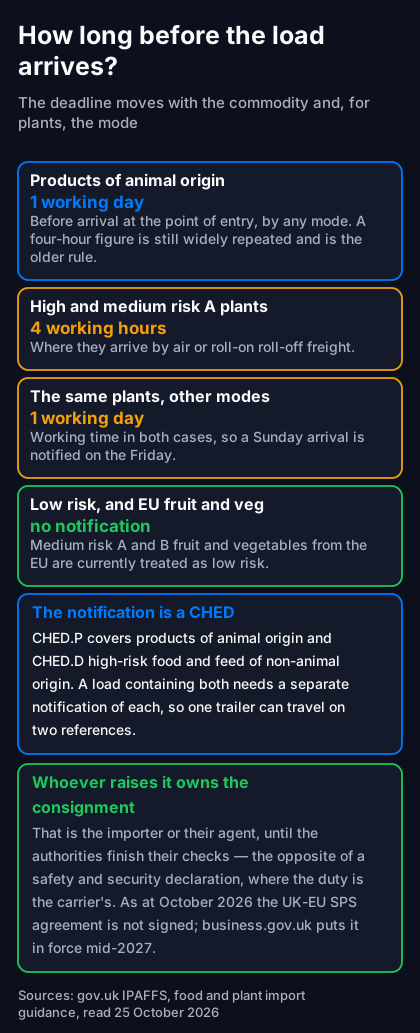
IPAFFS is the service importers and their agents use to tell the Great Britain authorities that a regulated food, plant or animal consignment is arriving. Products of animal origin need one working day's notice; high risk and medium risk A plants need 4 working hours by road or air. The notification is a CHED and the reference, not the paper, is what the border works from. This sets out who notifies, by when, and what has to travel with the load.
What is IPAFFS, and what is it for?
IPAFFS is the Import of Products, Animals, Food and Feed System, the online service used to tell the authorities in Great Britain that a regulated consignment is on its way before it arrives. It is a notification system, not a customs system: it exists so that animal and plant health checks can be planned, and it sits alongside the customs declaration rather than replacing it.
The gov.uk guidance puts the duty on importers and import agents. An agent registers with its own business details rather than as an intermediary, because the intermediary option does not apply to this service.
What makes it matter to a carrier is the consequence of getting it wrong. A notification is not paperwork that can be caught up afterwards; without one the consignment can be held at the border while a vehicle, a driver and a refrigeration unit wait with it.
Which goods have to be pre-notified?
Six categories, and the list applies to imports from the EU and from the rest of the world alike.
- Live animals and germinal products.
- Animal by-products.
- High-risk food and feed not of animal origin.
- Products of animal origin.
- Composite food products.
- Medium-risk and high-risk plants and plant products.
Risk category does the work inside those headings. For plants the categories are high risk, medium risk A, medium risk B and low risk; pre-notification applies to high risk and medium risk A. Products of animal origin are all either low or medium risk. Low-risk goods in both families fall outside plant health controls and outside the notification duty.
One easement is live and worth knowing: medium risk A and B fruit and vegetables from the EU are currently treated as low risk, so they need neither a phytosanitary certificate nor a notification.
How long before arrival must the notification be in?
One working day for animal products, and as little as 4 working hours for plants arriving by road or air. The deadline differs by commodity family and, for plants, by mode of transport.
| Goods | Mode | Minimum notice |
|---|---|---|
| Products of animal origin | Any | 1 working day before arrival at the point of entry |
| High risk and medium risk A plants | Air and roll-on roll-off freight | 4 working hours before the goods land in Great Britain |
| High risk and medium risk A plants | All other freight | 1 working day before arrival |
Note the word working in both figures. Four working hours across a Friday evening is not four hours, and a Sunday arrival is notified on the Friday — which is why weekend sailings cause more of these failures than weekday ones. Late notice does not void the import, but gov.uk is explicit that it may delay the consignment.
Be careful with older guidance here. A four-hour deadline for products of animal origin is still widely repeated online; it was the earlier rule, and the current figure for that family is one working day.
What is a CHED, and which type do you need?
A CHED is a common health entry document — the import notification itself, raised on IPAFFS, which receives a reference in the form CHEDP.GB.YYYY.XXXXXXX. The reference, not the paper, is what the border works from.
| Type | Used for |
|---|---|
| CHED.P | Products of animal origin |
| CHED.D | High-risk food and feed of non-animal origin |
A mixed consignment needs more than one. Where a load contains both animal products and high-risk food of non-animal origin, gov.uk requires a separate notification of each type rather than one covering both — so a single trailer can travel on two references, and a driver who has one of them has an incomplete movement.
That is the detail most worth checking before departure, because it is invisible from the vehicle. Nothing about a pallet of mixed ambient goods shows which of the two documents it needs.
Who is responsible for the notification?
Whoever raises it, and the responsibility is broader than filling in a form. Gov.uk states that whoever raises the notification is responsible for the consignment from its entry into Great Britain until the authorities have finished their checks.
In practice that is the importer or an agent acting for them, and the distinction from the carrier is sharper here than it is for a security filing. On a safety and security declaration the carrier holds the duty; on an IPAFFS notification the importer does. Our entry summary declaration article covers the one that is ours.
The split creates a predictable gap. The party with the obligation is not at the border, and the party at the border has the vehicle — so the reference has to travel from one to the other before the wheels turn, by whatever means, and "the importer has done it" is not evidence that it exists.
Does the load have to go through a border control post?
For high risk and medium risk A plants, yes. Those goods must enter through an airport or port with a border control post able to handle plants or plant products, unless they enter through a point of entry on the west coast of Great Britain.
Checks do not all happen at the quayside. They can take place at a border control post or at a control point, which is an inland inspection facility — so a routing that satisfies the rule may still add a leg to the journey rather than a wait at the port. Medium risk B goods are not put through a border control post by this rule; they need a phytosanitary certificate and nothing more.
How the transporter finds out depends on whether the movement uses GVMS. Where it does, there is a service to check whether the vehicle must report for an inspection. Where it does not, the importer receives an initial risk assessment through IPAFFS and, if checks are required, a text and email 2 hours before the transporter's estimated arrival. At airports the authorities carry out any checks before releasing the consignment for collection.
What paperwork travels with the goods?
A health certificate or a commercial document, and for plants a phytosanitary certificate with its own clock. The rule follows risk category rather than commodity.
| Goods | Document required |
|---|---|
| Medium-risk products of animal origin | A health certificate, issued in the country where the product was last exported, processed or checked |
| Low-risk products of animal origin | A commercial document |
| High risk, medium risk A and medium risk B plants | A phytosanitary certificate |
| Low-risk plants | None under plant health controls |
The phytosanitary certificate has two timing rules that catch people. It must be issued no more than 13 days before or after the consignment leaves the country of export, and where a paper original is used it must be posted to APHA or SASA within 3 days of arrival — a step that is not needed at all if the certificate moves electronically through ePhyto.
Wooden pallets and crates carry a separate requirement that has nothing to do with the goods on them: see ISPM 15 wood packaging.
What is changing, and when?
A UK-EU agreement is intended to remove most of this, and as at October 2026 it has not been signed. On 19 May 2025 the two sides agreed to pursue a new sanitary and phytosanitary agreement, and business.gov.uk — last updated in August 2026 — states that the agreement will come into effect in mid-2027 and calls that timeline ambitious.
What it would change is substantial rather than cosmetic. Export health certificates would no longer be required, and routine border checks by Port Health Authorities on dairy, fish, eggs and red meat imports would be removed. Trade in several products currently blocked, including fresh sausages and burgers, certain shellfish and seed potatoes, is expected to resume.
None of that is in force. Every figure above is the rule that applies now, and planning a 2027 supply chain on the agreement rather than on the current regime is a bet on a date the government itself describes as ambitious.
What is our part in this?
We carry chilled, frozen and ambient food, and the notification is the importer's. What we need before a vehicle commits to a crossing is the CHED reference, the point of entry it was raised against, and whether a border control post or inland control point is in the routing.
Those three facts decide the shape of the job rather than decorating it. A consignment routed through an inland control point is a different run from one cleared at the port, and a refrigerated load waiting for a notification that was never raised is the worst version of this: the clock on the goods keeps running while the paperwork catches up. Our frozen and chilled courier and temperature-controlled pages set out what the vehicles hold, and the food sector page the work.
We are not a customs agent and we do not raise notifications. For the customs half of the same movement see GVMS and goods movement references, and for goods moving to or from Northern Ireland, the Windsor Framework.
Questions
- What is IPAFFS used for?
- It is the Import of Products, Animals, Food and Feed System, the online service for notifying the authorities in Great Britain that a regulated consignment is arriving. It is a notification system rather than a customs system, and it sits alongside the customs declaration instead of replacing it. Importers and import agents use it, and an agent registers with its own business details because the intermediary option does not apply to this service.
- How long before arrival must an IPAFFS notification be submitted?
- Products of animal origin need at least one working day before the import is expected to arrive at the point of entry. High risk and medium risk A plants need at least 4 working hours before the goods land in Great Britain where they come by air or roll-on roll-off freight, and one working day by any other mode. Both figures are in working time, so a weekend arrival is notified before the weekend starts.
- What is a CHED?
- A common health entry document — the import notification itself, raised on IPAFFS, which receives a reference in the form CHEDP.GB.YYYY.XXXXXXX. The reference rather than the paper is what the border works from. CHED.P covers products of animal origin and CHED.D covers high-risk food and feed of non-animal origin. A load containing both needs a separate notification of each type, so one trailer can travel on two references.
- Which goods need pre-notification on IPAFFS?
- Six categories, from the EU and the rest of the world alike: live animals and germinal products, animal by-products, high-risk food and feed not of animal origin, products of animal origin, composite food products, and medium-risk and high-risk plants and plant products. Risk category decides the detail. One easement is live — medium risk A and B fruit and vegetables from the EU are currently treated as low risk and need no notification.
- Does a food import have to go through a border control post?
- High risk and medium risk A plants must enter through an airport or port with a border control post able to handle plants or plant products, unless they enter on the west coast of Great Britain. Checks can take place at a border control post or at a control point, which is an inland inspection facility, so the routing may add a leg rather than a wait. Medium risk B goods are not put through a post by this rule.
- Who is responsible for the IPAFFS notification — the importer or the haulier?
- The importer or an agent acting for them. Gov.uk states that whoever raises the notification is responsible for the consignment from its entry into Great Britain until the authorities have finished their checks. That is the opposite of a safety and security declaration, where the duty sits on the carrier. The gap is predictable: the party with the obligation is not at the border, so the reference must reach the driver before departure.
- Is the UK-EU SPS agreement going to remove these checks?
- Not yet, and not soon. As at October 2026 the agreement has not been signed. The two sides agreed on 19 May 2025 to pursue one, and business.gov.uk states that it will come into effect in mid-2027, describing that timeline as ambitious. It would remove export health certificates and routine Port Health Authority checks on dairy, fish, eggs and red meat. Until then the current rules apply in full.
Explore more
More from the blog
- Reverse logistics: why a return costs more than the…
- Safety and security declarations: who files them, a…
- Road Charges on a UK Delivery: What They Are, and W…
- UN3480 vs UN3481: which number applies to your lith…
- What a Van Can Legally Carry: Gross Vehicle Weight,…
- Waste transfer notes and the duty of care: which do…