
Packing groups: what I, II and III actually change
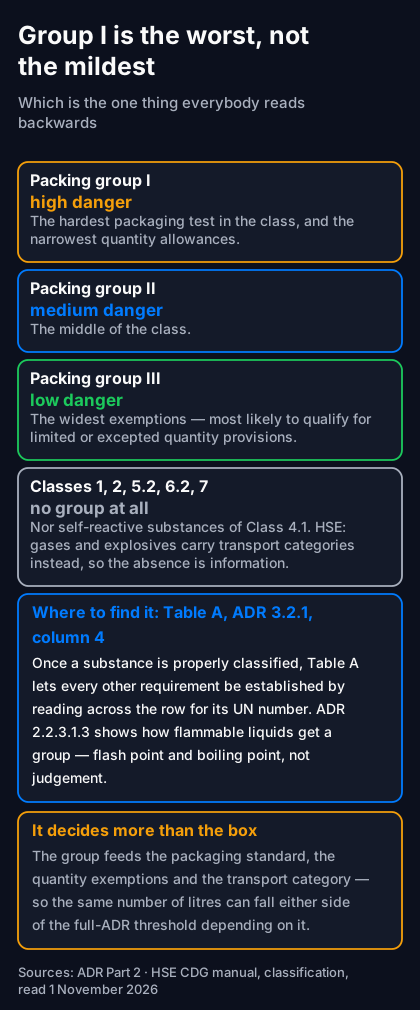
A packing group measures how dangerous a substance is within its class, and the numbering runs the opposite way to intuition: packing group I is high danger, II medium, III low. It is assigned by ADR rather than chosen by a shipper, it lives in column 4 of ADR's Table A, and several classes — gases and explosives among them — have no packing group at all. This sets out what the group changes, how it is assigned, and what a carrier needs on the document.
What is a packing group?
A packing group is a measure of how dangerous a substance is within its class, not of what kind of danger it presents. The class answers what the hazard is; the packing group answers how bad it is, and between them they decide what the goods have to travel in.
It is a classification output rather than a judgement made at the point of packing. ADR assigns the group to the substance, the substance appears in a table with its UN number, and the group comes with it — which means there is nothing for a shipper to decide and quite a lot to look up.
The reason it matters commercially is that it sets the packaging standard. Two consignments in the same class, one in packing group I and one in packing group III, are not the same job: they need different containers, qualify for different exemptions, and are counted differently against the thresholds that decide whether a vehicle needs full dangerous-goods treatment at all.
What do I, II and III mean?
Three degrees of danger, and the numbering runs the opposite way to intuition — group I is the worst.
| Packing group | Degree of danger |
|---|---|
| Packing group I | Substances presenting high danger |
| Packing group II | Substances presenting medium danger |
| Packing group III | Substances presenting low danger |
The inversion catches people who read the numbers as a scale of severity running upwards. A packing group III solvent is the mild end of its class; a packing group I substance of the same class is the end where the packaging is tested hardest. Written as Roman numerals in the regulations, they are frequently transcribed as 1, 2 and 3 in commercial paperwork, which is survivable — but a consignment described as "group 1" when it is group III is a serious mis-description rather than a typographical one.
Which classes do not have packing groups?
Several, and that is not an oversight. Packing groups are assigned to substances other than those of Classes 1, 2, 5.2, 6.2 and 7, and other than self-reactive substances of Class 4.1.
- Class 1, explosives — graded by compatibility group and division instead.
- Class 2, gases — where the hazard is the pressure and the contents, not a degree band.
- Division 5.2, organic peroxides, and self-reactive substances of Division 4.1.
- Division 6.2, infectious substances, which are categorised by their own scheme.
- Class 7, radioactive material, which has an entirely separate regime.
The HSE puts the practical consequence plainly: some substances are not assigned a packing group, notably gases and explosives, and they carry transport categories instead. So a shipper looking for a packing group on a cylinder of compressed gas is looking for something that does not exist, and the absence is information rather than a gap in the paperwork.
Where do you find the packing group for a substance?
In ADR's Table A, at 3.2.1, in column 4. That table is the spine of the whole regime: once a substance or article has been properly classified, Table A lets every other requirement be established by working logically across the columns.
That is worth restating as a method rather than a fact. You do not look up the packaging rule, the label, the quantity threshold and the documentation separately — you find the UN number, read along its row, and each column tells you which part of ADR applies. The packing group in column 4 is one of those reads, and several later columns depend on it.
Our ADR classes article covers the nine classes that occupy the first columns, and UN numbers the identifier the row is keyed on.
What does the packing group actually change?
Four things, in rising order of how much they cost.
| What it decides | How |
|---|---|
| Packaging performance | Which tested standard the container must meet |
| Quantity exemptions | Eligibility for limited and excepted quantity provisions |
| Transport category | Feeds the threshold calculation for the load |
| How much can travel before full ADR applies | Via that calculation |
The third and fourth rows are where a packing group turns into money. Our ADR classes article sets out the points calculation that decides whether a load is a full dangerous-goods movement or a smaller-quantity one; the packing group is an input to it, so the same number of litres can land on either side of the line depending on the group.
How is a packing group assigned?
By measured properties against the criteria for the class, not by how hazardous something feels. Each class sets its own test: ADR 2.2.3.1.3 shows how flammable liquids are assigned a packing group, and the criteria differ class by class because the hazards are not comparable.
For flammable liquids the inputs are flash point and boiling point; for toxic substances they are dose-based; for corrosives they are the contact time needed to damage skin or metal. A substance can therefore sit in a different group from a chemically similar one because a single measured value falls either side of a threshold.
This is why a safety data sheet is the starting point and not the answer. Section 14 of a data sheet carries the transport classification, and where it is absent, stale or inherited from a different formulation, the classification has to be established rather than assumed.
Does the packing group change the vehicle or the driver?
Indirectly, through the quantity thresholds rather than directly. There is no rule that a packing group I substance needs a different vehicle from a packing group III one; what changes is how quickly a load crosses the point where full ADR requirements apply.
Past that point the requirements are the familiar ones: a driver holding an ADR vocational training certificate for the relevant class, orange plates, the correct instructions in writing, and equipment on the vehicle. Below it a movement can run under smaller-quantity provisions with much less apparatus.
Our drivers hold ADR licences, which is why we can carry dangerous goods at all; the hazardous goods page sets out that work. What we do not do is classify anybody's substances, which is the shipper's duty and the subject of the next section.
How does it interact with limited and excepted quantities?
It decides whether those provisions are open to you at all, and how much fits inside them. Limited quantities and excepted quantities are the two routes by which small amounts of dangerous goods travel with substantially reduced requirements, and both are keyed to the substance's entry — which includes its packing group.
The practical shape is that the milder the group, the more generous the allowance, and the more likely a consignment is to qualify at all. A shipper sending the same product in two pack sizes can therefore have one shipment inside limited quantities and the other outside, with the paperwork, the labelling and the vehicle requirements changing between them.
Our limited quantities compared with excepted quantities page works through the two schemes, and lithium batteries is the case where most shippers meet them first.
What goes wrong in practice?
Four failures, and three of them happen on a keyboard rather than a loading bay.
- Roman numerals read as a severity scale, so group I is treated as the mild end.
- A data sheet carried over from a different concentration or formulation of the same product.
- A packing group quoted for a class that has none, which usually means the entry was guessed.
- The group omitted from the transport document, which leaves the carrier unable to work out the load's threshold position.
The last of those is the one a carrier notices. A dangerous goods note that names the substance and the class but not the packing group cannot be checked against the quantity thresholds, so a driver is being asked to carry a load whose regulatory position nobody has established — see the dangerous goods note for what the document should carry.
What should you give a carrier?
The full classification, in the order the regulations use, and the quantities per item rather than in total.
- UN number and the proper shipping name.
- Class, and division where the class has them.
- Packing group, in Roman numerals, or a note that the entry has none.
- Quantity per package and the number of packages.
- Whether limited or excepted quantity provisions are being relied on.
Those five give a carrier everything needed to establish the load's position before a vehicle is allocated. Supplying four of them and leaving the packing group to be looked up is the version that produces a phone call at the collection address.
What is our part in this?
We carry dangerous goods with ADR-licensed drivers and we do not classify them. The classification — UN number, class, packing group and whether a quantity provision applies — is the consignor's responsibility, and it has to exist before a vehicle is booked rather than be settled at the kerb.
What we do is check that the declaration is complete and consistent, because a load whose position against the thresholds cannot be worked out is a load we cannot plan. Our hazardous goods page sets out the service and ADR the regime behind it.
For the rest of the classification picture, see the nine ADR classes, UN numbers, and lithium batteries — the entry where a packing group question most often turns out to be a different question entirely.
Questions
- What is a packing group?
- A measure of how dangerous a substance is within its class, rather than of what kind of danger it presents. The class says what the hazard is; the packing group says how bad it is. ADR assigns it to the substance, so there is nothing for a shipper to decide and a good deal to look up. It sets the packaging standard, the quantity exemptions available, and how a load counts against the thresholds for full dangerous-goods treatment.
- What do packing groups I, II and III mean?
- Three degrees of danger, numbered the opposite way to intuition: packing group I is substances presenting high danger, II medium danger and III low danger. So group I is the worst, not the mildest. The regulations write them as Roman numerals and commercial paperwork often transcribes them as 1, 2 and 3, which is survivable — but describing a group III substance as “group 1” is a mis-description, not a typo.
- Which dangerous goods classes have no packing group?
- Packing groups are assigned to substances other than those of Classes 1, 2, 5.2, 6.2 and 7, and other than self-reactive substances of Class 4.1. So explosives, gases, organic peroxides, infectious substances and radioactive material are all outside the scheme, each graded by its own arrangement instead. HSE notes that gases and explosives carry transport categories rather than packing groups, so the absence is information rather than missing paperwork.
- Where do I find the packing group for a substance?
- In column 4 of Table A at ADR 3.2.1. That table is the spine of the regime: once a substance is properly classified, Table A lets every other requirement be established by reading across the columns of its UN number's row. A safety data sheet's section 14 carries the transport classification too, but where it is absent, stale or inherited from a different formulation the classification has to be established rather than assumed.
- What does the packing group change?
- Four things: which tested packaging standard the container must meet, whether limited or excepted quantity provisions are available, the transport category, and through that how much can travel before full ADR requirements apply. The last is where it becomes money — the same number of litres can fall either side of the threshold depending on the group, which decides whether a movement needs the full apparatus or not.
- How is a packing group assigned?
- By measured properties against criteria set class by class, because the hazards are not comparable. For flammable liquids the inputs are flash point and boiling point; for toxic substances they are dose-based; for corrosives, the contact time needed to damage skin or metal. A substance can therefore sit in a different group from a chemically similar one because one measured value falls either side of a threshold.
- Does a packing group change the vehicle or the driver needed?
- Only indirectly. No rule says a packing group I substance needs a different vehicle from a group III one; what changes is how quickly the load crosses the point where full ADR applies. Past it you need a driver holding an ADR vocational training certificate for the class, orange plates, instructions in writing and equipment on the vehicle. Below it, smaller-quantity provisions need much less.