
Deemed service by courier: when court papers count as served
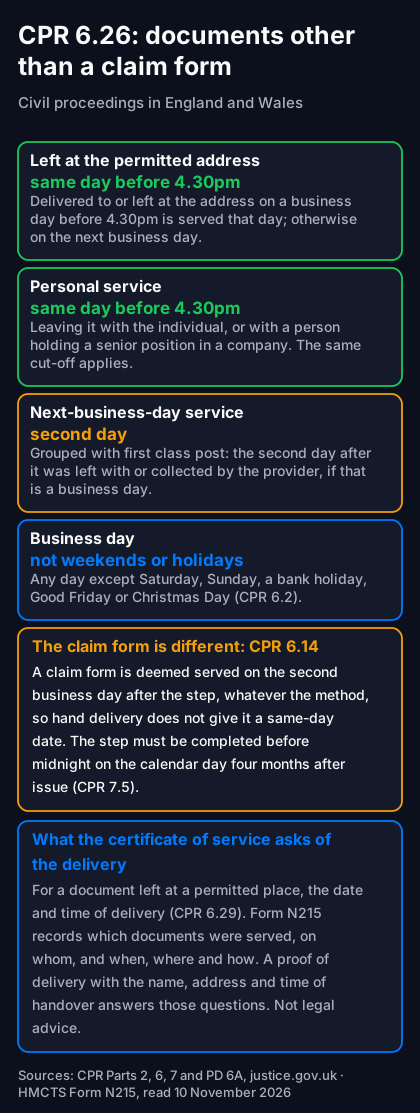
Under the Civil Procedure Rules, a document other than a claim form that a courier delivers to, or leaves at, the permitted address before 4.30pm on a business day is deemed served that day; after 4.30pm, or on a weekend or bank holiday, it is served on the next business day. A next-day courier service counts like first class post instead, and a claim form follows its own rule. This sets out each method, the business-day arithmetic and what the certificate of service needs from the delivery.
What does "deemed served" mean?
Deemed service is the date the court treats a document as served, whatever day the recipient actually read it. The Civil Procedure Rules fix that date by the method used, so the same envelope can be served on different days depending on how it travelled.
That date is what later deadlines count from. CPR 2.8 gives the example of particulars of claim due within 14 days of service of the claim form: the 14 days run from the deemed date, not from the day the courier was booked, so the method is a legal choice first.
This is not legal advice: the method of service is the party's or their solicitor's decision, and what follows is the text of the rules, not an interpretation of a case.
Which rules apply, and in which courts?
The Civil Procedure Rules apply to all proceedings in the County Court, the High Court and the Civil Division of the Court of Appeal, under CPR 2.1. Those are the civil courts of England and Wales.
The same rule carves several kinds of proceedings out, among them insolvency, family, adoption, Court of Protection and non-contentious probate proceedings, which run on their own rules. And the courts it lists do not include those of Scotland or Northern Ireland.
So everything below is about civil claims in England and Wales; other rule books are not covered.
What methods of service do the rules allow?
Five, for documents other than the claim form, listed in CPR 6.20.
| Method (CPR 6.20) | What it involves | Courier role |
|---|---|---|
| Personal service | Leaving the document with the person (rule 6.22, applying 6.5(3)) | Possible; the party chooses who serves |
| First class post, DX or other next-business-day service | Handing it to a service that delivers on the next business day | A next-day courier service falls here |
| Leaving it at a permitted address | Delivering it to, or leaving it at, the address under rule 6.23 | Same-day hand delivery falls here |
| Fax or other electronic means | Only if the recipient has previously indicated in writing that it will accept it (PD 6A para 4.1) | None |
| Method authorised by the court | An order under rule 6.27 | Only if the order names one |
Which row a courier job sits in depends on what the courier does: hand the document in at the address, or take it into a service that delivers the next business day.
When is a hand-delivered document deemed served?
On the same day, if it is delivered to or left at the permitted address on a business day before 4.30pm; otherwise on the next business day. That is row 3 of the table in CPR 6.26, and it applies to every document except the claim form.
| Method (CPR 6.26) | Deemed date of service |
|---|---|
| First class post or other next-business-day service | The second day after it was posted or left with the provider, if a business day; if not, the next business day |
| Document exchange | The second day after it was left with the DX, if a business day; if not, the next business day |
| Delivering to or leaving at a permitted address | That day, if a business day and before 4.30pm; otherwise the next business day |
| Personal service | That day, if a business day and before 4.30pm; otherwise the next business day |
| Email or other electronic method | That day, if sent on a business day before 4.30pm; otherwise the next business day |
The cut-off is the whole point for a courier. A document handed in at 4.20pm on a Tuesday is served on Tuesday; the same document at 4.40pm is served on Wednesday, and every period that runs from service moves with it.
What counts as a business day?
Any day except Saturday, Sunday, a bank holiday, Good Friday or Christmas Day, under CPR 6.2(b). Bank holiday means one in the part of the United Kingdom where service is to take place.
Practice Direction 6A gives worked examples, and the holiday one is the one that catches people. A document delivered to a permitted address after 4.30pm on the Thursday before Good Friday is deemed served on the following Tuesday, because Friday is Good Friday, the weekend does not count and Monday is a bank holiday.
Another example in Practice Direction 6A: a document served personally before 4.30pm on a Sunday is deemed served on the Monday.
Is a next-day courier treated the same as hand delivery?
No. A service that provides for delivery on the next business day sits with first class post in row 1 of CPR 6.26, so the document is deemed served on the second day after it was left with or collected by the provider, if that is a business day.
The Practice Direction's own example is first class post on a Monday, deemed served on the Wednesday. The same arithmetic applies to any next-business-day service, so a next-day service that collects the document on Monday gives a Wednesday date even if the envelope arrives on Tuesday morning. The count starts from collection, not from the day the job was booked.
So same-day hand delivery before 4.30pm can be served the day it is delivered; a next-day service is served two days later by rule rather than by arrival. Our same-day versus next-day guide covers the cost side of that choice, and this is the legal side.
Why is the claim form different?
Because CPR 6.14 deems a claim form served on the second business day after the relevant step is completed, whichever method is used. Hand delivery does not give a claim form a same-day service date.
The step itself has a hard deadline. Under CPR 7.5 the claimant must complete it before midnight on the calendar day four months after the date of issue: posting or leaving it with the service provider, delivering it to the relevant place, or leaving it with the person for personal service.
| Question | Claim form | Other documents |
|---|---|---|
| Rule fixing the deemed date | CPR 6.14 | CPR 6.26 |
| Hand delivery on a business day before 4.30pm | Second business day after the step | That day |
| Deadline for the step | Before midnight, four months after issue (CPR 7.5) | Set by the rule or order requiring service |
| Certificate details for hand delivery | Date delivered (CPR 6.17) | Date and time delivered (CPR 6.29) |
For a courier this means the claim form deadline is about when the step happens, and the record of that step is the evidence.
Can a courier carry out personal service?
The rules define personal service by what happens, not by who does it. Under CPR 6.5(3) a document is served personally on an individual by leaving it with that individual, and on a company by leaving it with a person holding a senior position.
Practice Direction 6A para 6.2 lists who that is for a registered company: a director, the treasurer, the secretary, a manager or other officer, among others. A receptionist is not on the list, which is the difference between personal service and delivery to a permitted address.
Whether to use a courier, a process server or someone from the firm for personal service is the solicitor's decision. Personal service is also not always available: rule 6.22(2) excludes it where the party has given an address for service, and in proceedings by or against the Crown.
When can DX or email be used instead?
Only when the recipient has signalled it in advance. Under PD 6A para 2.1, DX is available only where the address includes a numbered DX box or the writing paper shows one, and the recipient has not said in writing that it will not accept service by DX.
Email needs more: the recipient or its solicitor must have indicated in writing that it accepts service by electronic means and given the address to use (PD 6A para 4.1). An email address on a solicitor's letterhead counts only where it is stated that it may be used for service.
Where neither condition is met, physical delivery is the method left, which is the situation a courier versus DX decision starts from. The comparison of dedicated vehicle and shared network covers how the document travels once the method is settled.
What does the certificate of service need from the delivery?
For a document left at a permitted place, the date and time it was delivered, under CPR 6.29. For a claim form, rule 6.17 asks for the date, and the claimant must file the certificate within 21 days of service of the particulars of claim unless every defendant has acknowledged service.
HMCTS publishes the certificate as Form N215, which records which documents were served, on whom, and when, where and how. The party or their legal representative completes it and delivers it to the court.
A proof of delivery with the address as attended, the recipient's name and the time of handover answers the questions the form asks; one with only a signature leaves the time to be reconstructed. Our proof of delivery guide sets out what a usable record carries.
What should a firm agree with the courier before booking?
Four things, and all of them follow from the rules above.
- The method. Hand delivery to a permitted address, personal service, or a next-business-day service: each has a different deemed date.
- The address. The address for service from rule 6.23, usually the solicitor's business address, not a convenient branch.
- The cut-off. Arrival before 4.30pm on a business day if a same-day date matters, with the bank holidays of the part of the UK where service happens checked.
- The record. Name, time and address of handover, captured at the door, because the certificate asks for them.
Periods of 5 days or less also skip weekends and bank holidays under CPR 2.8(4), and an act due at a court office on a day it is closed is in time the next day it opens (CPR 2.8(5)). Both are worth checking before a deadline is treated as tight.
Where do we stand in this?
We are a courier. We carry documents and record the handover; we are not a process server, we do not complete or sign certificates of service, and nothing on this page is legal advice. The method of service, and the certificate, belong to the party and its solicitor.
What we provide is the delivery and the evidence of it: a signed proof of delivery with a photograph, captured at handover with the time recorded, on a dedicated vehicle with one driver between collection and delivery. For single envelopes across central London a motorcycle can be arranged through our partner network — see motorcycle courier for documents.
The service itself is on our legal document courier page, the sector view is under legal, and the handling of files and bundles is on shipping legal documents. Our licences page lists what we hold and the registers that prove it.
Questions
- When is a document delivered by courier deemed served?
- If it is delivered to or left at the permitted address on a business day before 4.30pm, it is deemed served that day; in any other case, on the next business day. That is row 3 of the table in CPR 6.26, and it applies to every document except the claim form. A next-day courier service is treated like first class post instead: the second day after the document was left with the provider, if that is a business day.
- Is a claim form delivered by hand served the same day?
- No. CPR 6.14 deems a claim form served within the UK on the second business day after the relevant step under rule 7.5 is completed, whichever method is used. The step itself, such as delivering the claim form to the relevant place, must be completed before midnight on the calendar day four months after the date of issue.
- What is a business day for service of documents?
- Any day except Saturday, Sunday, a bank holiday, Good Friday or Christmas Day, under CPR 6.2(b), with bank holidays taken from the part of the UK where service is to take place. Practice Direction 6A's example: a document delivered after 4.30pm on the Thursday before Good Friday is deemed served on the following Tuesday.
- Does a next-day courier count as hand delivery?
- No. CPR 6.26 groups any service that provides for delivery on the next business day with first class post, so the deemed date is the second day after the document was left with or collected by the provider, if a business day. Collected on a Monday, that is Wednesday, even if the envelope arrives on Tuesday.
- Can a courier carry out personal service on a company?
- The rules define personal service by what happens, not who does it: under CPR 6.5(3) a company is served personally by leaving the document with a person holding a senior position. Practice Direction 6A lists them for a registered company as including a director, the treasurer, the secretary, a manager or other officer. Who serves is the solicitor's decision.
- What does a certificate of service need to show?
- For a document delivered to or left at a permitted place, the date and time of delivery under CPR 6.29; for a claim form, the date under rule 6.17. HMCTS publishes the certificate as Form N215, which records which documents were served, on whom, and when, where and how. A proof of delivery with name, address and time makes it straightforward to complete truthfully.
- Do these rules apply in Scotland?
- No. CPR 2.1 applies the Civil Procedure Rules to the County Court, the High Court and the Civil Division of the Court of Appeal, which are the civil courts of England and Wales. The courts of Scotland and Northern Ireland are not on that list, and the same rule excludes family, adoption and insolvency proceedings, which run on their own rules.
Explore more
More from the blog
- Clinical trial logistics: who owns the obligation,…
- The CMR note: what it covers, and what it actually…
- The commercial invoice: what your customs declarati…
- Cross-docking: what it saves, and what it costs you
- Customs Procedure Codes: What DE 1/10 and DE 1/11 A…
- Customs value: what has to go in, and who answers f…