
Motorcycle courier for documents: when two wheels is the right answer
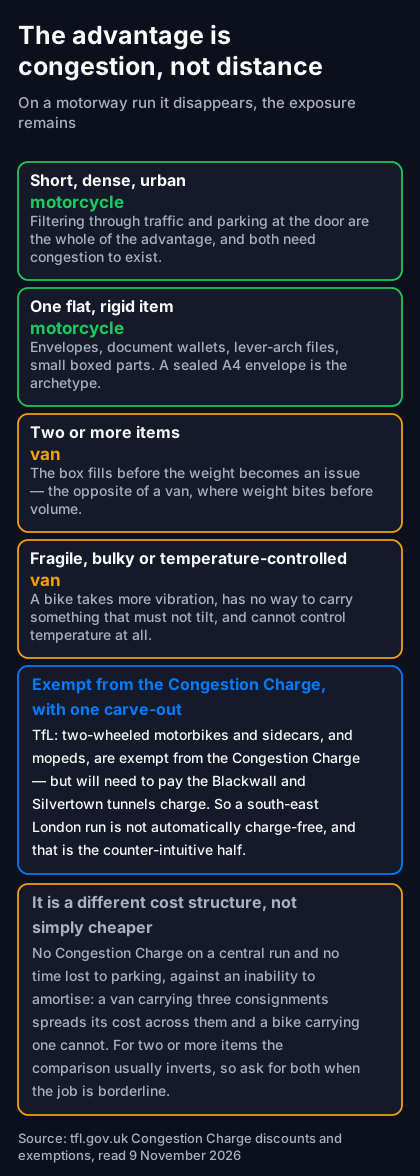
For a single urgent document across a congested city a motorcycle is often the right vehicle rather than a compromise: it carries one or two items, parks at the door, and two-wheeled motorbikes and mopeds are exempt from the Congestion Charge — though they still pay the Blackwall and Silvertown tunnels charge. The limit is the top box, not a rule. This sets out which document jobs suit a bike and which do not.
Can you hire a motorcycle courier for documents?
Yes, and for a single urgent document across a congested city it is frequently the right vehicle rather than a compromise. A motorcycle carries one or two items, parks at the door, and is unaffected by the traffic that decides a van's arrival time.
The reason it is not the default is capacity, not capability. A bike takes what fits in a top box and panniers, so the moment a job becomes two boxes it becomes a van job.
So the useful question is not whether a bike can carry documents — it obviously can — but which document jobs it suits better than the alternative, and which it suits worse.
What actually fits on a bike?
What fits in the luggage, and that is a property of the machine rather than of any rule. There is no regulator setting a motorcycle's carrying limit, which is exactly why the answer has to come from the carrier for the specific bike rather than from a page like this.
In practice the shapes that work are flat and rigid: envelopes, document wallets, lever-arch files, small boxed parts. The shapes that do not are anything that cannot be bent, anything taller than the box, and anything that needs to stay flat but is too large to.
A sealed A4 envelope is the archetype. A box of twelve lever-arch files is not, however urgent it is.
Weight is rarely the binding constraint, which surprises people who think of a bike as the small option. Paper is dense, so a full document wallet is heavier than it looks, but the box runs out of room long before the machine runs out of capacity — the opposite of the problem a van has, where our van payload article shows weight biting before volume does.
When is a bike faster than a van?
When the journey is short, urban and congested, and when the far end has nowhere to park. Those three conditions describe most central-city document runs.
| Condition | Favours |
|---|---|
| Dense urban traffic, short distance | Motorcycle |
| No loading bay or parking at either end | Motorcycle |
| One small item, one address | Motorcycle |
| Motorway distance between cities | Van or car — the bike's advantage disappears |
| Two or more items, or anything bulky | Van |
The fourth row is the one people get wrong. A bike's advantage is filtering through congestion and parking at the door; on a long motorway run there is no congestion to filter and the advantage is gone, while the exposure to weather and fatigue remains.
Does a motorcycle pay the Congestion Charge?
No. TfL states that two-wheeled motorbikes and sidecars, and mopeds, are exempt from the Congestion Charge — but will need to pay the Blackwall and Silvertown tunnels charge.
That exemption is a real cost difference on a central London job rather than a technicality, and it compounds with the parking advantage: a bike neither pays to enter nor needs somewhere to stop.
The tunnels carve-out is the part worth remembering, because it is counter-intuitive. A bike crossing the river by those tunnels is charged, so a south-east London run is not automatically charge-free — our road charges on a delivery article covers which charges follow the route and which follow the vehicle.
What does not suit a motorcycle?
Bulk, weight, and anything whose condition matters more than its speed. A bike's luggage is small, its load is exposed to vibration, and it has no way to carry something that must not be tilted.
- More than one or two items — the box fills before the weight becomes an issue.
- Anything bulky or rigid beyond the box, including most framed or boxed goods.
- Fragile items, which take more vibration on a bike than in a van.
- Anything requiring temperature control, which a bike cannot provide.
- Multi-drop rounds, where the capacity runs out after the first two stops.
Dangerous goods are a separate question with its own rules rather than a capacity one; see ADR classes for what governs those, and do not assume a small quantity makes them a bike job.
How are documents protected on a bike?
By the packaging and the protocol, not by the vehicle. A bike's luggage is weatherproof to a degree that varies by machine, so the sealed, waterproof wallet is doing the real work.
For legal and commercial documents the protocol matters as much as the waterproofing. A sealed-envelope job is one where the carrier does not open or inspect the contents and transports the envelope as-is, which is what makes it suitable for material under privilege or commercial confidence.
That is a procedural commitment rather than a feature of the bike, and it applies identically in a van — see legal document courier for the document-specific version of this work.
Who signs, and what proves it?
A named recipient, with the proof captured at the point of handover. For a document whose value is its deadline, the evidence that it arrived is as important as the arrival.
What that evidence consists of is worth agreeing in advance: a signature, the name of the person who gave it, a timestamp, and where required a photograph. Our proof of delivery article covers what each of those actually proves.
The weak point on urgent document jobs is the receiving end rather than the carrier. A courier at a reception desk at five o'clock with an envelope for a named solicitor who has left is a delivery that has technically failed, and the fix is a fallback name agreed at booking.
Does weather change the answer?
For the goods, yes; for the schedule, less than people assume. Paper and rain are a poor combination, and the mitigation is packaging rather than optimism.
Heavy rain and high winds affect a bike more than a van, and a responsible carrier will say so rather than accept a job that should not run on two wheels. That is a judgement about conditions on the day.
What rain does not do is remove the bike's advantage. Congestion gets worse in bad weather, not better, so the gap between a bike and a van in a city often widens.
The practical consequence is that weather changes the packaging requirement rather than the vehicle choice. A document that would travel in a plain envelope on a dry day needs a sealed waterproof wallet on a wet one, and that is a decision taken at collection by whoever hands the item over — which is why it belongs in the booking conversation rather than being left to the driver to improvise with a carrier bag.
How does the cost compare?
Different structure rather than simply cheaper. A motorcycle job prices on a dedicated vehicle and driver for one item, with no Congestion Charge on a central London run and no time spent finding parking.
Against that, the bike cannot amortise anything. A van carrying three consignments spreads its cost across them; a bike carrying one cannot, so for two or more items the comparison usually inverts.
| Cost driver | How the vehicle changes it |
|---|---|
| Distance | Same for both; the bike's edge is in traffic, not miles |
| Congestion Charge, central London | Exempt on a bike, payable in a van |
| Parking and waiting at each end | Usually lower on a bike |
| Number of items | A van spreads cost across them; a bike cannot |
| Time of day and urgency | Same for both |
Ask for both when the job is borderline. The cost drivers are the same ones as any dedicated job — distance, urgency, time of day, waiting — and the vehicle is one input among them rather than the whole answer.
What should you tell the carrier?
Four things, and the first decides whether a bike is possible at all.
- The item's real size and shape — "an envelope" and "a document wallet with 200 pages" are different jobs.
- The deadline, and what happens if it is missed.
- Who receives it, named, with a fallback.
- Whether the contents are confidential, which sets the handling protocol.
The second one changes the recommendation more than people expect. A deadline measured in hours in a congested city points at a bike; one measured in days points at a cheaper vehicle, and there is no merit in paying for speed that the deadline does not need.
Where do we stand in this?
We run vans, and for the single-item urban document job a motorcycle is arranged through our partner network rather than from our own fleet. That is worth stating plainly rather than implying a capability we do not operate.
What we can do either way is tell you which vehicle the job actually wants. A sealed envelope across central London in the afternoon is a different problem from a box of files to another city, and the honest answer is sometimes that a bike is the wrong recommendation — see van sizes compared for where the step up begins.
For the document work itself see legal document courier, and for the vehicle-weight arithmetic behind every larger alternative, van payload.
Questions
- Can you hire a motorcycle courier for documents?
- Yes, and for a single urgent document across a congested city it is often the right vehicle rather than a compromise: a bike carries one or two items, parks at the door, and is unaffected by the traffic that decides a van's arrival time. The reason it is not the default is capacity rather than capability — the moment a job becomes two boxes it becomes a van job.
- What fits on a courier motorcycle?
- What fits in the top box and panniers, which is a property of the machine rather than of any rule — there is no regulator setting a motorcycle's carrying limit, so the answer has to come from the carrier for the specific bike. The shapes that work are flat and rigid: envelopes, document wallets, lever-arch files, small boxed parts. A sealed A4 envelope is the archetype; a box of twelve files is not.
- Do motorcycles pay the London Congestion Charge?
- No. TfL states that two-wheeled motorbikes and sidecars, and mopeds, are exempt from the Congestion Charge — but they will need to pay the Blackwall and Silvertown tunnels charge. That exemption is a real cost difference on a central London job, and it compounds with the parking advantage. The tunnels carve-out is worth remembering, because a south-east London run is not automatically charge-free.
- When is a motorcycle courier faster than a van?
- When the journey is short, urban and congested, and the far end has nowhere to park — which describes most central-city document runs. The advantage disappears on a motorway run between cities, where there is no congestion to filter and the exposure to weather and fatigue remains. Two or more items, or anything bulky, points at a van regardless of distance.
- What should not go by motorcycle courier?
- Bulk, weight, and anything whose condition matters more than its speed: more than one or two items, anything bulky or rigid beyond the box, fragile items that take more vibration on a bike than in a van, anything needing temperature control, and multi-drop rounds where capacity runs out after two stops. Dangerous goods are a separate question governed by their own rules.
- How are confidential documents handled on a bike?
- By the packaging and the protocol rather than the vehicle. A bike's luggage is weatherproof to a degree that varies by machine, so a sealed waterproof wallet does the real work. For privileged or commercially confidential material the sealed-envelope protocol matters as much: the carrier does not open or inspect the contents and transports the envelope as-is — which applies identically in a van.
- Is a motorcycle courier cheaper than a van?
- It is a different cost structure rather than simply cheaper. A bike prices as a dedicated vehicle and driver for one item, with no Congestion Charge on a central London run and no time lost to parking. Against that it cannot amortise: a van carrying three consignments spreads its cost across them, so for two or more items the comparison usually inverts. Ask for both when the job is borderline.
Explore more
More from the blog
- Kerbside, tail lift or carried in: who unloads, and…
- Known consignor, regulated agent and screening: who…
- Load securing: the forces, the friction assumption,…
- NCTS Explained: UK Transit Declarations, Guarantees…
- Packing groups: what I, II and III actually change
- Who owns the pallet: exchange, pooled and one-way c…