
Load securing: the forces, the friction assumption, and what does not count
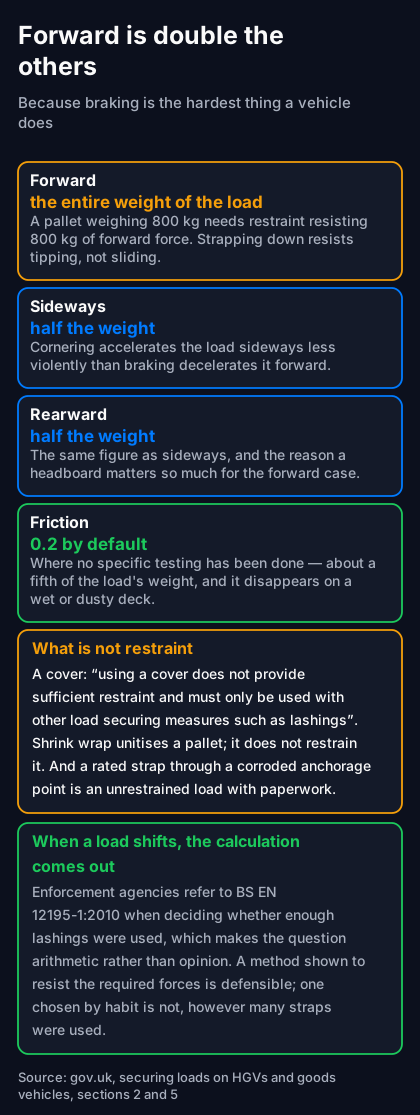
A secured load is one whose restraint system can resist the entire weight of the load forward and half its weight sideways and rearward. Friction counts for about a fifth by default, a cover is not restraint, and when a load shifts seriously, enforcement reaches for BS EN 12195-1:2010 and does the arithmetic. This sets out the forces, the pre-load checks, the lashing standards, and why none of it scales down for a van.
What does a secured load actually mean?
A secured load is one whose restraint system can hold it still against the forces a vehicle generates in normal use — braking, cornering and accelerating. It is a strength requirement rather than a tidiness one, and it is specified in multiples of the load's own weight.
That framing is the thing most senders miss. The question is not whether the load looks stable in a loading bay; it is whether the straps, the bodywork and the friction underneath it can between them resist a force equal to the load's whole weight.
And it is a system, not a strap. The platform, the bodywork, the anchorage points and the lashings are assessed together, because the weakest of them is what fails.
Which forces does the restraint have to resist?
Three, and they are not equal. Gov.uk requires the system to withstand the entire weight of the load in the forward direction, half the weight of the load to the sides, and half the weight of the load to the rear.
| Direction | Force the system must withstand |
|---|---|
| Forward | The entire weight of the load |
| Sideways | Half the weight of the load |
| Rearward | Half the weight of the load |
Put a figure on it and the scale becomes obvious. A single pallet weighing 800 kg needs restraint capable of resisting 800 kg of forward force and 400 kg sideways — which is not what a pallet standing loose against a bulkhead provides.
Why is the forward figure double the others?
Because braking is the hardest thing a vehicle does to its load. Emergency braking decelerates the whole mass faster than cornering accelerates it sideways, so the forward case sets the design requirement and the others follow from it.
The practical consequence is that forward restraint is where loads are most often under-secured. A load strapped down to stop it toppling has been secured against the wrong direction: downward pressure resists tipping, not sliding, and sliding forward is what happens under heavy braking.
It also explains why a headboard matters so much. A load resting against a headboard has a structure taking the forward force; the same load on a flat bed without one is relying entirely on lashings, and gov.uk notes that very large or tall loads may need additional lashings on a vehicle with no headboard.
Does friction count towards restraint?
Yes, and the assumption used is lower than people expect. Where no specific testing has been done, the guidance uses a friction coefficient of 0.2 in all other cases — the default when the surfaces involved have not been established.
A coefficient of 0.2 means friction alone resists about a fifth of the load's weight. It is a contribution, not a restraint system, and it disappears when the deck is wet, dusty, or finished in something slick.
That is the argument for anti-slip matting rather than more straps. Raising the friction under the load reduces the force the lashings have to take, and it does so for every direction at once.
Is a curtain or a cover restraint?
No, and this is stated plainly: using a cover does not provide sufficient restraint and must only be used with other load securing measures such as lashings.
| Element | Restraint? |
|---|---|
| Lashings to rated anchorage points | Yes |
| Headboard, bulkhead or load-rated bodywork | Yes |
| Friction under the load | Partly — 0.2 by default |
| A cover or sheet over the load | No, only alongside lashings |
| Shrink wrap holding a pallet together | No — it unitises, it does not restrain |
The last row is worth dwelling on. Wrapping stops a pallet from coming apart, which is a different job from stopping the pallet from moving. Our pallet exchange article covers what the pallet itself is rated to carry; the wrap around it is not part of the restraint calculation.
What has to be checked before loading?
Four things, and all of them before anything goes on. The operator has to be satisfied that the load platform, the bodywork, the anchorage points and the twist locks where fitted are appropriate for the load and in good condition.
- The load platform — sound, and the right surface for the load.
- The bodywork — and whether it is rated to take any of the force at all.
- The anchorage points — present, rated, and undamaged.
- Twist locks where fitted — functioning rather than merely present.
Anchorage points are the item that quietly fails. A strap is only as strong as what it is attached to, and a rated strap through a corroded tie-down ring is an unrestrained load with paperwork.
What do the lashing standards cover?
Equipment and calculation, in separate documents. BS EN 12195-2:2001 covers web lashings made from man-made fibres and BS EN 12195-3:2001 covers lashing chains, while BS EN 12195-1:2010 is the calculation of securing forces.
The split matters when buying rather than when loading. A strap carries a rated capacity because it was made to the equipment standard; how many of them a given load needs comes from the calculation standard, and the two are often confused in conversation.
None of which substitutes for the rating being legible. A strap whose label has worn off has no demonstrable capacity, which puts it in the same position as an unrated one.
Angle changes the arithmetic too, and not gently. A lashing pulled at a shallow angle across a load contributes far less to resisting forward movement than the same strap pulled closer to the direction of the force, because only the component acting along that direction counts. Two straps thrown over a load in an X can therefore look thorough and deliver less forward restraint than one strap run fore and aft — which is the sort of result that only shows up if somebody does the calculation rather than counting the straps.
What happens when a load shifts?
The calculation comes out. If there is a serious load shift, enforcement agencies refer to BS EN 12195-1:2010 when deciding whether enough lashings were used — so the question becomes arithmetic rather than opinion.
That is a useful thing to know in advance, because it means the defence is quantitative. A load secured by a method that can be shown to resist the required forces is defensible; one secured by habit is not, however many straps were used.
Liability for what follows is a separate question, and our own transport versus a courier comparison covers who answers for a shifted load depending on who loaded and who drove.
Does any of this apply to a van?
Yes. The guidance covers light goods vehicles, small vans and cars as well as HGVs, and the forces do not scale down with the vehicle.
If anything the van case is harsher. A small vehicle has fewer rated anchorage points, less bodywork designed to take load forces, and a shorter distance between the load and the cab — so the consequence of a forward shift is more immediate.
It is also the case where loads are most often simply placed rather than secured. A couple of boxes in a van look harmless, and under emergency braking a 30 kg box behaves like a 30 kg projectile. When your load is too big for a van covers the point at which the vehicle itself is the wrong answer.
What does a sender control?
More than most senders realise, and all of it before collection. The restraint happens on the vehicle, but almost everything that makes restraint possible is decided by how the consignment is presented.
- A load that can be unitised — palletised and square, so that it can be strapped as one thing.
- No overhang, which prevents a pallet being lashed or stacked properly.
- Weight declared accurately, since the required force is a multiple of it.
- A flat, stable base, because friction and lashing angles both depend on it.
Our pallet sizes and vehicle capacity article covers how a load is configured for the deck, and groupage why a consolidated consignment has to survive more handling than a dedicated one.
Where do we stand in this?
Securing the load on the vehicle is ours, and it is not negotiable down. A consignment that cannot be restrained to the required forces does not travel, which occasionally means a collection is refused on the day — and that is the right outcome rather than a service failure.
What decides it is usually presentation rather than the vehicle. A pallet with 200 mm of overhang and a soft, uneven top cannot be strapped as a unit however many straps are available, and nothing on the vehicle fixes that.
For loads beyond ordinary restraint — oversize, indivisible, or needing engineered securing — the work goes to specialist partners under their own licences; see abnormal loads. For everything else, telling us the real weight and whether the load is square is the most useful thing a sender can do, and it happens before anybody arrives: see who unloads for the other end of the same conversation.
Questions
- What forces must a load restraint system resist?
- The entire weight of the load in the forward direction, half the weight of the load to the sides, and half the weight to the rear. Put a figure on it and the scale is obvious: a single pallet weighing 800 kg needs restraint capable of resisting 800 kg of forward force and 400 kg sideways — which is not what a pallet standing loose against a bulkhead provides.
- Why is the forward force requirement the largest?
- Because braking is the hardest thing a vehicle does to its load: emergency braking decelerates the whole mass faster than cornering accelerates it sideways, so the forward case sets the requirement. The practical consequence is that forward restraint is most often missed — strapping a load down resists tipping, not sliding, and sliding forward is what happens under heavy braking.
- Does friction count towards load restraint?
- Yes, but the default assumption is low: where no specific testing has been done the guidance uses a friction coefficient of 0.2, meaning friction alone resists about a fifth of the load's weight. It is a contribution rather than a restraint system, and it disappears on a wet, dusty or slick deck. That is the argument for anti-slip matting, which reduces the force the lashings take in every direction at once.
- Is a curtain or cover enough to secure a load?
- No. The guidance states that using a cover does not provide sufficient restraint and must only be used with other load securing measures such as lashings. Shrink wrap is in the same position for a different reason: it unitises a pallet so it does not come apart, which is a different job from stopping the pallet moving. Neither counts as restraint on its own.
- What must be checked before a load goes on?
- That the load platform, the bodywork, the anchorage points and the twist locks where fitted are appropriate for the load and in good condition. Anchorage points are the item that quietly fails — a strap is only as strong as what it is attached to, so a rated strap through a corroded tie-down ring is an unrestrained load with paperwork.
- What happens if a load shifts in transit?
- The calculation comes out: where there is a serious load shift, enforcement agencies refer to BS EN 12195-1:2010 when deciding whether enough lashings were used. That makes the question arithmetic rather than opinion, which is useful in advance — a method that can be shown to resist the required forces is defensible, and one chosen by habit is not, however many straps were used.
- Do load securing rules apply to vans?
- Yes — the guidance covers light goods vehicles, small vans and cars as well as HGVs, and the forces do not scale down with the vehicle. The van case is arguably harsher: fewer rated anchorage points, less load-rated bodywork, and a shorter distance between the load and the cab. Under emergency braking a 30 kg box that was placed rather than secured behaves like a 30 kg projectile.
Explore more
More from the blog
- Do you actually need a bonded warehouse, or just a…
- Do your goods need an export licence, and who has t…
- Drivers' hours: the number that decides your delive…
- Duty deferment accounts: paying import duty and VAT…
- EMCS: how a duty-suspended excise movement actually…
- EORI Number Explained: GB, XI, and Who Actually Nee…